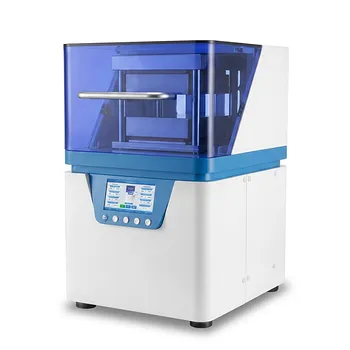
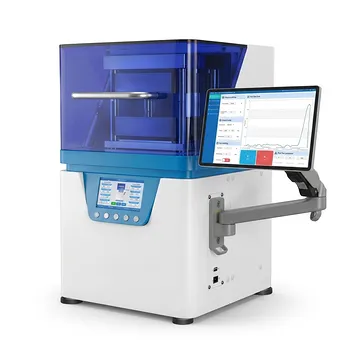
Hydraulic presses act as the foundational manufacturing tool for creating high-performance materials like super alloys, ceramics, and composites. They function by applying immense, controlled pressure to manufacture critical components—such as turbine blades, engine parts, and medical implants—where structural integrity and reliability are paramount.
The core value of the hydraulic press in advanced manufacturing is not just force, but precision under pressure. By coupling high-tonnage output with exact control, these machines ensure that advanced materials achieve the consistent density and geometric accuracy required for aerospace, automotive, and medical safety standards.
Enabling High-Performance Material Synthesis
Processing Super Alloys and Composites
Hydraulic presses are the primary mechanism for shaping advanced materials that are difficult to manipulate.
This includes super alloys and composites frequently used in the aerospace and automotive sectors. Because these materials are designed to withstand extreme conditions, they require the immense, uniform force that only a hydraulic system can provide during the forming process.
Densification of Advanced Powders
In the production of experimental solid-state electrolytes and phase-change materials, the press plays a critical role in the upstream process.
By applying precise and uniform pressure, the press densifies raw material powders into compact bodies. This ensures compositional uniformity and reliable electrical performance, which is vital for subsequent steps like thin-film deposition.
Fabrication of Critical Components
Complex Aerospace Geometries
The manufacturing of turbine blades and complex engine parts relies heavily on hydraulic forging and stamping.
These components require intricate shapes that must maintain exceptional strength. Hydraulic presses allow manufacturers to form these complex geometries without compromising the internal structure of the material.
Medical and Biocompatible Implants
In the medical field, reliability is a matter of patient safety.
Hydraulic presses are used to manufacture implants and other medical devices where precision is crucial. The ability to control the forming process ensures that these components meet strict regulatory standards for geometry and durability.
The Role of Temperature and Control
Altering Bonding States via Heated Pressing
Advanced manufacturing often requires more than just pressure; it requires thermal control.
Heated laboratory presses allow for "warm-pressing" techniques, such as those used to develop new buffer materials like bentonite. By applying heat simultaneously with pressure, researchers can alter the bonding state between particles, creating blocks with specific thermal conductivity or shear strength.
Precision Force to Minimize Damage
Unlike crude crushing machinery, advanced hydraulic presses offer adjustable pressure settings.
This allows researchers and manufacturers to apply the exact force needed for delicate operations. This precision minimizes sample damage during laboratory testing or the assembly of sensitive components.
Understanding the Operating Trade-offs
Specificity of Equipment
Not all hydraulic presses are interchangeable; a press designed for heavy industrial forging lacks the nuance required for laboratory sample preparation.
Using a machine with insufficient control features for advanced materials can lead to sample destruction or inconsistent density. You must ensure the press capability matches the material fragility.
Balancing Force and Complexity
While hydraulic presses are generally durable and cost-effective, adding advanced features like heating elements and automated pressure control increases maintenance complexity.
Operators must balance the need for high-end features against the simplicity of maintenance. High-precision presses require rigorous calibration to maintain the geometric accuracy essential for advanced components.
Making the Right Choice for Your Goal
When selecting a hydraulic press for advanced manufacturing, focus on the specific material properties you are trying to isolate.
- If your primary focus is R&D and Material Science: Prioritize a heated laboratory press with adjustable pressure settings to control particle bonding and densification in powders.
- If your primary focus is Aerospace or Automotive Production: Prioritize a high-tonnage industrial press capable of forging super alloys and stamping complex geometries like turbine blades.
- If your primary focus is Component Assembly: Prioritize a precision press designed for joining and crimping to ensure exact fittings without damaging the parts.
Ultimately, the correct hydraulic press transforms raw potential into reliable performance by enforcing structure at the molecular level.
Summary Table:
| Application Category | Key Materials & Components | Primary Function of Press |
|---|---|---|
| Aerospace & Auto | Super alloys, turbine blades, engine parts | Forging complex geometries and ensuring structural integrity |
| Medical Tech | Biocompatible implants, medical devices | High-precision forming for safety and regulatory standards |
| Battery Research | Solid-state electrolytes, phase-change materials | Densification of raw powders for uniform electrical performance |
| Material Science | Bentonite, buffer materials, composites | Heated pressing to alter bonding states and thermal conductivity |
Elevate Your Manufacturing Precision with KINTEK
At KINTEK, we understand that advanced material synthesis requires more than just raw force—it requires exact control. Whether you are conducting cutting-edge battery research or fabricating high-performance aerospace components, our comprehensive laboratory pressing solutions are engineered to meet your rigorous standards.
Our value to you:
- Versatile Solutions: Choose from manual, automatic, and heated models tailored for R&D.
- Advanced Capabilities: Specialized multifunctional and glovebox-compatible presses for sensitive materials.
- Industrial Strength: High-performance cold and warm isostatic presses for superior material density.
Transform your raw materials into reliable, high-performance components today. Contact our experts to find your ideal press solution.
Related Products
- Automatic Hydraulic Hot Press with Large Plate and Precision Temperature Control for Advanced Material Sample Preparation and Industrial Research
- Automatic Hydraulic Heat Press Machine with Multi Stage Programmable Control and Integrated Water Cooling Plate Size 180x180mm
- Automatic High Temperature Heated Hydraulic Press Machine with Heated Plates for Lab
- Automatic Heated Hydraulic Lab Press with Programmable Touch Screen Controls and Precision Temperature Regulation
- Manual Heated Hydraulic Lab Press with Integrated Hot Plates Hydraulic Press Machine
People Also Ask
- What are the specific features and applications of hydraulic hot press machines? Precision Solutions for Modern Labs
- How does an automatic hydraulic press operate? Achieve Precision and Consistency in Lab Pelleting
- What are the advantages and common applications of an automatic hydraulic press? Elevate Your Lab's Precision
- What is the technical significance of setting a precise dwell time? Achieve Peak Material Density and Stability
- When is an automatic hydraulic press more suitable than a manual press? Scale Your Lab with Precision & Speed