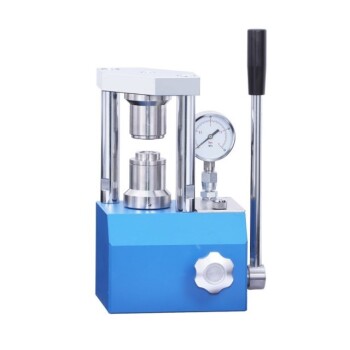
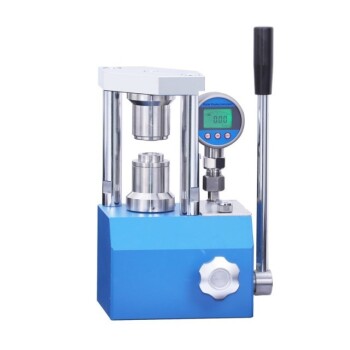
Precision assembly is the invisible foundation of reproducible battery data. A high-precision lab press or battery crimper ensures the reliability of long-term cycle life tests by applying uniform, constant pressure to create a hermetic seal and maintain intimate physical contact between the electrode, separator, and electrolyte. By stabilizing the cell's internal environment, this equipment eliminates mechanical variables—such as contact resistance fluctuations or electrolyte leakage—that would otherwise compromise data integrity over extended testing periods.
Core Takeaway To accurately verify the performance of high-entropy materials over 10,000+ cycles, the cell assembly must be as robust as the chemistry itself. A high-precision crimper isolates the electrochemical behavior of the material by removing assembly defects, ensuring that failure is dictated by the chemistry, not by a poor seal or inconsistent contact.
The Mechanics of Reliability
Establishing Uniform Sealing Pressure
The primary function of a high-precision crimper is to apply specific, uniform pressure during the closing of coin cells (such as the CR2032 format).
Unlike manual tools that introduce human variability, a high-precision machine ensures the sealing force is constant across every sample. This uniformity is required to crimp the cell casing without deforming the internal components or warping the gasket.
Minimizing Contact Resistance
For NASICON-based systems, which often involve solid or semi-solid interfaces, electrical connectivity is driven by physical pressure.
The crimper forces the cathode electrode, separator, and electrolyte into tight, intimate contact. This physical proximity is critical for minimizing interfacial impedance and ensuring efficient ion transport throughout the lifespan of the cell.
Preventing Physical Delamination
Over thousands of cycles, electrode materials expand and contract.
A precise initial crimp provides the mechanical confinement necessary to keep the stack compressed. This prevents the layers from delaminating or separating, which would cause a sudden spike in resistance and premature cell failure.
Protecting the Internal Environment
Creating a Hermetic Seal
Long-term testing requires a closed system that remains chemically invariant over months of operation.
High-precision crimpers deform the cell gasket exactly enough to create a hermetic seal. This prevents liquid electrolytes from evaporating (drying out) and stops external moisture or oxygen from infiltrating the cell, both of which are catastrophic to cycle life data.
Stabilizing Electrochemical Performance
Reliability in testing means eliminating noise.
By preventing electrolyte loss and blocking contaminants, the equipment ensures the internal electrochemical environment remains stable. This allows researchers to attribute capacity fade or voltage decay strictly to the degradation of the high-entropy cathode material, rather than assembly errors.
The Role in Validating High-Entropy Materials
Enabling Ultra-Long Cycle Testing
High-entropy NASICON materials are designed for extreme durability, often exceeding 10,000 charge-discharge cycles.
To verify this claim, the test vehicle (the coin cell) must physically survive longer than the material inside it. A high-precision crimp ensures the casing integrity holds up for the duration of these multi-month tests.
Reducing Data Scatter
In material science, reproducibility is key to validation.
Using high-precision equipment reduces the standard deviation between coin cells in the same batch. When the assembly pressure and sealing quality are identical across all samples, outliers are minimized, and the resulting trend lines accurately reflect the material's true potential.
Understanding the Trade-offs
The Risk of Over-Compression
While pressure is vital, "more" is not always "better."
Excessive crimping pressure can crush the porous structure of the separator or fracture brittle ceramic (NASICON) components. This mechanical damage can lead to internal short circuits before testing even begins.
The Limits of Coin Cell Geometry
Even with a perfect crimp, coin cells have limitations compared to pouch or cylindrical cells.
They utilize a spring component to maintain internal pressure, which may relax over very long durations. Researchers must acknowledge that while a high-precision crimper optimizes the coin cell format, the format itself introduces physical constraints for commercial-scale simulation.
Ensuring Validity for Your Research
To ensure your long-term cycling data is publication-ready, select your assembly parameters based on your specific testing goals.
- If your primary focus is material validation: Prioritize repeatability by using automated crimpers to ensure every cell in your test batch has identical internal contact resistance.
- If your primary focus is electrolyte stability: Ensure your crimping pressure is calibrated to form a perfect hermetic seal to prevent "dry-out" from masking the true electrochemical window of the electrolyte.
Ultimately, the precision of your assembly equipment sets the ceiling for the accuracy of your long-term data.
Summary Table:
| Key Benefit | Impact on Battery Reliability | Why it Matters for High-Entropy Materials |
|---|---|---|
| Uniform Sealing | Eliminates human variability & casing deformation | Ensures consistent results across 10,000+ cycles |
| Interfacial Contact | Minimizes internal contact resistance | Facilitates efficient ion transport in solid-state systems |
| Hermetic Seal | Prevents electrolyte evaporation & contamination | Isolates chemistry behavior from environmental noise |
| Mechanical Confinement | Prevents electrode delamination during cycling | Maintains cell integrity during material expansion/contraction |
Elevate Your Battery Research with KINTEK Precision
Maximize the integrity of your long-term cycle data with KINTEK’s industry-leading laboratory pressing solutions. Whether you are developing high-entropy NASICON materials or next-generation solid-state batteries, our comprehensive range of manual, automatic, heated, and glovebox-compatible presses—along with advanced isostatic options—ensures your assembly is as robust as your chemistry.
Don't let assembly variables compromise your results. Contact our specialists today to find the perfect crimping or pressing solution tailored to your research goals.
References
- Wei Zhang, Ivan P. Parkin. Configurational entropy-tailored NASICON cathode redox chemistry for capacity-dense and ultralong cyclability. DOI: 10.1039/d5ee00877h
This article is also based on technical information from Kintek Solution Knowledge Base .
Related Products
- Lab Button Battery Tablet Press Sealing Mold
- Button Battery Sealing Press Machine for Lab
- Manual Button Battery Sealing Machine for Battery Sealing
- Button Battery Sealing Machine for Button Batteries
- Laboratory Hydraulic Press Lab Pellet Press Button Battery Press
People Also Ask
- How does a sealed battery mold facilitate the assembly and testing of asymmetric supercapacitors using VO2?
- Why use standardized CR2032 components & high-precision presses? Ensure reliability in lithium metal battery research.
- Why is a laboratory battery sealing press essential for desolvation energy testing? Ensure Reliable Kinetic Data
- What is the function of specialized battery molds and sealing consumables? Optimize Your In-situ XRD Testing Today
- What role does a laboratory sealing press play in thermal analysis of solid dispersion films? Ensure Data Integrity