
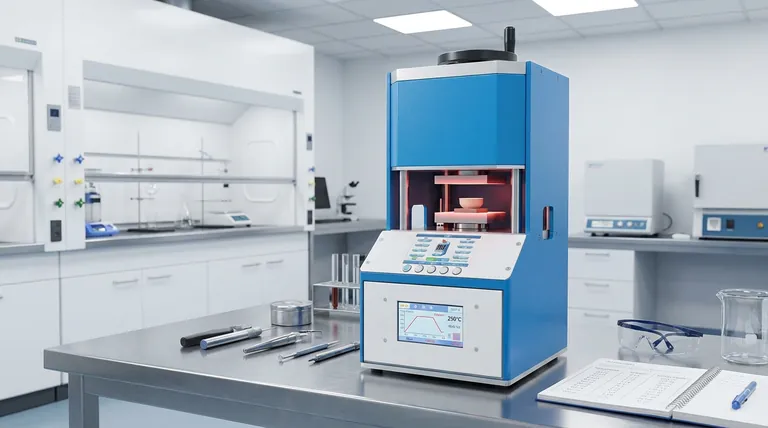
At the core of modern laboratory presses, temperature control has evolved from simple heating to a highly sophisticated system. Advanced presses feature programmable digital controllers, often with dual heating elements and thermometers built directly into the platens, capable of reaching temperatures up to 250°C. These systems are further enhanced with integrated digital timers and audible alarms to ensure precise process management from start to finish.
The crucial shift in advanced laboratory presses is from merely applying heat to precisely managing a thermal profile. Modern features like programmable controllers and dual-zone heating are not luxuries; they are fundamental tools for ensuring the accuracy, repeatability, and integrity of your experimental results.
The Anatomy of Advanced Temperature Control
To understand the value of these systems, it's essential to break down their core components. Each feature addresses a specific challenge in achieving reliable and consistent sample processing.
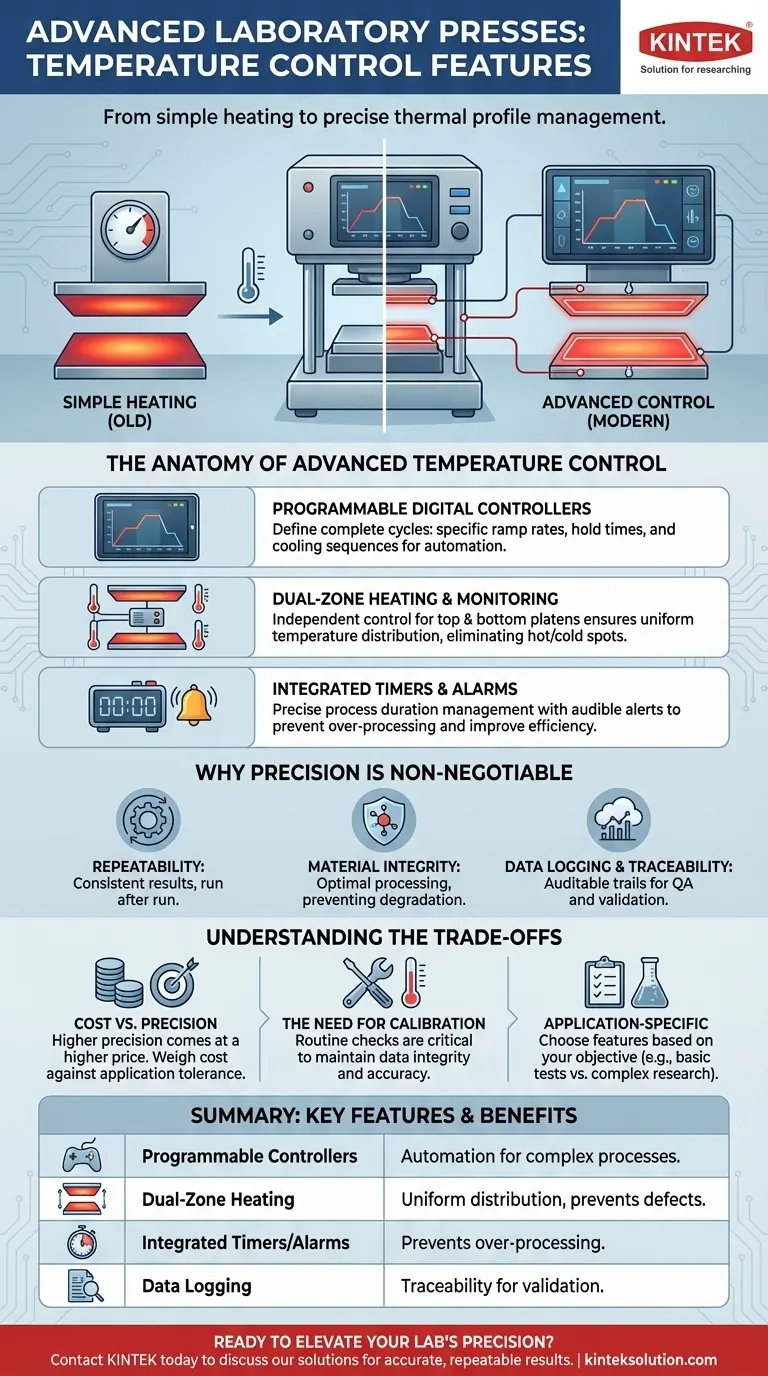
Programmable Digital Controllers
The brain of the system is the programmable digital controller. Unlike a simple thermostat that maintains a single setpoint, a programmable controller allows you to define a complete thermal cycle.
This includes setting specific temperature ramp rates (how fast to heat up), hold times (how long to maintain a temperature), and even controlled cooling sequences. This level of automation is critical for complex material processing.
Dual-Zone Heating and Monitoring
Many advanced presses incorporate dual heaters and thermometers, with one set for each platen (top and bottom). This design is crucial for ensuring uniform temperature distribution across the entire surface of your sample.
Without it, you risk creating hot or cold spots, leading to inconsistent material properties and unreliable data. Dual-zone control actively corrects for any temperature deviations between the platens.
Integrated Timers and Alarms
A digital timer works in concert with the temperature controller. Once the target temperature is reached, the timer begins its countdown, ensuring the sample is processed for the exact intended duration.
When the timer completes, an audible alarm notifies the operator. This simple feature prevents accidental over-processing and frees up the technician to perform other tasks, improving lab efficiency and process consistency.
Why Precision Temperature Control is Non-Negotiable
These features are not merely for convenience. They directly impact the quality and validity of your work by providing control over critical process variables.
Ensuring Process Repeatability
The foundation of sound scientific and quality control work is repeatability. Programmable controllers ensure that every sample is subjected to the exact same thermal profile, run after run. This eliminates temperature fluctuation as a variable in your experiment or production process.
Guaranteeing Material Integrity
Many materials, especially polymers, composites, and biological samples, are highly sensitive to temperature. Too much heat can cause degradation, while too little can result in incomplete curing or melting. Precise control ensures you are always working within the material's optimal processing window.
Enabling Data Logging and Traceability
Modern digital controllers often feature outputs that allow for data logging. This enables you to record the entire temperature profile for each run, providing an auditable trail for quality assurance, research publications, and process validation.
Understanding the Trade-offs
While advanced features offer significant benefits, it's important to approach them with a clear understanding of their implications.
Cost vs. Required Precision
More sophisticated control systems come at a higher price. A press with basic analog or non-programmable digital controls is less expensive but offers limited precision and no repeatability guarantees. You must weigh the cost against your application's tolerance for thermal variability.
The Need for Calibration
High-precision instruments require routine calibration to remain accurate. You must implement a schedule to verify that the temperature displayed on the controller matches the actual temperature of the platens. This is a critical but often overlooked aspect of maintaining data integrity.
Application-Specific Requirements
Not every task requires multi-zone, programmable heating. For simple, non-sensitive compression tasks, a basic temperature controller may suffice. Over-specifying a press leads to unnecessary complexity and cost.
Making the Right Choice for Your Application
Selecting the appropriate level of temperature control depends entirely on your primary objective.
- If your primary focus is basic material compaction or simple tests: A press with a single-setpoint digital controller provides adequate heat for non-sensitive applications.
- If your primary focus is high-precision polymer research or composite curing: You require programmable controls for ramp/hold cycles, dual-zone heating for uniformity, and data logging for traceability.
- If your primary focus is standardized quality control: Repeatability is paramount, making programmable controllers with integrated timers and alarms essential for process consistency.
Choosing the right temperature control features gives you direct command over a critical variable, transforming your press from a simple tool into a precision instrument.
Summary Table:
| Feature | Description | Key Benefit |
|---|---|---|
| Programmable Digital Controllers | Allows setting of thermal cycles with ramp rates, hold times, and cooling sequences. | Enables automation and repeatability for complex processes. |
| Dual-Zone Heating and Monitoring | Uses separate heaters and thermometers for top and bottom platens. | Ensures uniform temperature distribution and prevents hot/cold spots. |
| Integrated Timers and Alarms | Digital timer starts at target temperature with audible completion alerts. | Prevents over-processing and improves lab efficiency. |
| Data Logging Capabilities | Records temperature profiles for each run via controller outputs. | Provides traceability for quality assurance and research validation. |
Ready to elevate your lab's precision? KINTEK specializes in advanced lab press machines, including automatic lab presses, isostatic presses, and heated lab presses, designed to deliver superior temperature control for accurate, repeatable results in material testing and research. Contact us today to discuss how our solutions can meet your specific laboratory needs and boost your efficiency!
Visual Guide
Related Products
- Automatic High Temperature Heated Hydraulic Press Machine with Heated Plates for Lab
- Automatic Heated Hydraulic Press Machine with Hot Plates for Laboratory
- 24T 30T 60T Heated Hydraulic Lab Press Machine with Hot Plates for Laboratory
- Automatic Heated Hydraulic Press Machine with Heated Plates for Laboratory
- Manual Heated Hydraulic Lab Press with Integrated Hot Plates Hydraulic Press Machine
People Also Ask
- Function of a Laboratory Hydraulic Press with Heated Platens in SSE? Enhance Battery Density & Conductivity
- What are the requirements for electrode pressing with high-viscosity ionic liquids like EMIM TFSI? Optimize Performance
- How does a laboratory heated hydraulic press facilitate PBN sample prep for WAXS? Achieve Precise X-Ray Scattering
- What are the industrial applications of heated hydraulic presses? Master Heat & Force for Precision Manufacturing
- Why is a laboratory hydraulic press with heating plates required for PLA/TEC films? Achieve Precise Sample Integrity



















