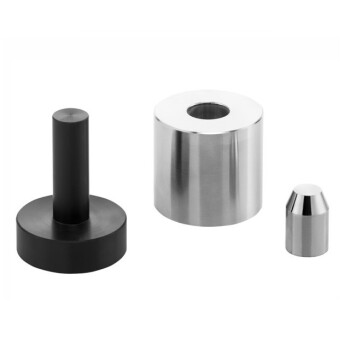
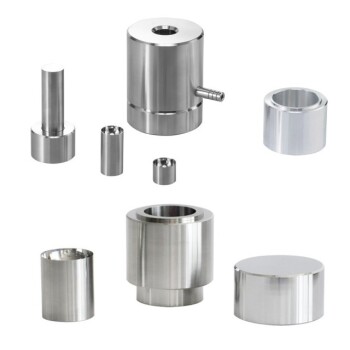
High-hardness precision dies are strictly required to withstand the immense force of a hydraulic press without deforming. If the die yields even slightly under pressure, it cannot achieve the perfect replication of microscopic chiral geometric features necessary for sub-unit-cell resolution.
Core Insight: In chiral photonics, physical geometry dictates quantum-like behavior. Because chiral polarization is hypersensitive to structural dimensions, the fabrication process must be mechanically rigid to ensure the experimental sample aligns perfectly with theoretical models.
The Mechanics of Precision Fabrication
Resisting Deformation Under Pressure
A hydraulic press applies significant force to mold materials. Standard dies often suffer from microscopic compression or warping under this load.
High-hardness dies possess the mechanical strength to maintain their exact shape, ensuring that the force is directed entirely into molding the sample rather than distorting the tool.
Replicating Microscopic Features
The goal is to create features with sub-unit-cell resolution. These are intricate, microscopic structures that define the material's properties.
Only a die that remains absolutely rigid can stamp these fine details with the fidelity required for experimental use.
Connecting Structure to Physics
The Sensitivity of Chiral Polarization
Chiral polarization is not merely a material property; it is a geometric one.
The primary reference notes that this polarization is highly sensitive to structural dimensions. Even a deviation of a few microns in the sample's geometry can alter its polarization characteristics, rendering the experiment invalid.
Controlling Wave Function Imbalance
The physical structure of the sample determines the behavior of waves moving through it. Specifically, the structure dictates the spatial imbalance of wave functions on sublattices.
To observe the correct wave physics, the physical "sublattices" (the repeating patterns in the crystal) must be fabricated without error. High-hardness dies ensure this spatial distribution is preserved from the design phase to the final product.
The Risk of Low-Hardness Tooling
The Divergence from Theory
The primary pitfall in this process is a mismatch between the theoretical model and the physical reality.
If the die deforms, the resulting sample will not accurately represent the chiral charge distribution predicted by theory. This makes it impossible to verify complex phenomena, such as the chiral Zak phase, because the physical artifact no longer reflects the math it was meant to test.
Making the Right Choice for Your Goal
To ensure your fabrication process yields usable scientific data, consider the following:
- If your primary focus is Structural Integrity: Prioritize die hardness to prevent deformation and ensure the perfect replication of microscopic features.
- If your primary focus is Theoretical Verification: Prioritize geometric precision to ensure the sample accurately reflects the spatial imbalance of wave functions required to measure the chiral Zak phase.
Success in this field depends on the ability to translate exact theoretical dimensions into a rigid physical reality.
Summary Table:
| Requirement | Benefit for Chiral Photonics | Impact of Failure |
|---|---|---|
| High Hardness | Prevents microscopic deformation under high pressure | Distorted structural dimensions & invalid data |
| Precision Geometry | Ensures perfect replication of sub-unit-cell features | Mismatch between theoretical models and physical samples |
| Rigid Tooling | Maintains exact spatial imbalance of wave functions | Loss of chiral polarization sensitivity and Zak phase |
| Force Resistance | Directs full hydraulic pressure into material molding | Microscopic warping of the sample's repeating patterns |
Elevate Your Materials Research with KINTEK Precision Solutions
To achieve sub-unit-cell resolution in chiral photonics and battery research, your equipment must deliver absolute mechanical rigidity. KINTEK specializes in comprehensive laboratory pressing solutions, offering manual, automatic, heated, multifunctional, and glovebox-compatible models, alongside high-performance cold and warm isostatic presses.
Whether you are verifying the chiral Zak phase or developing next-generation energy storage, our high-hardness precision dies and hydraulic systems ensure your physical samples align perfectly with your theoretical models.
Ready to eliminate structural divergence in your experiments?
Contact KINTEK Today to Consult with Our Specialists
References
- Marcelo Guzmán, David Carpentier. Geometry and topology tango in ordered and amorphous chiral matter. DOI: 10.21468/scipostphys.12.1.038
This article is also based on technical information from Kintek Solution Knowledge Base .
Related Products
- Lab Button Battery Tablet Press Sealing Mold
- Lab Ball Press Mold
- Lab Infrared Press Mold for No Demolding
- Lab Heat Press Special Mold
- XRF KBR Steel Ring Lab Powder Pellet Pressing Mold for FTIR
People Also Ask
- How does a sealed battery mold facilitate the assembly and testing of asymmetric supercapacitors using VO2?
- Why use standardized CR2032 components & high-precision presses? Ensure reliability in lithium metal battery research.
- Why is a laboratory battery sealing press essential for desolvation energy testing? Ensure Reliable Kinetic Data
- What is the function of specialized battery molds and sealing consumables? Optimize Your In-situ XRD Testing Today
- What role does a laboratory sealing press play in thermal analysis of solid dispersion films? Ensure Data Integrity