
Titanium rods serve as the critical interface between the mechanical force required for assembly and the delicate electrochemistry of the cell. They are explicitly selected for their dual ability to transmit immense pressure while resisting chemical corrosion, particularly when in contact with highly reactive sulfide-based solid electrolytes.
The Core Reality In all-solid-state batteries (ASSBs), you are trying to force rigid solids to behave like a cohesive unit. Titanium is the industry standard because it provides the necessary mechanical hardness to lower interfacial resistance without triggering the chemical side reactions that plague softer or more reactive metals.
The Chemical Imperative: Why Material Stability Matters
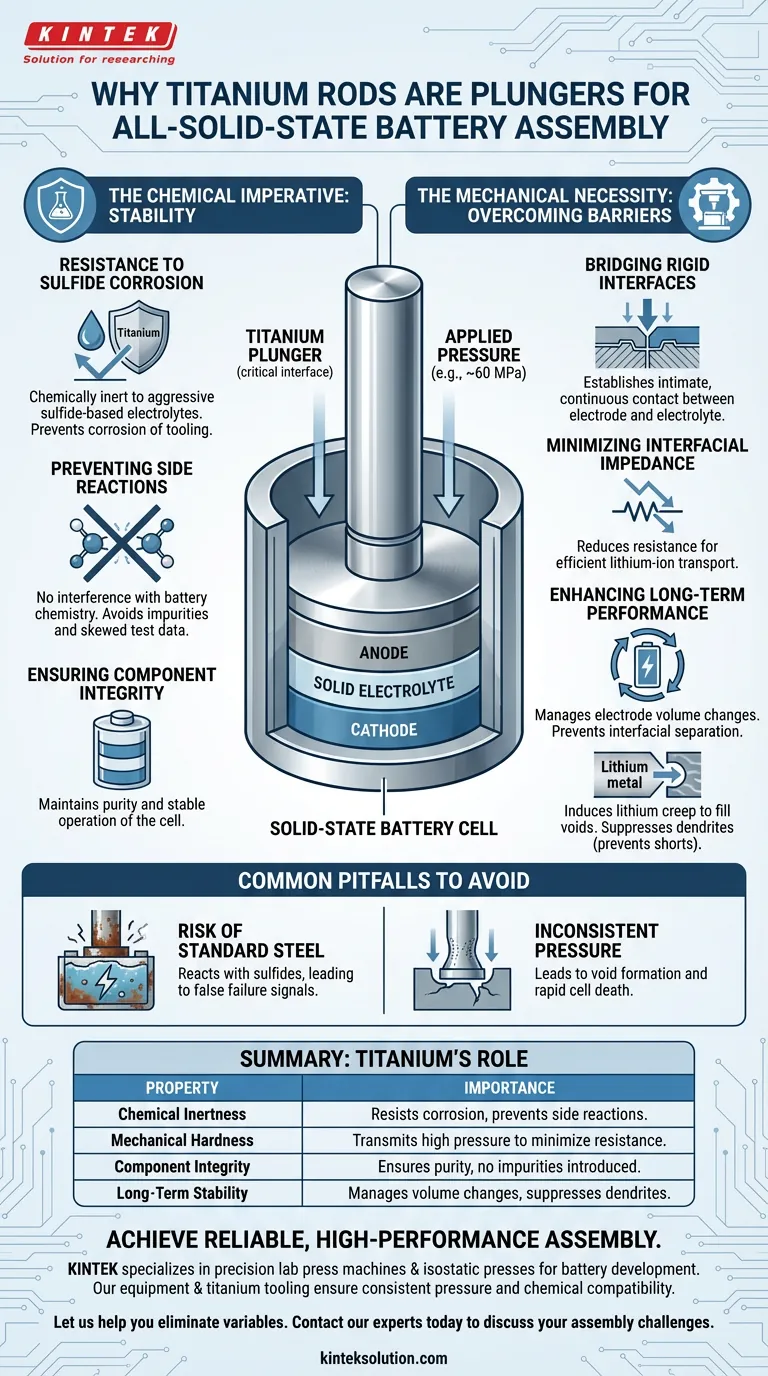
Resistance to Sulfide Corrosion
Many high-performance solid-state batteries utilize sulfide-based solid electrolytes. These electrolytes are chemically aggressive and can corrode standard tooling materials.
Preventing Side Reactions
Under the high-pressure conditions required for assembly, chemical reactivity is accelerated. Titanium is chemically inert in this environment, ensuring it does not engage in side reactions that would degrade the battery components or skew test data.
Ensuring Component Integrity
Using a reactive plunger would introduce impurities into the cell stack. Titanium ensures the integrity and stable operation of the battery remains uncompromised during both the compaction process and subsequent testing.
The Mechanical Necessity: Overcoming the Solid-Solid Barrier
Bridging Rigid Interfaces
Unlike liquid electrolytes, solid electrolytes do not flow into pores or wet surfaces naturally. The internal interfaces are rigid and prone to gaps.
The Role of Initial Pressure
A laboratory press uses the titanium rod to apply precise initial pressure (often around 60 MPa). This force is mandatory to establish intimate, continuous physical contact between the electrode particles and the electrolyte.
Minimizing Interfacial Impedance
Without this extreme compression, the resistance at the material boundaries remains too high. The titanium plunger allows for the stable application of force needed to minimize interfacial impedance, a prerequisite for efficient lithium-ion transport.
Enhancing Long-Term Performance
Managing Volume Changes
During cycling, electrodes expand and contract. Constant external pressure, applied via the titanium apparatus, prevents interfacial separation caused by these volume changes.
Inducing Lithium Creep
Appropriate pressure can induce "creep" (deformation) in lithium metal anodes. This helps the lithium actively fill interfacial voids, ensuring uniform current distribution and preventing hot spots.
Suppressing Dendrites
In anode-free configurations, the pressure transmitted by the rod keeps the lithium layer flush against the electrolyte. This mechanical suppression is key to stopping lithium dendrite penetration, which is a primary cause of short circuits.
Common Pitfalls to Avoid
The Risk of Standard Steel
A common mistake in early-stage research is substituting titanium with standard stainless steel plungers. While mechanically strong, steel often reacts with sulfide electrolytes, leading to false failure signals attributed to the battery chemistry rather than the tooling.
Inconsistent Pressure Application
The hardness of the plunger material is irrelevant if the pressure is not maintained. Using a material that deforms under load—or failing to maintain pressure during testing—leads to void formation and rapid cell death, regardless of the chemical stability.
Making the Right Choice for Your Goal
To ensure reliable data and high-performance assembly, align your tooling choices with your specific objectives:
- If your primary focus is chemical compatibility: Prioritize titanium plungers specifically when working with sulfide-based or halide-based electrolytes to eliminate side reactions.
- If your primary focus is cycle life: Ensure your assembly setup allows for continuous pressure maintenance during testing to accommodate electrode breathing and suppress dendrites.
Success in solid-state battery assembly relies on treating mechanical pressure as a fundamental electrochemical parameter.
Summary Table:
| Property | Importance for ASSB Assembly |
|---|---|
| Chemical Inertness | Resists corrosion from aggressive sulfide-based electrolytes, preventing side reactions. |
| Mechanical Hardness | Transmits high pressure (e.g., 60 MPa) to minimize interfacial resistance without deforming. |
| Component Integrity | Ensures no impurities are introduced, maintaining the purity of the cell stack. |
| Long-Term Stability | Helps manage electrode volume changes and suppresses lithium dendrite growth during cycling. |
Achieve reliable, high-performance assembly for your all-solid-state battery research.
KINTEK specializes in precision lab press machines, including automatic lab presses and isostatic presses, designed to meet the exacting demands of laboratory battery development. Our equipment, when paired with the correct tooling like titanium plungers, ensures the consistent pressure application and chemical compatibility critical for your success.
Let us help you eliminate tooling-related variables and focus on your battery chemistry. Contact our experts today to discuss your specific assembly challenges and how our solutions can enhance your research outcomes.
Visual Guide
Related Products
- Lab Cylindrical Press Mold for Laboratory Use
- XRF KBR Steel Ring Lab Powder Pellet Pressing Mold for FTIR
- Lab Double Plate Heating Mold for Laboratory Use
- Lab XRF Boric Acid Powder Pellet Pressing Mold for Laboratory Use
- Square Lab Press Mold for Laboratory Use
People Also Ask
- What is the purpose of incorporating cartridge heaters into a lab press mold for MLCC block compression? Optimize Results
- Why is precise cooling management of the lab press mold necessary? Protect Core Integrity in Thermoforming
- What is the function of a pressing tool in thermoplastic panels? Master Precision Shaping & Fusion Bonding
- Why is a high-performance laboratory molding press critical for in-situ electrolyte formation? Unlock Battery Success
- How does the geometry of laboratory molds influence mycelium-based composites? Optimize Density and Strength



















