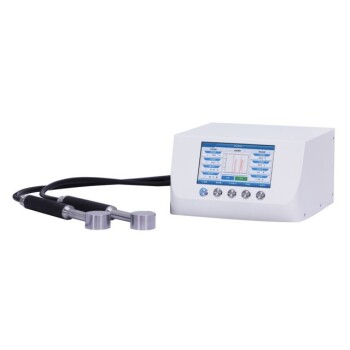
Precise control of laboratory heating and stirring is mandatory because the kinetic conditions created by these devices directly dictate the reaction equilibrium of the precipitation process. By maintaining a specific temperature and a stable stirring speed, you ensure that oxalic acid binds completely with iron impurities to form precipitates that are easily separated from the solution.
Core Takeaway Achieving an iron removal rate exceeding 97% is impossible without strict regulation of kinetic variables. This precision is the mechanism that transforms raw chemical potential into a purified electrolyte with optimized electrochemical activity.
The Role of Kinetic Conditions
Determining Reaction Equilibrium
In the context of purifying iron-chromium flow battery electrolytes, the purification process is governed by kinetics. The equipment used is not just facilitating a mixture; it is defining the reaction equilibrium.
Ensuring Complete Chemical Binding
For the purification to be effective, oxalic acid must interact thoroughly with impurity iron ions. Without precise control, the binding process may remain incomplete, leaving residual impurities in the solution.
Critical Process Variables
Thermal Precision
The primary reference highlights a reaction temperature of 25 degrees Celsius as a standard for this process. Deviating from the target temperature can shift the equilibrium, potentially reducing the efficiency of the iron removal.
Stability in Agitation
Stirring speeds must remain stable throughout the process. This consistency is required to create easily separable precipitates, ensuring that the solid impurities can be mechanically removed from the liquid electrolyte without redissolving or fragmenting.
Impact on Electrolyte Quality
Maximizing Iron Removal Rates
When heating and stirring are synchronized and controlled, the process achieves an iron removal rate of over 97 percent. This high benchmark is the direct result of optimizing the kinetic environment.
Optimizing Electrochemical Activity
The ultimate goal of this purification is not just cleanliness, but function. By removing the vast majority of iron impurities, the electrochemical activity of the electrolyte is significantly enhanced, leading to better battery performance.
Understanding the Risks of Imprecision
Incomplete Precipitation
If the kinetic conditions fluctuate, the oxalic acid may fail to bind fully with the iron. This leads to a lower removal rate and a final product that still contains detrimental levels of impurities.
Difficulty in Separation
Inconsistent stirring or temperature can lead to the formation of precipitates that are difficult to isolate. If the precipitates cannot be easily separated, the purification step fails regardless of the chemical reaction's success.
Optimizing Your Purification Strategy
To ensure high-performance iron-chromium flow batteries, you must prioritize equipment capability alongside chemical formulation.
- If your primary focus is Maximum Purity: Prioritize thermal regulation systems that can hold the reaction strictly at 25 degrees Celsius to push iron removal rates above 97%.
- If your primary focus is Process Efficiency: Focus on stirrers with high torque and speed stability to ensure the formation of precipitates that are large enough for rapid, easy separation.
True electrolyte optimization is achieved when mechanical precision aligns perfectly with chemical necessity.
Summary Table:
| Parameter | Requirement | Impact on Electrolyte Quality |
|---|---|---|
| Temperature | Fixed at 25°C | Ensures reaction equilibrium and max iron binding |
| Stirring Speed | Stable/Constant | Creates large, easily separable precipitates |
| Iron Removal Rate | > 97% | Maximizes electrochemical activity and battery life |
| Kinetic Control | High Precision | Prevents incomplete precipitation and impurity residue |
Elevate Your Battery Research with KINTEK Precision
To achieve superior iron removal and optimize electrochemical activity, your laboratory needs equipment that masters kinetic variables. KINTEK specializes in comprehensive laboratory solutions designed for rigorous research environments. Whether you require manual, automatic, heated, or glovebox-compatible models, our technology ensures the stability needed for critical processes like oxalic acid precipitation.
Our value to you:
- Precision Thermal Control: Maintain the strict 25°C environment required for 97%+ iron removal.
- Stable Agitation: Advanced stirring systems to ensure easy precipitate separation.
- Versatile Solutions: From specialized laboratory presses to isostatic solutions for battery material synthesis.
Don't let fluctuating conditions compromise your electrolyte purity. Contact KINTEK today to find the perfect pressing and stirring solution for your lab!
References
- Minghao Huang. Application and Future Development of Iron-chromium Flow Batteries. DOI: 10.54254/2755-2721/2025.19567
This article is also based on technical information from Kintek Solution Knowledge Base .
Related Products
- Cylindrical Lab Electric Heating Press Mold for Laboratory Use
- Automatic Heated Hydraulic Press Machine with Hot Plates for Laboratory
- Automatic Heated Hydraulic Press Machine with Heated Plates for Laboratory
- Automatic High Temperature Heated Hydraulic Press Machine with Heated Plates for Lab
- 24T 30T 60T Heated Hydraulic Lab Press Machine with Hot Plates for Laboratory
People Also Ask
- How does a laboratory electric heated press ensure sample quality? Optimize SiR-EPDM vulcanization and molding.
- What role does a laboratory electric heated press play in polymer composite fabrication? Key for Standardized Specimens
- What role does a laboratory electric heating press play in NBR molding? Master Vulcanization & Material Density
- Why is a laboratory electric heating press required for PP/EPDM molding? Achieve Superior Specimen Integrity
- What is the purpose of incorporating cartridge heaters into a lab press mold for MLCC block compression? Optimize Results