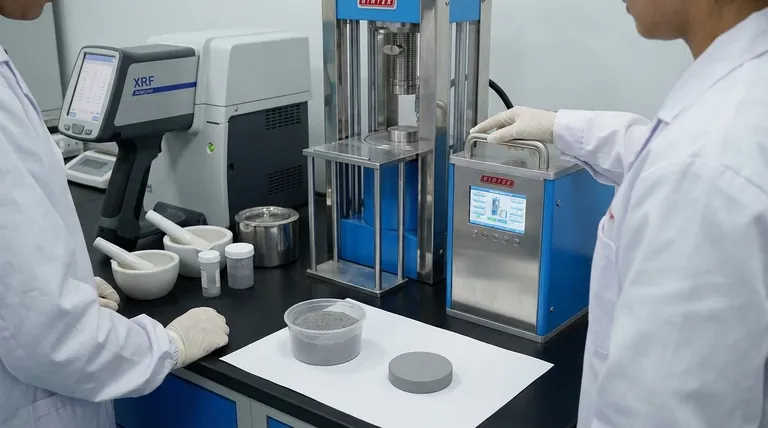
Pressed pellets provide superior XRF data because they fundamentally alter the physical state of the sample to ensure uniformity. By compressing loose powder under significant load (typically 10 to 40 tonnes), you eliminate the variable void spaces between particles. This creates a sample with consistent density and a perfectly flat surface, which allows for higher signal intensities and minimizes the scattering effects that degrade accuracy in loose powder analysis.
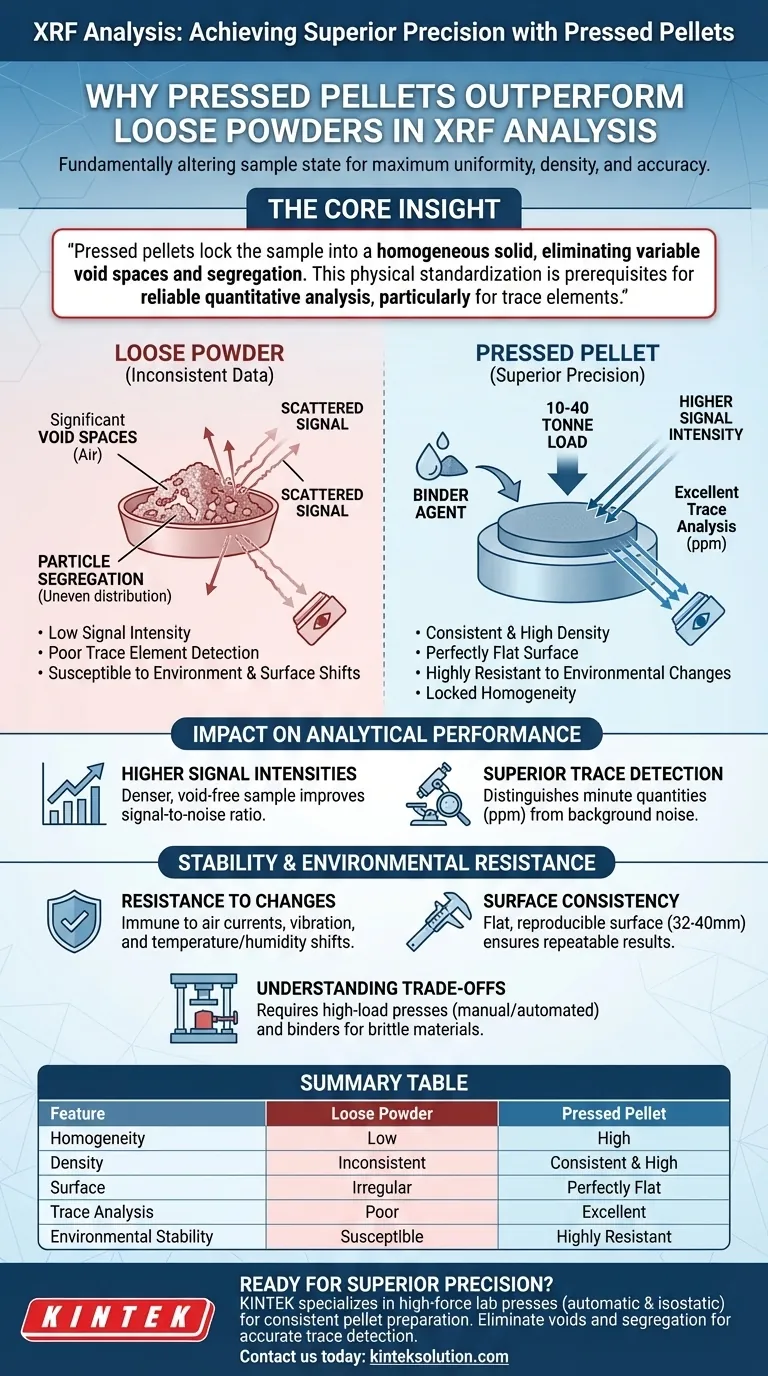
The Core Insight While loose powders are susceptible to segregation, environmental shifts, and irregular density, pressed pellets lock the sample into a homogeneous solid. This physical standardization is the prerequisite for reliable quantitative analysis, particularly when measuring elements in the trace (ppm) range.
The Physics of Homogeneity
To understand why pellets outperform powder, you must look at how X-rays interact with the sample's physical structure.
Eliminating Void Spaces
Loose powders contain significant amounts of air between particles. These void spaces act as contaminants, scattering X-rays and effectively diluting the sample intensity.
Pressing the material compacts particles into a solid form, removing these air gaps. This densification ensures the X-ray beam interacts with more sample material and less empty space.
Preventing Particle Segregation
In a loose powder, particles often separate based on size or density—a phenomenon known as segregation. Heavier or smaller particles may settle differently, leading to a non-representative surface measurement.
The pressing process locks particles into a fixed matrix. This guarantees that the analyzed surface remains chemically and physically homogeneous, minimizing the risk of uneven element distribution.
Impact on Analytical Performance
The physical improvements of a pressed pellet translate directly into measurable analytical gains.
Higher Signal Intensities
Because the sample is denser and void-free, the XRF instrument detects higher intensities for most elements.
Stronger signals improve the signal-to-noise ratio. This is the primary driver behind the improved sensitivity pellets offer over loose powders.
Superior Trace Element Detection
Precision is most critical when analyzing elements present in minute quantities. Pressed pellets are particularly excellent for the analysis of elements in the ppm (parts per million) range.
The stability and density of the pellet allow the instrument to distinguish trace peaks that would otherwise be lost in the background noise of a loose powder spectrum.
Stability and Environmental Resistance
Accuracy is not just about the measurement moment; it is about the sample's durability over time.
Resistance to Environmental Changes
Loose powders are physically unstable. They are susceptible to disturbances from air currents, vibrations, and fluctuations in temperature or humidity.
A pressed pellet creates a durable, solid form. It is immune to these minor environmental shifts, ensuring that the sample condition remains constant throughout the analysis cycle.
Surface Consistency
For XRF, the distance between the sample surface and the detector is critical. Loose powders can have irregular surfaces.
Pressed pellets provide a perfectly flat, reproducible surface area (typically 32 mm or 40 mm). This geometric consistency is vital for maintaining reproducible results across repeated measurements.
Understanding the Trade-offs
While pressed pellets offer superior data, the preparation process introduces variables that must be managed to avoid errors.
Necessity of Binders
Hard or brittle materials (such as geological samples) often struggle to bind together under pressure. They usually require a binding agent, such as cellulose wax or boric acid, to prevent the pellet from crumbling.
While binders improve physical integrity, they must be mixed thoroughly to avoid re-introducing inhomogeneity.
Equipment and Throughput Requirements
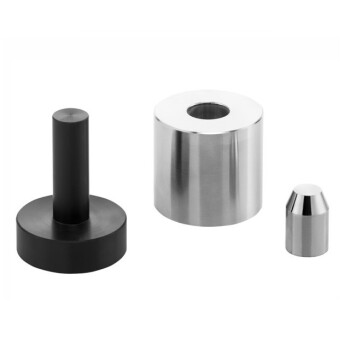
Creating pellets requires specialized equipment, including hydraulic presses and dies capable of withstanding high loads.
For laboratories managing high volumes, this necessitates high-throughput automated presses. These systems can be costly but are essential for rapid cycles and ensuring every pellet meets the same stringent density criteria.
Making the Right Choice for Your Goal
The decision to use pressed pellets should be driven by your specific analytical requirements.
- If your primary focus is Quantitative Accuracy: You must use pressed pellets to eliminate particle size effects and ensuring reproducible density, especially for trace elements.
- If your primary focus is Hard/Brittle Materials: You must introduce a binding agent and use higher loads (up to 40 tonnes) to ensure the pellet does not disintegrate during handling.
- If your primary focus is High Throughput: You should invest in automated hydraulic presses to maintain consistent sample preparation speeds without sacrificing pellet quality.
By standardizing density and eliminating physical variables, pressed pellets transform a raw sample into a reliable analytical standard.
Summary Table:
| Feature | Loose Powder | Pressed Pellet |
|---|---|---|
| Homogeneity | Low (segregation risk) | High (locked matrix) |
| Density | Inconsistent (void spaces) | Consistent and high |
| Surface | Irregular | Perfectly flat |
| Trace Analysis (ppm) | Poor sensitivity | Excellent sensitivity |
| Environmental Stability | Susceptible to shifts | Highly resistant |
Ready to achieve superior precision in your XRF analysis?
The consistent, high-quality results from pressed pellets are dependent on reliable, high-force pressing. KINTEK specializes in lab press machines, including automatic lab presses and isostatic presses, designed to meet the rigorous demands of laboratory sample preparation.
Our equipment ensures your pellets are pressed with the necessary force (10-40 tonnes) and uniformity to eliminate voids and segregation, directly contributing to the accuracy of your trace element detection.
Contact us today to find the perfect press for your laboratory's needs and transform your sample preparation workflow.
Visual Guide
Related Products
- Manual Laboratory Hydraulic Pellet Press Lab Hydraulic Press
- Laboratory Hydraulic Split Electric Lab Pellet Press
- Laboratory Hydraulic Pellet Press for XRF KBR FTIR Lab Press
- Automatic Laboratory Hydraulic Press Lab Pellet Press Machine
- XRF KBR Plastic Ring Lab Powder Pellet Pressing Mold for FTIR
People Also Ask
- What is the primary purpose of a manual lab hydraulic pellet press? Ensure Accurate Sample Prep for XRF and FTIR
- What is the primary purpose of manual lab hydraulic pellet presses? Achieve High-Precision Sample Preparation for Spectroscopy
- What role does a lab hydraulic press play in researching squishy granular matter? Expert Insights into Material Physics
- What is the primary function of a laboratory hydraulic press in evaluating the ionic conductivity of Li6PS5X (LMSX)?
- What is the purpose of initial axial molding using a lab hydraulic press? Optimizing Electrolyte Green Bodies