Applying constant external pressure is a fundamental mechanical requirement for the successful operation and testing of all-solid-state batteries. Specifically, a pressure of approximately 8 MPa is applied to counteract the physical separation of layers caused by volume changes during cycling, ensuring the rigid solid components remain in tight electrical and ionic contact.
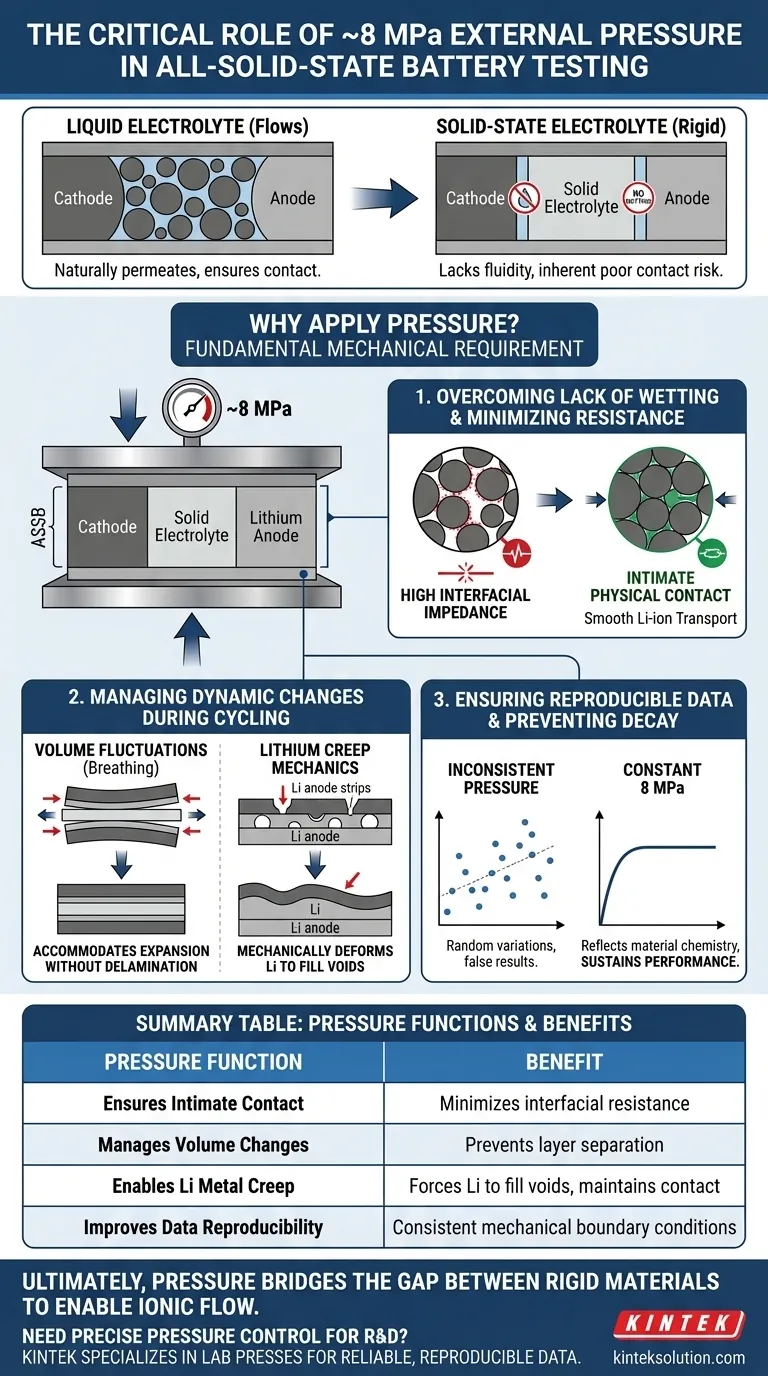
Core Insight: Unlike liquid electrolytes, solid-state electrolytes cannot "flow" to maintain contact with electrodes. External pressure acts as a mechanical substitute for wetting, forcing solid particles together to minimize interfacial resistance and prevent permanent delamination during the expansion and contraction of active materials.
The Physical Challenge of Solid-Solid Interfaces
Overcoming Lack of Wetting
In conventional batteries, liquid electrolytes naturally permeate porous electrodes, ensuring ions can move freely. Solid-state batteries lack this fluidity. Because the internal interfaces are rigid solid-solid boundaries, there is an inherent risk of poor contact between the cathode, anode, and electrolyte particles.
Minimizing Interfacial Resistance
Without significant external force, these solid particles barely touch, creating high interfacial impedance. Applied pressure ensures intimate physical contact is established and maintained. This tight contact is a prerequisite for smooth lithium-ion transport across the interfaces, directly enabling the battery to function efficiently.
Ensuring Reproducible Data
Testing fixtures often use distinct pressure devices to apply a specific load (e.g., 8 MPa, 75 MPa, or higher). Consistent pressure is vital for data authenticity. It ensures that performance metrics, such as ionic conductivity and capacity, reflect the material's chemistry rather than random variations in physical contact.
Managing Dynamic Changes During Cycling
Compensating for Volume Fluctuations
Electrode materials physically expand and contract ("breathe") during charging and discharging. Without external pressure, this movement leads to interlayer separation. The 8 MPa pressure helps the cell assembly accommodate these volume changes without losing the critical connection between layers.
Utilizing Lithium Creep Mechanics
When lithium is stripped from the anode during discharge, voids can form at the interface, breaking the circuit. Pressure exploits the "creep" properties of lithium metal. The applied force mechanically deforms the lithium, forcing it to fill these voids, thereby maintaining continuous contact and preventing a spike in resistance.
Preventing High-Rate Decay
Test cells relying on minimal pressure (e.g., weak springs < 0.2 MPa) often fail rapidly under high-rate cycling. Higher, controlled pressures sustain performance by suppressing the delamination that typically occurs when ions move quickly. This ensures the battery maintains stable capacity performance over long-term cycling.
Understanding the Trade-offs
Pressure Magnitude Variability
While your specific context calls for 8 MPa, it is important to note that optimal pressure requirements vary heavily by material design. Some references suggest pressures as low as 3.2 MPa for certain setups, while others necessitate up to 100 MPa to simulate commercial packaging constraints.
The Risk of Insufficient Load
If the pressure is too low, the interfacial impedance will rise uncontrollably as the cycle count increases. This results in "false negative" test results where a promising material appears to fail simply because the mechanical boundary conditions were not met.
Making the Right Choice for Your Goal
To ensure your electrochemical testing yields valid results, you must align your pressure strategy with your testing objectives.
- If your primary focus is Cycle Life Stability: Ensure the applied pressure is high enough to deform the lithium anode and fill voids created during stripping (utilizing Li creep).
- If your primary focus is Reproducibility: Use a specialized cell holder with a quantified pressure device rather than simple springs to eliminate contact variance between samples.
- If your primary focus is High-Rate Performance: Maintain strict pressure constancy (e.g., 8 MPa) to prevent immediate delamination caused by rapid volume expansion.
Ultimately, external pressure is not merely a testing parameter; it is an active component of the solid-state cell that bridges the gap between rigid materials to enable ionic flow.
Summary Table:
| Pressure Function | Benefit |
|---|---|
| Ensures Intimate Contact | Minimizes interfacial resistance between solid components |
| Manages Volume Changes | Prevents layer separation during electrode expansion/contraction |
| Enables Li Metal Creep | Forces lithium to fill voids, maintaining electrical contact |
| Improves Data Reproducibility | Provides consistent mechanical boundary conditions for testing |
Need precise pressure control for your solid-state battery R&D? KINTEK specializes in laboratory press machines, including automatic and heated lab presses, designed to deliver the consistent, high-pressure environments required for accurate electrochemical testing. Our equipment helps researchers like you achieve reliable, reproducible data by ensuring optimal solid-solid contact. Contact our experts today to discuss how our lab presses can support your battery development goals.
Visual Guide
Related Products
- Warm Isostatic Press for Solid State Battery Research Warm Isostatic Press
- Laboratory Hydraulic Press Lab Pellet Press Button Battery Press
- Carbide Lab Press Mold for Laboratory Sample Preparation
- Button Battery Sealing Press Machine for Lab
- Lab Infrared Press Mold for Laboratory Applications
People Also Ask
- Why must composite cathodes be sealed in vacuum lamination bags for WIP? Ensure Battery Stability and Density
- What is the function of elastic molds in warm isostatic pressing? Achieve Uniform Density in Composite Particles
- How do sacrificial volume materials (SVM) maintain microchannels in isostatic pressing? Ensure Structural Integrity
- How does Warm Isostatic Pressing differ from traditional pressing methods? Unlock Uniform Density for Complex Parts
- What is the mechanism of a Warm Isostatic Press (WIP) on cheese? Master Cold Pasteurization for Superior Safety