
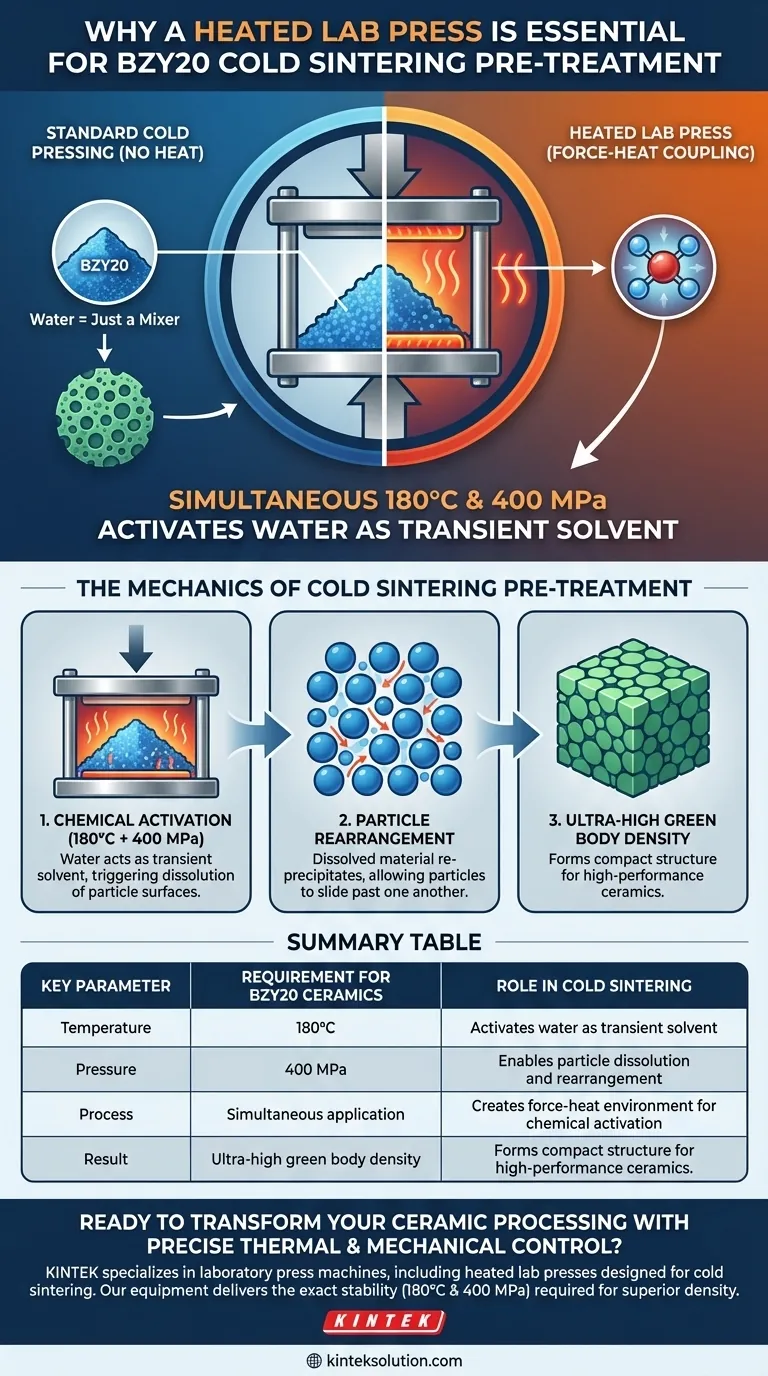
A heated lab press is indispensable for BZY20 ceramics because it provides the simultaneous thermal and mechanical energy required to activate the cold sintering mechanism. By maintaining the sample at exactly 180°C while applying 400 MPa of pressure, the press enables water to function as a transient solvent, a chemical state that is impossible to achieve with standard cold pressing methods.
Core Insight: The heated press does not merely shape the powder; it creates a "force-heat" environment that alters the chemical behavior of water, allowing it to dissolve and rearrange ceramic particles for superior density prior to final sintering.
The Mechanics of Cold Sintering Pre-treatment
The Necessity of "Force-Heat" Coupling
For BZY20 ceramics, applying pressure alone is insufficient.
The heated lab press is unique because it couples high pressure with a specific thermal environment.
It maintains the die and the sample at a constant 180°C.
Simultaneously, it applies approximately 400 MPa of pressure.
Activating the Transient Solvent
The primary role of this specific temperature and pressure combination is chemical activation.
Under standard conditions, water is simply a liquid mixed with powder.
However, under the "force-heat" conditions provided by the press, water acts as a transient solvent.
This activated state triggers the dissolution of particle surfaces.
Achieving Particle Rearrangement
Once the particle surfaces dissolve, the material enters a dynamic phase.
The dissolved material re-precipitates, allowing particles to slide past one another and fill voids.
This process is known as particle rearrangement.
It results in an ultra-high green body density, creating a compact structure that is far denser than what is achievable through dry pressing.
Understanding the Limitations
Why Conventional Cold Pressing Fails
It is critical to understand why a standard press cannot replace a heated press in this workflow.
Without the 180°C heat source, the water within the BZY20 powder does not activate as a solvent.
Consequently, no dissolution or re-precipitation occurs.
The result is a lower-density "green body" that lacks the structural integrity required for high-performance BZY20 ceramics.
The Requirement for Precision
The effectiveness of the pre-treatment relies on stability.
The press must maintain the temperature precisely at the target setpoint (180°C) throughout the compression cycle.
Fluctuations in temperature or pressure can prevent the solvent mechanism from activating uniformly.
Making the Right Choice for Your Goal
To determine if this equipment is strictly necessary for your specific application, consider your density targets.
- If your primary focus is BZY20 Cold Sintering: You require a heated lab press capable of simultaneous 400 MPa pressure and 180°C heating to activate the necessary solvent chemistry.
- If your primary focus is Standard Dry Pressing: A conventional cold press is sufficient, but you must accept significantly lower green body densities and forego the cold sintering mechanism.
By controlling the thermodynamic environment, you transform the pressing stage from simple shaping into a critical chemical processing step.
Summary Table:
| Key Parameter | Requirement for BZY20 Ceramics | Role in Cold Sintering |
|---|---|---|
| Temperature | 180°C | Activates water as a transient solvent |
| Pressure | 400 MPa | Enables particle dissolution and rearrangement |
| Process | Simultaneous application | Creates "force-heat" environment for chemical activation |
| Result | Ultra-high green body density | Forms compact structure for high-performance ceramics |
Ready to transform your ceramic processing with precise thermal and mechanical control? KINTEK specializes in laboratory press machines, including automatic lab presses, isostatic presses, and heated lab presses specifically designed for advanced processes like the cold sintering of BZY20 ceramics. Our equipment delivers the exact temperature stability (180°C) and high pressure (400 MPa) required to activate the transient solvent mechanism and achieve superior density. Don't settle for lower-density results from standard pressing methods. Contact KINTEK today to discuss how our heated lab presses can optimize your ceramic pre-treatment process and elevate your research outcomes.
Visual Guide
Related Products
- 24T 30T 60T Heated Hydraulic Lab Press Machine with Hot Plates for Laboratory
- Manual Heated Hydraulic Lab Press with Integrated Hot Plates Hydraulic Press Machine
- Automatic High Temperature Heated Hydraulic Press Machine with Heated Plates for Lab
- Automatic Heated Hydraulic Press Machine with Hot Plates for Laboratory
- Heated Hydraulic Press Machine with Heated Plates for Vacuum Box Laboratory Hot Press
People Also Ask
- Function of a Laboratory Hydraulic Press with Heated Platens in SSE? Enhance Battery Density & Conductivity
- Why is a laboratory hydraulic press with heating plates required for PLA/TEC films? Achieve Precise Sample Integrity
- What role does a laboratory heated hydraulic press play in LTCC? Essential for High-Density Ceramic Lamination
- What is the primary function of a laboratory heated hydraulic press? Mastering Thermoplastic Carbon Fiber Composites
- What is the critical role of a laboratory heated hydraulic press? Mastering PVC Sample Prep for Testing



















