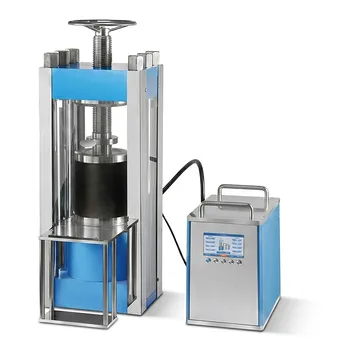
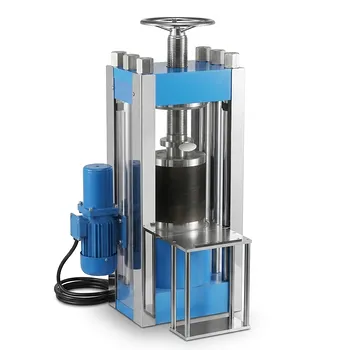
The reshaping of Thiol-Polyurethane Liquid Crystal Elastomers (PTU LCEs) requires a heated laboratory press to simultaneously trigger and manage dynamic bond exchange. It provides the constant high temperature (approximately 150 °C) and mechanical pressure (often up to 2 tons) necessary to transform a rigid, thermoset-like network into a flowable state. This process allows the material to be molded into films or complex geometries without damaging its underlying chemical structure.
Core Takeaway: A heated laboratory press provides the synergistic thermal and mechanical environment required to activate dynamic covalent bond exchanges in PTU LCEs. This allows a normally permanent polymer network to undergo plastic flow, enabling the reshaping, recycling, and repair of the elastomer.
Activating the Dynamic Covalent Network
Overcoming Thermoset Rigidity
PTU LCEs typically exhibit thermoset characteristics, meaning they possess a permanently cross-linked network that does not melt when heated. Under normal conditions, these materials are chemically "locked" into their original shape.
The Role of High Temperature in Bond Exchange
The laboratory press maintains a constant temperature of approximately 150 °C, which is the threshold required to activate dynamic covalent bond exchange. At this temperature, the chemical bonds within the PTU LCE network can dissociate and recombine.
Enabling Plastic Flow
By allowing bonds to break and reform, the high heat induces plastic flow in the material. This state is critical because it allows the polymer chains to slide past one another and rearrange into a new configuration without degrading the polymer's molecular weight.
The Necessity of High Mechanical Pressure
Inducing Macroscopic Deformation
While heat activates the chemistry, high pressure (such as 2 tons) is required to physically force the activated network into a new shape. This pressure ensures the material fills the mold cavity or flattens into a uniform film.
Eliminating Voids and Vents
The application of constant pressure helps to eliminate internal air bubbles and voids that can form during the reshaping process. This leads to a higher specimen density and ensures the material's mechanical integrity is preserved after cooling.
Precision in Geometry and Flatness
A heated press provides the control necessary to achieve precise sample thickness and surface flatness. This level of accuracy is essential for researchers who must prepare standard specimens for subsequent physical or chemical performance testing.
Understanding the Trade-offs
Risk of Thermal Degradation
While 150 °C is necessary for bond exchange, prolonged exposure to high heat can lead to thermal degradation of the polymer. Precise temperature control is vital to ensure the material remains within its "processing window" where exchange occurs but decomposition does not.
Balancing Pressure and Flow
If the pressure is applied too rapidly before the material reaches the required temperature, the network may experience mechanical fracture rather than plastic flow. Conversely, insufficient pressure may lead to incomplete molding and poor interfacial bonding.
Complexity of Recovery
Reshaping a PTU LCE resets its "programmed" shape; however, the material must be cooled under controlled conditions to maintain its liquid crystal alignment. Failure to manage the cooling phase can result in a loss of the elastomer's unique actuating properties.
How to Apply This to Your Project
Recommendations for Material Processing
- If your primary focus is recycling or repair: Use a temperature of at least 150 °C and sustained pressure to ensure full "welding" of different material interfaces through bond recombination.
- If your primary focus is producing optical-grade films: Prioritize the press's ability to provide uniform thermal fields and high-precision plates to minimize surface defects and thickness variations.
- If your primary focus is complex geometric molding: Ensure the mold is pre-heated and that pressure is maintained throughout the entire cooling cycle to "lock in" the new physical configuration.
The heated laboratory press is the essential tool for unlocking the "re-processability" of PTU LCEs, turning a permanent material into a versatile, sustainable resource.
Summary Table:
| Feature | Requirement for PTU LCE Reshaping | Key Function/Benefit |
|---|---|---|
| Temperature | Approximately 150 °C | Activates dynamic covalent bond exchange & induces plastic flow. |
| Pressure | Up to 2 Tons (Mechanical) | Forces network into new shapes and eliminates internal air bubbles. |
| Thermal Control | High Precision Management | Prevents material degradation and preserves liquid crystal alignment. |
| Output Lead | Precise Geometry & Flatness | Ensures high specimen density and mechanical integrity for testing. |
Unlock Advanced Material Processing with KINTEK
Precision is paramount when managing the complex thermal and mechanical requirements of Thiol-Polyurethane Liquid Crystal Elastomers. KINTEK specializes in comprehensive laboratory pressing solutions designed to meet the rigorous demands of advanced material science and battery research.
Whether you need to trigger dynamic bond exchanges or prepare high-density specimens, our versatile range includes:
- Manual & Automatic Presses: For flexible or high-throughput workflows.
- Heated & Multifunctional Models: Perfect for precise temperature-dependent reshaping.
- Glovebox-Compatible & Isostatic Presses: Specialized cold and warm solutions for sensitive environments.
Elevate your lab's capabilities—contact our experts today to find the ideal pressing solution for your research goals!
References
- Mohand O. Saed, Eugene M. Terentjev. Extrudable Covalently Cross‐Linked Thio‐Urethane Liquid Crystalline Elastomers. DOI: 10.1002/adfm.202307202
This article is also based on technical information from Kintek Solution Knowledge Base .
Related Products
- 24T 30T 60T Heated Hydraulic Lab Press Machine with Hot Plates for Laboratory
- Automatic Large Format Laboratory Heated Hydraulic Press 400x400mm Plate Capacity
- Automatic Heated Hydraulic Lab Press Machine 200x200 Plate Size for Battery Research and Materials Science
- Automatic Heated Hydraulic Lab Press with Programmable Touch Screen Controls and Precision Temperature Regulation
- Heated Hydraulic Press Machine with Heated Plates for Vacuum Box Laboratory Hot Press
People Also Ask
- Function of a Laboratory Hydraulic Press with Heated Platens in SSE? Enhance Battery Density & Conductivity
- Why is a laboratory hydraulic press with heating plates required for PLA/TEC films? Achieve Precise Sample Integrity
- What role does a laboratory heated hydraulic press play in LTCC? Essential for High-Density Ceramic Lamination
- Why reduce load when applying composite strengthening tabs? Protect Specimen Integrity and Data Accuracy
- Why is a laboratory heated hydraulic press required? Ensure Precise Vulcanization for NBR/EPDM Nanocomposites