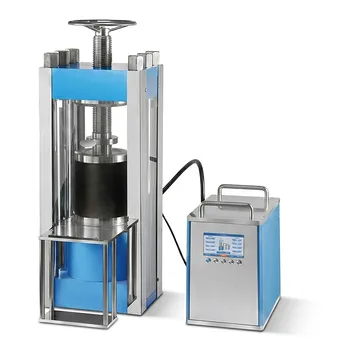
Reliable adhesion testing begins with a high-precision laboratory hot press. This specialized equipment is essential because it produces polypropylene (PP) composite films with uniform thickness, flat surfaces, and a dense internal microstructure. By controlling these variables, the press ensures that subsequent measurements—such as peel strength—reflect the material’s true properties rather than inconsistencies created during sample fabrication.
Core Takeaway: A high-precision laboratory hot press eliminates sample-to-sample variability by providing exact control over temperature and pressure. This standardization is critical for removing internal defects and ensuring that the physical dimensions of the film do not interfere with the accuracy of adhesion and mechanical testing.
Ensuring Dimensional and Surface Uniformity
The primary role of a precision press is to transform bulk polypropylene into a standardized geometry suitable for analytical testing.
Eliminating Thickness Interference
Adhesion tests, particularly peel strength evaluations, are highly sensitive to the thickness of the substrate. A high-precision press maintains specific thicknesses (such as 200 µm) with minimal deviation, preventing variations in sample thickness from skewing the force data collected during testing.
Optimizing Surface Quality for Treatment
Adhesion often requires a smooth, flat surface for secondary processes like corona treatment or chemical functionalization. Precision platens apply uniform pressure across the entire film area, ensuring that the surface is perfectly flat and free of macroscopic irregularities that could lead to inconsistent contact during adhesion.
Achieving Microstructural Integrity
Beyond external dimensions, the hot press manages the internal state of the polypropylene matrix and its fillers.
Eliminating Internal Voids and Air Bubbles
Under high temperature (e.g., 190°C to 210°C) and sustained pressure, the polypropylene reaches a molten state that allows it to flow into every part of the mold. This process purges air bubbles and internal voids, which would otherwise act as stress concentrators and lead to premature failure during mechanical testing.
Maximizing Structural Density
Precision control allows the PP matrix to redistribute and fill the gaps between nanofillers or fibers. This results in a dense microstructure and strong interfacial adhesion within the composite itself, ensuring that the film functions as a single, cohesive unit during the pull-off or peel phases of an adhesion test.
Managing Thermal and Mechanical Stresses
The way a material is heated and cooled significantly impacts its final physical behavior.
Reducing Internal Processing Stresses
Rapid or uneven cooling can trap internal stresses within a polymer film, causing it to warp or become brittle. High-precision presses often feature programmable cooling stages, which allow the material to stabilize gradually, ensuring the resulting test specimen is dimensionally stable and stress-free.
Facilitating Component Flow and Cross-linking
The application of controlled thermal energy facilitates the physical cross-linking and flow between the polypropylene and different composite components. This ensures that the additives are thoroughly integrated into the matrix, providing a reliable baseline for evaluating how well the composite adheres to other surfaces.
Understanding the Trade-offs
While high-precision presses are superior to manual versions, they come with specific considerations.
- Complexity and Cost: These machines require a higher initial investment and more rigorous calibration to maintain their precision compared to standard industrial presses.
- Material Sensitivity: Applying excessive pressure or heat in an attempt to achieve density can lead to thermal degradation of the polypropylene or the fillers, which can negatively alter the chemical properties you intend to test.
- Cycle Times: Achieving the highest level of uniformity often requires longer, staged heating and cooling cycles, which can reduce the throughput of sample preparation.
How to Apply This to Your Project
To achieve the most reliable data, match your hot press settings to your specific testing goals.
- If your primary focus is Adhesion/Peel Strength: Prioritize thickness consistency (e.g., +/- 5 µm) and surface smoothness to ensure the adhesive bond is the only variable being measured.
- If your primary focus is Mechanical Reinforcement: Focus on high-pressure stages (up to 30 MPa) to ensure a dense microstructure and the total elimination of internal voids between the matrix and fibers.
- If your primary focus is Surface Treatment (Corona/Plasma): Use the highest precision platens available to ensure a mirror-flat finish, which allows for uniform energy distribution during the treatment process.
By standardizing the preparation of your polypropylene composite films through precision pressing, you transform your laboratory results from mere observations into definitive, reproducible data.
Summary Table:
| Feature | Impact on Adhesion Testing | Precision Benefit |
|---|---|---|
| Thickness Control | Prevents variability in peel strength data | Maintains tolerance (e.g., +/- 5 µm) |
| Surface Quality | Ensures uniform contact for corona/chemical treatments | Produces mirror-flat, irregularity-free surfaces |
| Void Elimination | Removes stress concentrators that cause premature failure | High-pressure flow (up to 30 MPa) for dense matrix |
| Thermal Stability | Prevents warping and brittleness in test specimens | Programmable cooling cycles for stress-free films |
Elevate Your Material Research with KINTEK Precision
Don't let sample inconsistencies compromise your laboratory results. KINTEK specializes in comprehensive laboratory pressing solutions designed to transform your polypropylene composite preparation from mere observation into definitive, reproducible data.
Whether you are engaged in advanced battery research or polymer engineering, our diverse range of equipment ensures the perfect fit for your workflow:
- Manual & Automatic Presses for varying throughput needs.
- Heated & Multifunctional Models for precise thermal control up to 210°C.
- Glovebox-Compatible Systems for air-sensitive material processing.
- Cold and Warm Isostatic Presses for specialized density requirements.
Ready to achieve superior thickness uniformity and void-free microstructures? Contact KINTEK today to find the ideal pressing solution for your lab!
References
- Rogério Ramos de Sousa, Demétrio Jackson dos Santos. Improvement of Polypropylene Adhesion by Kraft Lignin Incorporation. DOI: 10.1590/1980-5373-mr-2018-0123
This article is also based on technical information from Kintek Solution Knowledge Base .
Related Products
- Automatic Hydraulic Hot Press with Large Plate and Precision Temperature Control for Advanced Material Sample Preparation and Industrial Research
- Automatic Heated Hydraulic Lab Press with Programmable Touch Screen Controls and Precision Temperature Regulation
- Automatic High Temperature Heated Hydraulic Press Machine with Heated Plates for Lab
- 24T 30T 60T Heated Hydraulic Lab Press Machine with Hot Plates for Laboratory
- Automatic Heated Hydraulic Press Machine with Hot Plates for Laboratory
People Also Ask
- What are the specific features and applications of hydraulic hot press machines? Precision Solutions for Modern Labs
- How does an automatic hydraulic press operate? Achieve Precision and Consistency in Lab Pelleting
- What are the advantages and common applications of an automatic hydraulic press? Elevate Your Lab's Precision
- What is the technical significance of setting a precise dwell time? Achieve Peak Material Density and Stability
- When is an automatic hydraulic press more suitable than a manual press? Scale Your Lab with Precision & Speed