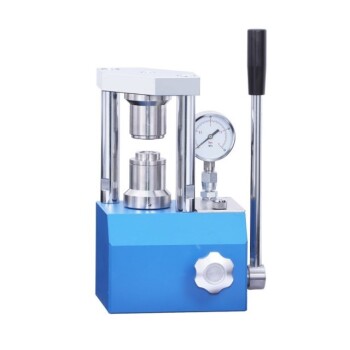
Precision pressure application is the fundamental mechanism for stabilizing lithium-metal interfaces during battery operation. A high-precision laboratory press machine is essential because it imposes uniform, controllable external physical constraints that suppress the vertical growth of lithium dendrites and force dense, planar lithium deposition.
Core Takeaway: By creating a stable mechanical environment, high-precision presses preserve the integrity of the solid electrolyte interphase (SEI) and eliminate contact resistance. This directly prevents the formation of "dead lithium" and ensures the consistent ionic transport required for high cycle life and safety.
The Critical Role of Mechanical Constraint
Suppressing Dendrite Growth
Lithium metal naturally tends to deposit in high-specific-surface-area structures, often referred to as dendrites.
A high-precision press applies a specific physical load that counters this vertical growth. This constraint forces the lithium to deposit laterally, promoting a dense, uniform layer rather than a porous, mossy structure that could puncture separators.
Preserving SEI Integrity
The Solid Electrolyte Interphase (SEI) is a fragile passivation layer that forms on the anode.
Uneven pressure leads to the mechanical fracture of this layer during charge/discharge cycles. By maintaining a stable pressure environment, the press prevents the continuous breaking and reforming of the SEI, which consumes electrolyte and degrades battery life.
Preventing Dead Lithium
When the SEI fractures or lithium detaches due to volume changes, it becomes electrically isolated, forming "dead lithium."
Uniform pressure ensures that lithium remains electrically connected to the current collector. This reduces the accumulation of inactive lithium, directly improving the battery's reversible capacity and coulombic efficiency.
Optimizing Electrode Architecture
Minimizing Interfacial Impedance
In both liquid and solid-state systems, the interface between the electrode and electrolyte is a primary source of resistance.
High-precision pressing forces these layers into atomic-level close contact. This is particularly critical in all-solid-state batteries, where the press ensures the solid electrolyte bonds tightly to the anode, significantly lowering interfacial transport impedance.
Enhancing Volumetric Energy Density
During electrode manufacturing, the press is used to compact active materials, conductive agents, and binders.
This process eliminates internal voids and optimizes porosity. By increasing the compaction density, the machine maximizes the amount of active material per unit volume, leading to higher overall energy density without sacrificing ionic conductivity.
Ensuring Research Reproducibility
Scientific validity relies on the ability to replicate results.
Manual or low-precision pressing creates density gradients and inconsistent contact points. A high-precision automated press ensures that every electrode sheet or coin cell has the exact same density and thickness, guaranteeing that variations in test data are due to material chemistry, not assembly errors.
Understanding the Trade-offs
The Risks of Improper Pressure
While pressure is essential, it is not a case of "more is better"—it must be precise.
Excessive pressure can crush the porous structure of the separator or electrode, cutting off the pathways required for ion transport (pore closure). It may also lead to short circuits if the separator is mechanically compromised.
Insufficient pressure, conversely, leads to delamination. This causes high contact resistance and uneven current distribution, which accelerates localized degradation and thermal hotspots. The value of a high-precision machine lies in finding and maintaining the exact "Goldilocks" zone between these two failure states.
Making the Right Choice for Your Goal
To maximize the value of a high-precision press in your research, align the pressure application with your specific objective:
- If your primary focus is All-Solid-State Batteries: Prioritize high pressure capability to overcome the physical gap between solid electrolytes and electrodes, minimizing interfacial impedance.
- If your primary focus is Lithium-Metal Anode Protection: Focus on the stability and uniformity of the pressure to maintain SEI integrity and suppress dendrites without crushing the separator.
- If your primary focus is Material Characterization: Rely on the machine's repeatability to eliminate void-induced variables, ensuring your electrochemical data accurately reflects the material's intrinsic properties.
Ultimate success in lithium-metal research depends on transforming variable chemistry into a controlled mechanical system.
Summary Table:
| Feature | Impact on Lithium-Metal Research |
|---|---|
| Dendrite Suppression | Forces lateral lithium deposition, preventing separator puncture. |
| SEI Preservation | Maintains a stable mechanical environment to prevent SEI fracture and electrolyte loss. |
| Impedance Reduction | Ensures atomic-level contact between electrodes and electrolytes to lower resistance. |
| Repeatability | Eliminates assembly variables, ensuring data validity across multiple tests. |
| Density Optimization | Maximizes compaction density to increase volumetric energy density. |
Elevate Your Battery Research with KINTEK Precision
Transform your variable chemistry into a controlled mechanical system with KINTEK’s comprehensive laboratory pressing solutions. Whether you are focused on suppressing dendrites in lithium-metal anodes or minimizing interfacial impedance in all-solid-state batteries, our precision equipment provides the exact "Goldilocks" pressure your research demands.
Our specialized lineup includes:
- Manual and Automatic Presses for versatile lab workflows.
- Heated and Multifunctional models for advanced material synthesis.
- Glovebox-compatible systems for sensitive lithium handling.
- Cold (CIP) and Warm (WIP) Isostatic Presses for uniform material compaction.
Don't let inconsistent assembly compromise your electrochemical data. Contact KINTEK today to find the perfect pressing solution for your battery research needs!
References
- Abdolkhaled Mohammadi, Lorenzo Stievano. From Formation to Reactivation of Inactive Lithium in Lithium Metal Anodes. DOI: 10.1002/celc.202500242
This article is also based on technical information from Kintek Solution Knowledge Base .
Related Products
- Lab Infrared Press Mold for Laboratory Applications
- Warm Isostatic Press for Solid State Battery Research Warm Isostatic Press
- Laboratory Hydraulic Press Lab Pellet Press Button Battery Press
- Carbide Lab Press Mold for Laboratory Sample Preparation
- Button Battery Sealing Press Machine for Lab
People Also Ask
- What is the purpose of incorporating cartridge heaters into a lab press mold for MLCC block compression? Optimize Results
- Why is a high-performance laboratory molding press critical for in-situ electrolyte formation? Unlock Battery Success
- Why is precise cooling management of the lab press mold necessary? Protect Core Integrity in Thermoforming
- What is the function of a pressing tool in thermoplastic panels? Master Precision Shaping & Fusion Bonding
- What challenges are associated with recycling textiles, and how do laboratory presses help? Overcome Recycling Hurdles with Precision Tools