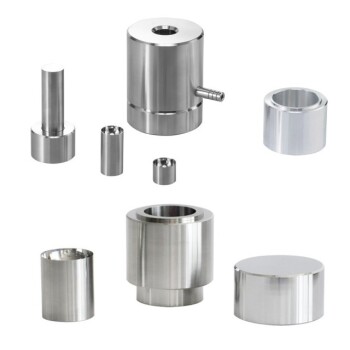
A high-precision laboratory press is indispensable for polymer composite research because it establishes the strictly controlled pressure environment needed to eliminate internal structural defects and ensure material uniformity. By maintaining a uniform and stable pressure field, the press ensures optimal impregnation of the polymer matrix into reinforcement fibers and particulate fillers. This process is the only reliable way to remove internal air pores and density gradients, creating specimens where the experimental density aligns perfectly with theoretical calculations.
Core Takeaway Without the exact pressure control of a high-precision press, composite specimens suffer from microscopic voids and inconsistent densities that invalidate experimental results. The core value lies in achieving a homogeneous microstructure that yields reproducible, quantitative data for erosion and mechanical testing.
Achieving Microstructural Integrity
Elimination of Voids and Air Pores
The primary function of the laboratory press is to eradicate internal air pockets. During the molding process, the press applies significant, uniform force to drive out trapped air bubbles that naturally occur during the mixing of the polymer and reinforcement.
Optimizing Matrix Impregnation
High precision is required to force the polymer melt to fully infiltrate the reinforcement structure. Whether dealing with fibers or particulate fillers, the pressure must be sufficient to overcome viscosity and surface tension, ensuring the matrix completely surrounds every filler element.
Removing Density Gradients
A common failure in composite fabrication is uneven density, where some regions are more compacted than others. A high-precision press mitigates this by applying a balanced force across the entire mold surface, ensuring the material achieves a homogeneous state where the experimental density matches the theoretical density.
Ensuring Geometric and Mechanical Precision
Guaranteeing Sample Parallelism
For accurate mechanical testing, the end faces of a specimen must be perfectly parallel. The laboratory press ensures that the resulting sample—whether a flat plate or a cylinder—has uniform thickness and parallel faces, which prevents sample tilting and uneven stress distribution during subsequent testing.
Reducing Internal Processing Stresses
Rapid or uneven cooling and compression can lock internal stresses into a composite material. By precisely controlling the pressure dwell time and temperature profile, the press allows the material to relax and consolidate, minimizing internal stresses that could skew mechanical property evaluations.
Compliance with Testing Standards
Standardized testing protocols (such as ASTM) require specimens with specific dimensions and dense microstructures. High-precision molding allows researchers to consistently produce specimens that meet these rigorous geometric and physical requirements, ensuring data reproducibility.
Common Pitfalls to Avoid
Misinterpreting Pressure as a Cure-All
While high pressure is critical, it cannot compensate for poor upstream processing. If the initial mixing of the polymer and fillers is inadequate, the press will simply consolidate a poorly mixed material, resulting in a dense but inhomogeneous specimen.
Overlooking Temperature Synchronization
Precision pressure is ineffective without equally precise temperature control. If the temperature is too low, the polymer melt viscosity will be too high for the pressure to affect proper impregnation; if too high, the polymer may degrade before consolidation is complete.
Making the Right Choice for Your Goal
To ensure your composite specimens yield valid data, align your equipment usage with your specific research objectives:
- If your primary focus is Erosion Wear Research: Prioritize pressure stability to ensure the experimental density matches the theoretical density, as density gradients will radically alter wear rates.
- If your primary focus is Mechanical Property Testing: Focus on the mold alignment capabilities of the press to ensure perfect parallelism of specimen end faces, preventing uneven loading during tests.
- If your primary focus is Material Formulation: Ensure the press offers precise control over dwell time to allow full infiltration of the polymer melt into complex filler arrangements.
Ultimately, the high-precision laboratory press acts as the final gatekeeper of quality, transforming raw mixtures into standardized, scientifically valid specimens.
Summary Table:
| Key Factor | Impact on Polymer Composites | Benefit of Precision Pressing |
|---|---|---|
| Void Elimination | Microscopic pores weaken structural integrity | Forces out trapped air for a dense microstructure |
| Matrix Impregnation | Incomplete bonding between resin and fiber | Overcomes viscosity to ensure full reinforcement coating |
| Density Consistency | Internal gradients skew mechanical data | Uniform force application matches experimental to theoretical density |
| Sample Geometry | Non-parallel faces lead to uneven stress | Guarantees perfect parallelism for ASTM/ISO standard compliance |
| Stress Management | Internal processing stresses cause warping | Controlled dwell time relaxes material for stable specimens |
Elevate Your Composite Research with KINTEK Precision
Don't let inconsistent specimen quality compromise your experimental data. KINTEK specializes in comprehensive laboratory pressing solutions designed specifically for high-stakes research. Whether you need manual, automatic, heated, or glovebox-compatible models, our equipment delivers the stable pressure and temperature control essential for perfect polymer matrix impregnation.
From advanced battery research to erosion wear testing, our cold and warm isostatic presses ensure your specimens achieve zero-void integrity and perfect parallelism every time.
Ready to standardize your sample preparation? Contact our laboratory experts today to find the ideal pressing solution for your material formulation needs!
References
- Raffi Mohammed. DEVELOPMENT OF A THEORETICAL MODEL TO ESTIMATE THE EROSION WEAR RATE OF POLYMER COMPOSITES. DOI: 10.26782/jmcms.2024.02.00002
This article is also based on technical information from Kintek Solution Knowledge Base .
Related Products
- Lab Polygon Press Mold
- Special Shape Lab Press Mold for Laboratory Applications
- Lab Round Bidirectional Press Mold
- Lab Cylindrical Press Mold for Laboratory Use
- Square Lab Press Mold for Laboratory Use
People Also Ask
- What is the purpose of incorporating cartridge heaters into a lab press mold for MLCC block compression? Optimize Results
- How do the design and geometric precision of pressing molds and mandrels affect the quality of PTFE composite samples?
- What role do precision positioning and pressure molds play in single-lap joints? Ensure 100% Data Integrity
- What are the requirements for pressing molds when using SSCG? Key Materials for Complex Single Crystal Production
- How do industrial-grade pressure molds affect zinc metal pouch cells? Maximize Energy Density & Performance