
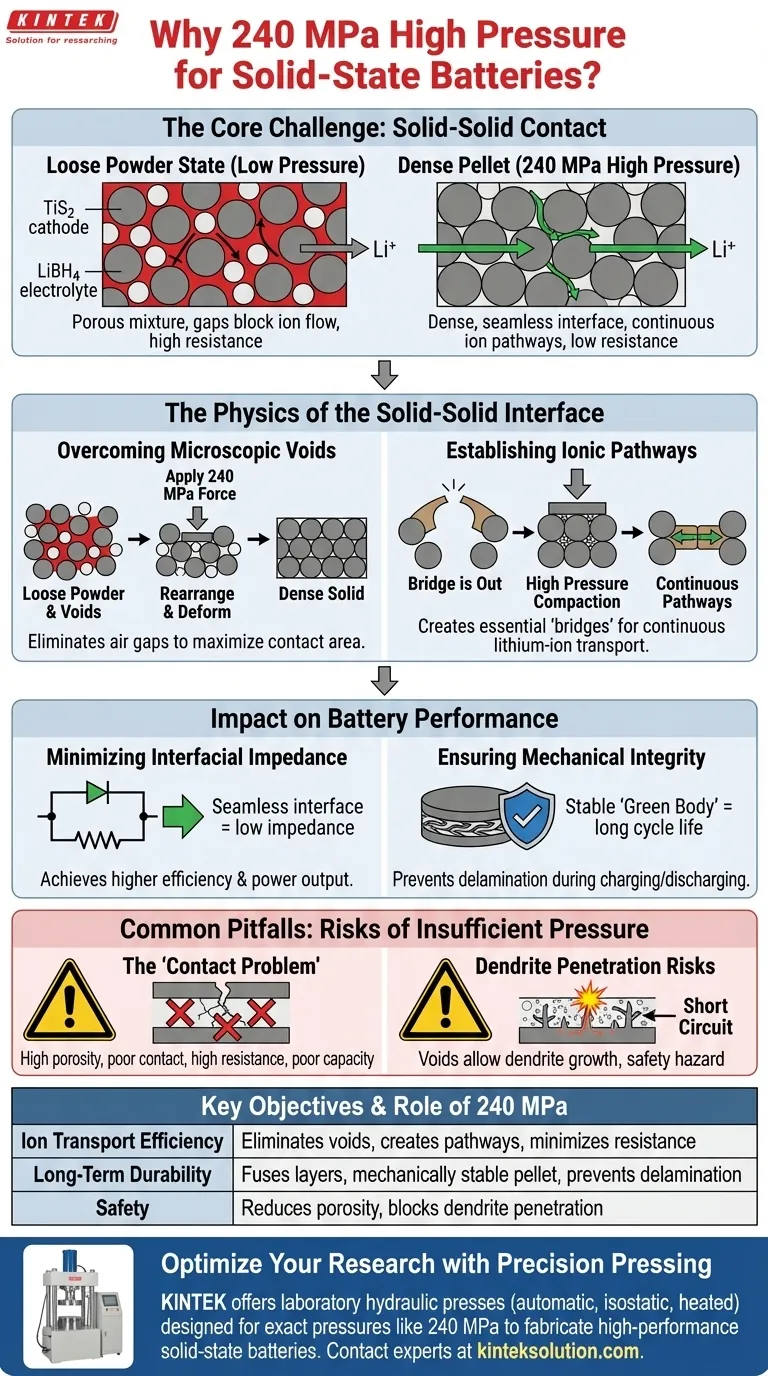
High pressure is the primary mechanism used to overcome the inherent lack of contact between solid materials in battery manufacturing. Applying 240 MPa specifically targets the elimination of microscopic voids between the TiS₂ cathode and the LiBH₄ electrolyte layers. This creates a dense, seamless interface necessary for ions to travel freely, directly lowering the internal resistance that would otherwise cripple the battery's performance.
The Core Challenge: Unlike liquid electrolytes that naturally "wet" and cover electrode surfaces, solid electrolytes are rigid. Without the application of significant force (240 MPa), gaps remain between particles, blocking the flow of ions. The high pressure mechanically fuses these layers into a single, cohesive unit to ensure efficient conductivity and structural stability.
The Physics of the Solid-Solid Interface
Overcoming Microscopic Voids
In a loose powder state, air gaps (voids) exist between the solid electrolyte and active material particles. These voids act as insulators, preventing lithium ions from moving between the cathode and the electrolyte.
Applying 240 MPa forces the particles to rearrange and deform, effectively squeezing out these voids. This process maximizes the contact area, transforming a porous mixture into a dense, continuous solid.
Establishing Ionic Pathways
Lithium ions require a continuous physical medium to transport electrical charge. If the particles are not touching, the "bridge" is out, and transport stops.
High-pressure compaction creates these essential bridges, forming continuous pathways for lithium-ion transport. This connectivity is the fundamental prerequisite for the battery to function at all.
Impact on Battery Performance
Minimizing Interfacial Impedance
The most critical outcome of this process is the reduction of interfacial impedance (resistance). A seamless interface ensures that ions do not encounter barriers as they move from the TiS₂ layer to the LiBH₄ layer.
By maximizing the solid-solid contact area, the battery achieves a low-impedance state. This allows for higher efficiency and better power output during operation.
Ensuring Mechanical Integrity and Cycle Life
Beyond electrical performance, the pressure creates a mechanically stable "green body" or pellet. The layers must remain bonded during the stress of charging and discharging.
A tight, well-formed interface prevents delamination and maintains stability over time. This structural integrity is directly linked to achieving a long cycle life for the battery.
Common Pitfalls: The Risks of Insufficient Pressure
The "Contact Problem"
If the applied pressure is too low, the interface will retain significant porosity. This results in "poor contact," a primary failure mode in solid-state systems.
Poor contact restricts the active area of the battery, leading to high resistance and poor capacity utilization.
Dendrite Penetration Risks
A dense, low-porosity electrolyte layer is also a safety feature. High compaction helps create a barrier that is difficult for lithium dendrites to penetrate.
If voids remain due to lack of pressure, dendrites can grow through the electrolyte layer, potentially causing short circuits and safety hazards.
Making the Right Choice for Your Goal
When configuring your hydraulic press for solid-state battery fabrication, consider your primary objectives:
- If your primary focus is Ion Transport Efficiency: Ensure the pressure is sufficient (e.g., 240 MPa) to fully eliminate interstitial voids, as this is the only way to minimize interfacial resistance.
- If your primary focus is Long-Term Durability: Prioritize creating a high-density pellet to maintain mechanical integrity and prevent layer separation during repeated cycling.
- If your primary focus is Safety: Utilize high pressure to minimize porosity in the electrolyte layer, reducing the risk of lithium dendrite penetration.
To achieve a high-performance all-solid-state battery, treat the hydraulic pressing stage not as a simple shaping step, but as the critical process that defines the electrochemical efficiency of your cell.
Summary Table:
| Key Objective | Role of 240 MPa Pressure |
|---|---|
| Ion Transport Efficiency | Eliminates microscopic voids to create seamless ionic pathways, minimizing interfacial resistance. |
| Long-Term Durability | Fuses layers into a mechanically stable pellet to prevent delamination during cycling. |
| Safety | Reduces porosity in the electrolyte layer to block lithium dendrite penetration. |
Ready to optimize your solid-state battery research with precision pressing? KINTEK specializes in laboratory hydraulic presses (including automatic, isostatic, and heated lab presses) designed to deliver the exact pressures—like 240 MPa—needed to fabricate high-performance, durable all-solid-state batteries. Our equipment ensures maximal interfacial contact and minimal resistance for your TiS₂/LiBH₄ cells. Contact our experts today to discuss how our presses can enhance your battery development process!
Visual Guide
Related Products
- Laboratory Hydraulic Press Lab Pellet Press Machine for Glove Box
- Laboratory Hydraulic Press 2T Lab Pellet Press for KBR FTIR
- 24T 30T 60T Heated Hydraulic Lab Press Machine with Hot Plates for Laboratory
- Laboratory Hydraulic Press Lab Pellet Press Button Battery Press
- Laboratory Hydraulic Pellet Press for XRF KBR FTIR Lab Press
People Also Ask
- How does a laboratory hydraulic press contribute to the preparation of Li3-3xScxSb samples? Optimize Ionic Conductivity
- What is the function of a laboratory hydraulic press in FT-IR of curcumin-coated MWCNTs? Achieve Optical Clarity.
- Why is a laboratory hydraulic press required for compression molding boron-siloxane? Solve High-Loading Density Challenges
- What role does a laboratory hydraulic press play in reaction pellets? Optimizing Lunar Soil and Metal Fuel Density
- What role does a laboratory hydraulic press play in the preparation of piezoelectric ceramic discs for DC-PG? | KINTEK



















