
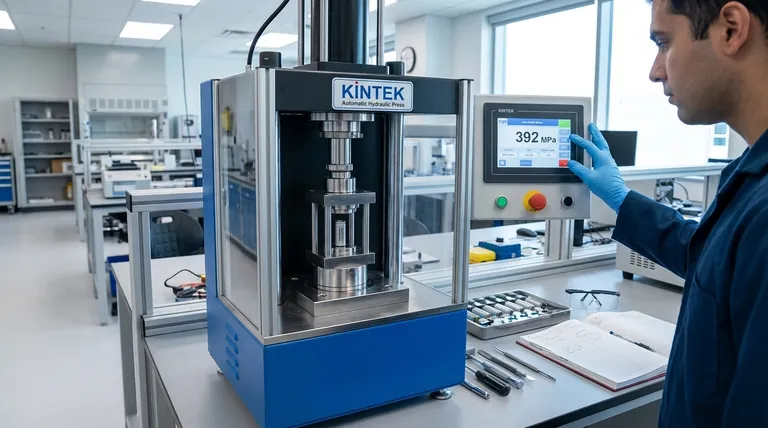
High-pressure application during assembly is the primary method used to overcome the inherent physical limitations of solid materials to create a unified electrochemical system. By applying pressures as high as 392 MPa, manufacturers force solid electrolyte powders and electrode materials to undergo plastic deformation, eliminating microscopic voids and establishing the intimate physical contact necessary for ions to move between layers.
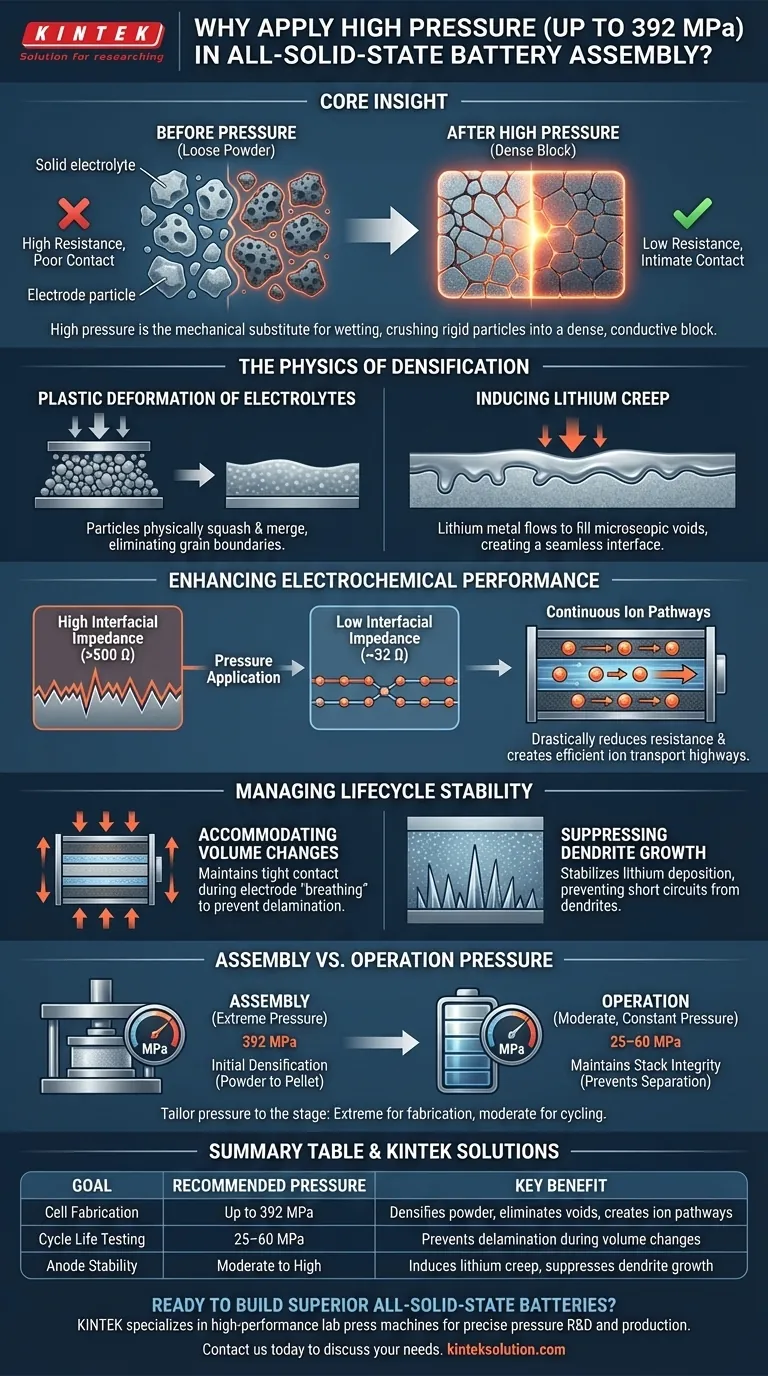
The Core Insight: Unlike liquid electrolytes, which naturally flow into pores to "wet" electrode surfaces, solid electrolytes are rigid. High pressure is the mechanical substitute for wetting; it crushes separate particles into a dense, continuous block, drastically lowering the resistance that would otherwise prevent the battery from functioning.
The Physics of Densification
The application of 392 MPa is not merely about holding parts together; it is a transformative process that alters the microstructure of the battery components.
Plastic Deformation of Electrolytes
Under extreme pressure, specific materials—particularly sulfide-based solid electrolytes—lose their granular nature. They undergo plastic deformation, meaning the particles physically squash and merge.
This effectively erases the boundaries between grains. The result is a transition from a loose powder to a solid, dense separator layer with minimized porosity.
Inducing Lithium Creep
Pressure has a unique effect on lithium metal anodes. Lithium is a relatively soft metal, and under sufficient pressure, it exhibits creep behavior.
This means the metal acts somewhat like a slow-moving fluid, actively filling microscopic voids and uneven areas on the solid electrolyte’s surface. This ensures a seamless interface where the electrode meets the electrolyte.
Enhancing Electrochemical Performance
The structural changes caused by high pressure directly translate to the battery's electrical capabilities.
Drastic Reduction in Impedance
The primary enemy of solid-state batteries is interfacial impedance—the resistance ions face when trying to cross from one material to another.
Without high pressure, contact is limited to microscopic points. With pressure, these points become broad contact areas. References indicate that proper pressure application can drop interfacial impedance significantly, for example, reducing resistance from over 500 Ω to approximately 32 Ω.
Creating Continuous Ion Pathways
For a battery to charge or discharge, lithium ions must travel from the cathode to the anode.
High pressure densifies the stack, creating a continuous "highway" for these ions. By removing pores within layers and at interfaces, the pressure facilitates efficient transport and ensures high critical current density.
Managing Lifecycle Stability
Pressure plays a vital role in the long-term survival of the battery cell, extending beyond the initial assembly.
Accommodating Volume Changes
Electrodes breathe—they expand and contract—during charging and discharging cycles. Without external pressure, this movement would cause layers to separate (delaminate).
Maintained pressure ensures that even as components change volume, the physical contact remains tight, preventing the battery from failing electrically after a few cycles.
Suppressing Dendrite Growth
In anode-free configurations or cells using lithium metal, pressure helps stabilize the deposition of new lithium.
By maintaining intimate contact and minimizing voids during stripping (discharge), pressure suppresses the formation of lithium dendrites—needle-like structures that can puncture the electrolyte and cause short circuits.
Understanding the Nuance: Assembly vs. Operation
It is critical to distinguish between the pressure required to make the cell and the pressure required to run the cell.
The Trade-off of Pressure Magnitude
While 392 MPa is often cited for the initial densification (turning powder into a solid pellet), maintaining this specific extreme pressure during operation is not always practical or necessary.
Operational pressures are often lower (e.g., 25–60 MPa) but are equally critical. The trade-off is that while extreme initial pressure creates the structure, a stable, moderate "stack pressure" is required continuously to prevent interfacial separation during cycling. Failing to maintain this lower pressure can undo the benefits of the initial high-pressure assembly.
Making the Right Choice for Your Goal
The application of pressure must be tailored to the specific stage of battery development and the materials being used.
- If your primary focus is Cell Fabrication: You must apply extreme pressure (up to 392 MPa) to plastically deform electrolyte powders and eliminate porosity for a dense, conductive stack.
- If your primary focus is Cycle Life Testing: You must apply a consistent, moderate stack pressure (e.g., 25–60 MPa) to accommodate volume expansion and prevent delamination.
- If your primary focus is Anode Stability: You should leverage pressure to induce lithium creep, ensuring void-free contact and suppressing dendrite penetration.
High pressure is the non-negotiable mechanical bridge that transforms isolated solid particles into a cohesive, high-performance energy storage device.
Summary Table:
| Goal | Recommended Pressure | Key Benefit |
|---|---|---|
| Cell Fabrication | Up to 392 MPa | Densifies powder, eliminates voids, creates ion pathways |
| Cycle Life Testing | 25–60 MPa | Prevents delamination during electrode expansion/contraction |
| Anode Stability | Moderate to High | Induces lithium creep, suppresses dendrite growth |
Ready to build superior all-solid-state batteries?
KINTEK specializes in high-performance lab press machines, including automatic and isostatic presses, designed to deliver the precise pressures required for your R&D and production. Our equipment helps you achieve the critical densification and stable interfaces necessary for high-performance, long-lasting batteries.
Contact us today to discuss how our press solutions can enhance your battery development process. Get in touch via our contact form and let our experts assist you.
Visual Guide
Related Products
- Automatic High Temperature Heated Hydraulic Press Machine with Heated Plates for Lab
- Laboratory Split Manual Heated Hydraulic Press Machine with Hot Plates
- Heated Hydraulic Press Machine with Heated Plates for Vacuum Box Laboratory Hot Press
- Heated Hydraulic Press Machine With Heated Plates For Vacuum Box Laboratory Hot Press
- 24T 30T 60T Heated Hydraulic Lab Press Machine with Hot Plates for Laboratory
People Also Ask
- Function of a Laboratory Hydraulic Press with Heated Platens in SSE? Enhance Battery Density & Conductivity
- What are the requirements for electrode pressing with high-viscosity ionic liquids like EMIM TFSI? Optimize Performance
- How does a laboratory heated hydraulic press facilitate PBN sample prep for WAXS? Achieve Precise X-Ray Scattering
- What are the industrial applications of heated hydraulic presses? Master Heat & Force for Precision Manufacturing
- Why is a laboratory hydraulic press with heating plates required for PLA/TEC films? Achieve Precise Sample Integrity



















