
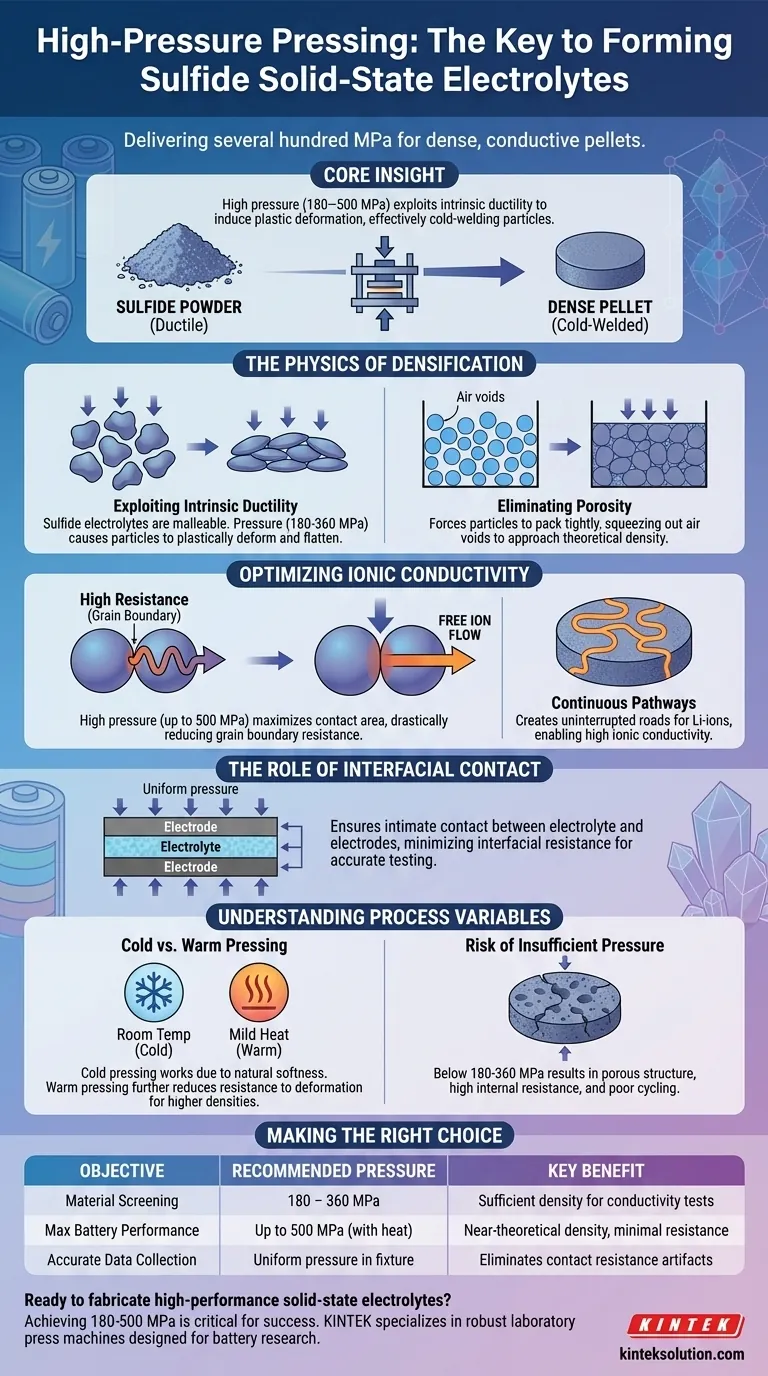
High pressure is the critical mechanism required to induce plastic deformation in sulfide solid-state electrolytes, effectively cold-welding individual powder particles into a dense, conductive pellet. Because sulfide materials possess intrinsic ductility, applying forces between 180 and 500 MPa eliminates voids and creates continuous lithium-ion pathways without the need for high-temperature sintering.
The Core Insight: Unlike oxide ceramics that require extreme heat to bond, sulfides are malleable. The application of several hundred megapascals exploits this softness to mechanically fuse particles, effectively trading porosity for conductivity.
The Physics of Densification
Exploiting Intrinsic Ductility
Sulfide electrolytes are unique among ceramic materials due to their intrinsic plasticity and ductility. They are relatively soft.
When you apply pressure in the range of 180 to 360 MPa, the material does not merely compress; it undergoes plastic deformation. The particles physically change shape, flattening against one another to fill empty spaces.
Eliminating Porosity
A loose powder bed consists of material particles and air voids. Ions cannot travel through air.
High-pressure pressing forces the particles to pack tightly, effectively squeezing out these voids. This process, often referred to as densification, creates a solid mass where the density approaches the theoretical maximum of the material.
Optimizing Ionic Conductivity
Reducing Grain Boundary Resistance
The primary barrier to ion movement in a solid electrolyte is the interface between particles, known as the grain boundary.
If particles are merely touching, the contact area is small, resulting in high resistance. By applying pressure up to 500 MPa, you maximize the contact area between particles. This drastically reduces grain boundary resistance, allowing ions to flow freely.
Creating Continuous Pathways
For a battery to function, lithium ions require an uninterrupted road from one side of the electrolyte to the other.
High-pressure forming connects isolated particles into continuous lithium-ion conduction pathways. This structural continuity is fundamental to achieving high ionic conductivities, such as the 1.7×10⁻² S cm⁻¹ observed in highly dense pellets.
The Role of Interfacial Contact
Electrode Integration
The need for pressure extends beyond the electrolyte pellet itself to the interface with the electrodes (such as lithium foil or stainless steel).
Uniform pressure ensures intimate physical contact between the electrolyte and the current collectors. This minimizes interfacial resistance, which is critical for obtaining accurate, repeatable measurements of the material's properties during testing.
Understanding Process Variables
Cold vs. Warm Pressing
While sulfides are ductile at room temperature (cold pressing), applying mild heat (warm pressing) can further enhance the process.
Simultaneous heat and pressure reduce the material's resistance to deformation. This allows for even higher densities and lower void counts, though many sulfides process excellently via cold pressing alone due to their natural softness.
The Risk of Insufficient Pressure
If the pressure applied is too low (below the 180–360 MPa threshold), the particles will retain their original shape.
This results in a porous structure with poor particle-to-particle contact. The resulting electrolyte will exhibit high internal resistance and poor cycling stability, rendering the battery inefficient regardless of the material's chemical quality.
Making the Right Choice for Your Goal
To achieve optimal performance in solid-state battery fabrication, align your pressing strategy with your specific objectives:
- If your primary focus is basic material screening: Use a cold press at 180–360 MPa to achieve sufficient density for conductivity measurements without complex heating setups.
- If your primary focus is maximum battery performance: Consider warm pressing or higher pressures (up to 500 MPa) to achieve near-theoretical density and minimize internal resistance for high-rate cycling.
- If your primary focus is accurate data collection: Ensure your testing fixture applies constant, uniform pressure to eliminate contact resistance artifacts from your results.
Success in solid-state electrolytes depends not just on the chemistry, but on the mechanical integrity of the formed layer.
Summary Table:
| Objective | Recommended Pressure Range | Key Benefit |
|---|---|---|
| Material Screening | 180 – 360 MPa | Sufficient density for conductivity tests |
| Max Battery Performance | Up to 500 MPa (with heat) | Near-theoretical density, minimal resistance |
| Accurate Data Collection | Uniform pressure in fixture | Eliminates contact resistance artifacts |
Ready to fabricate high-performance solid-state electrolytes?
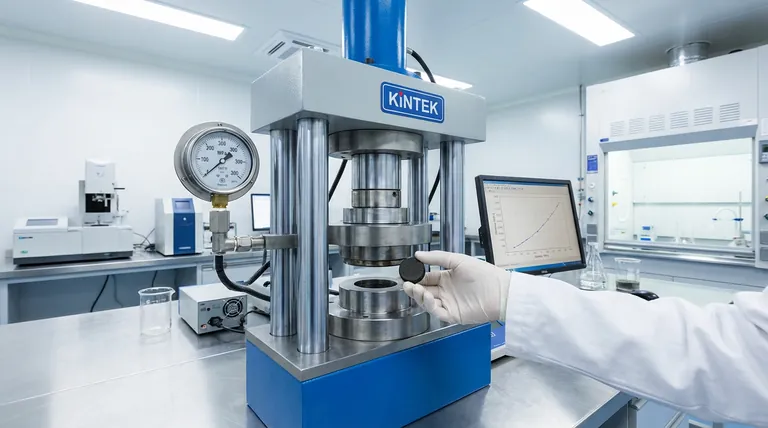
Achieving the necessary 180-500 MPa pressure is critical for success. KINTEK specializes in laboratory press machines—including automatic, isostatic, and heated lab presses—designed to meet the precise demands of battery research and development.
Our robust and reliable equipment ensures you can achieve the perfect densification for your sulfide electrolytes, enabling accurate material characterization and superior battery performance.
Contact KINTEK today to find the ideal lab press for your solid-state battery projects!
Visual Guide
Related Products
- Warm Isostatic Press for Solid State Battery Research Warm Isostatic Press
- Automatic Laboratory Hydraulic Press for XRF and KBR Pellet Pressing
- Special Shape Lab Press Mold for Laboratory Applications
- Lab Polygon Press Mold
- Laboratory Hydraulic Pellet Press for XRF KBR FTIR Lab Press
People Also Ask
- Why must composite cathodes be sealed in vacuum lamination bags for WIP? Ensure Battery Stability and Density
- What is the function of elastic molds in warm isostatic pressing? Achieve Uniform Density in Composite Particles
- How do sacrificial volume materials (SVM) maintain microchannels in isostatic pressing? Ensure Structural Integrity
- What is the mechanism of a Warm Isostatic Press (WIP) on cheese? Master Cold Pasteurization for Superior Safety
- What are the advantages of using a Warm Isostatic Press (WIP) for batteries? Achieve Superior Interface Contact



















