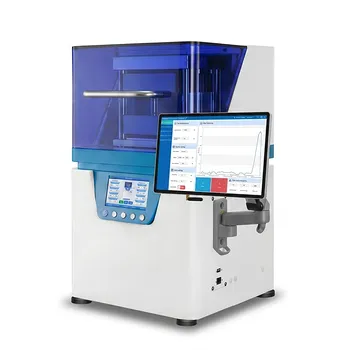
The definitive advantage of a hydraulic mini press lies in its integrated pressure gauge. Unlike a basic hand press, which relies entirely on operator "feel," a hydraulic mini press allows you to visualize and standardize the specific load applied to every sample. This eliminates guesswork, ensuring that every pellet or sample is produced under identical, quantifiable conditions.
Reliability in sample production is defined by repeatability. By providing a readable metric for force application, the hydraulic mini press transforms sample preparation from a subjective manual task into a quantifiable, scientific process.
The Role of Quantifiable Pressure
Eliminating the "Feel" Factor
Basic hand presses lack a method for standardizing pressure, forcing the operator to guess when "enough" force has been applied.
This reliance on subjective sensation leads to significant variance between different operators, or even the same operator at different times of the day.
Ensuring Scientific Repeatability
For analytical testing, samples must be prepared under identical conditions to yield comparable results.
The hydraulic mini press features a pressure gauge that allows the user to apply the exact same load to every sample. This consistency makes the mini press far more reliable for critical applications.
Efficiency and Operator Control
High Output with Low Input
While compact (often weighing around 4kg), these units utilize hydraulic principles to generate immense force—typically up to 2 tons.
This design allows the device to generate high pressure with relatively low input power from the user.
Reducing Physical Fatigue
Standard-sized, manually hand-pumped hydraulic presses often require significant physical exertion.
The mini press is designed to require significantly less physical effort to operate. By reducing operator fatigue, you further reduce the risk of human error during repetitive sample preparation.
Understanding the Trade-offs
Capacity Limitations
While effective for many lab applications, the 2-ton limit is specific to the "mini" form factor.
If your specific application requires force exceeding 2 tons, this compact solution will not be sufficient, and a standard benchtop press would be required.
Manual Operation
Despite being hydraulic, these units are typically operated manually via a pumping handle.
They offer mechanical advantage, but they are not fully automated; they still require a degree of physical interaction compared to electric automated presses.
Making the Right Choice for Your Goal
Reliability is a product of consistency, but your choice should also factor in space and force requirements.
- If your primary focus is Data Consistency: Choose the hydraulic mini press for its pressure gauge, which ensures every sample is identical.
- If your primary focus is Laboratory Space: Choose the mini press for its compact, tabletop design that fits easily into space-restricted labs.
- If your primary focus is High-Force Applications: Assess if 2 tons is sufficient; if you need higher pressure, you must look beyond the mini category.
True reliability comes from removing variables; the hydraulic mini press removes the variable of human strength from your sample prep.
Summary Table:
| Feature | Basic Hand Press | Hydraulic Mini Press |
|---|---|---|
| Pressure Monitoring | Subjective "feel" | Integrated Pressure Gauge |
| Repeatability | Low (Varies by operator) | High (Standardized load) |
| Maximum Force | Limited by user strength | Typically up to 2 Tons |
| Physical Effort | High | Low (Hydraulic advantage) |
| Main Advantage | Portability/Cost | Data Consistency & Accuracy |
Elevate Your Sample Precision with KINTEK
Reliability in the lab starts with eliminating variables. KINTEK specializes in comprehensive laboratory pressing solutions, offering a versatile range of manual, automatic, heated, and multifunctional models, as well as specialized cold and warm isostatic presses for advanced battery research.
Whether you need a compact 2-ton mini press for space-saving consistency or a high-force automated system for industrial output, our expert team is ready to help you find the perfect match for your application. Contact us today to optimize your lab's workflow!
Related Products
- Automatic Hydraulic Hot Press with Large Plate and Precision Temperature Control for Advanced Material Sample Preparation and Industrial Research
- Automatic Laboratory Hydraulic Press Lab Pellet Press Machine
- Laboratory Hydraulic Press Lab Pellet Press Machine for Glove Box
- Automatic Hydraulic Heat Press Machine with Multi Stage Programmable Control and Integrated Water Cooling Plate Size 180x180mm
- Laboratory Hydraulic Press Lab Pellet Press Button Battery Press
People Also Ask
- What are the specific features and applications of hydraulic hot press machines? Precision Solutions for Modern Labs
- How does an automatic hydraulic press operate? Achieve Precision and Consistency in Lab Pelleting
- What are the advantages and common applications of an automatic hydraulic press? Elevate Your Lab's Precision
- What is the technical significance of setting a precise dwell time? Achieve Peak Material Density and Stability
- When is an automatic hydraulic press more suitable than a manual press? Scale Your Lab with Precision & Speed