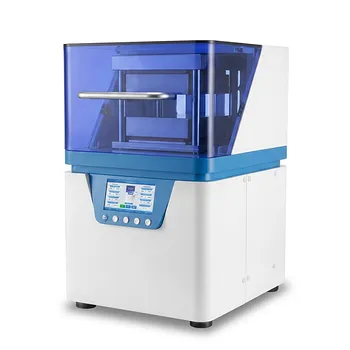
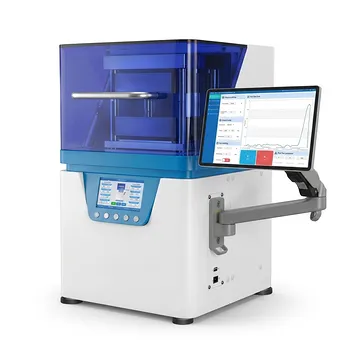
A laboratory hydraulic press is the workhorse of the modern laboratory, revered for its ability to transition seamlessly between delicate sample creation and heavy-duty material testing. By utilizing fluid mechanics to apply precise, multi-ton pressure, it enables applications ranging from spectroscopy pellet generation to the evaluation of composite material durability.
The press's versatility stems from its ability to deliver uniform, high-tonnage pressure on demand. This allows it to serve dual roles: preparing homogeneous samples for chemical analysis (like FTIR and XRF) and physically testing the mechanical limits of new materials.
The Mechanics of Versatility
Pascal’s Law in Action
The fundamental versatility of the press relies on force magnification. By pressurizing fluid via a pump, a small force applied to a narrow channel is transferred to a larger piston.
Multi-Ton Capability
This application of Pascal's law allows the machine to generate massive compressive forces. Despite the high power, the pressure remains controllable and precise, which is critical for sensitive laboratory work.
Primary Applications in Spectroscopy
Creating Homogeneous Samples
In chemical analysis, the press is indispensable for creating samples with uniform consistency. It compresses powders into thin films or pellets, such as KBr pellets for FTIR (Fourier Transform Infrared Spectroscopy) or sample pellets for XRF (X-ray Fluorescence).
Enhancing Optical Quality
For advanced applications like Time-of-Flight Positron Emission Tomography (ToF-PET), the press forms high-density bulk composite scintillators. The uniform pressure eliminates micro-bubbles, enhancing the material's packing density and optical clarity for better detection results.
Material Engineering and Testing
Durability and Strength Evaluation
Beyond creation, the press is a testing instrument. It is widely used for tension testing, where materials are pulled apart or compressed to evaluate their structural integrity and yield strength.
Controlling Porosity and Density
The press allows researchers to manipulate the physical properties of a material. By providing uniform pressure distribution during powder molding, the press can regulate a material's porosity, which directly influences its thermal performance and heat exchange capabilities.
Advanced Prototyping
The tool's adaptability extends to R&D sectors, including pharmaceutical research and microfluidic device prototyping. It is also used to compress nanomaterials into specific shapes for industrial wastewater treatment, preventing the loss of adsorbent materials.
Understanding the Operational Trade-offs
Dependence on Precision Molds
While the press generates the force, the output is only as good as the mold used. Achieving specific shapes, such as spherical or cylindrical pellets with structural integrity, requires high-quality precision molds.
The Necessity of Parameter Control
The power of a hydraulic press must be strictly managed. For applications like porous heat exchange matrices, failing to maintain exact pressure regulation can result in incorrect density distribution, compromising the material's intended thermal performance.
Making the Right Choice for Your Goal
To maximize the utility of a hydraulic press, align its capabilities with your specific research objectives:
- If your primary focus is Spectroscopic Analysis: Prioritize a press known for extreme consistency to ensure your KBr or XRF pellets are homogeneous and free of optical defects.
- If your primary focus is Material Engineering: Focus on a system that offers granular control over pressure settings to precisely dictate the density and porosity of your composite materials.
A hydraulic press is not just a crushing tool; it is a precision instrument for shaping the physical reality of your samples.
Summary Table:
| Application Category | Specific Use Case | Key Benefit |
|---|---|---|
| Spectroscopy | KBr & XRF Pellet Making | Homogeneous samples & high optical clarity |
| Material Engineering | Tension & Durability Testing | Precise evaluation of structural integrity |
| Powder Metallurgy | Controlled Porosity Molding | Regulated density for thermal performance |
| Advanced R&D | Nanomaterial Compression | Efficient prototyping & wastewater treatment |
Elevate Your Research with KINTEK Precision Pressing Solutions
Unlock the full potential of your lab with KINTEK, your specialist in comprehensive laboratory pressing solutions. Whether you are conducting cutting-edge battery research or precise spectroscopic analysis, our diverse range of equipment—including manual, automatic, heated, multifunctional, and glovebox-compatible models, as well as cold and warm isostatic presses—is designed to meet your exact specifications.
Why choose KINTEK?
- Unmatched Versatility: Systems tailored for both delicate sample creation and heavy-duty material testing.
- Precision Control: Achieve the exact density and porosity required for your advanced materials.
- Expert Support: Benefit from high-quality precision molds and reliable multi-ton force magnification technology.
Contact KINTEK Today to Find Your Perfect Pressing Solution!
Related Products
- Automatic Hydraulic Hot Press with Large Plate and Precision Temperature Control for Advanced Material Sample Preparation and Industrial Research
- Automatic Hydraulic Heat Press Machine with Multi Stage Programmable Control and Integrated Water Cooling Plate Size 180x180mm
- Automatic Heated Hydraulic Lab Press with Programmable Touch Screen Controls and Precision Temperature Regulation
- Manual Heated Hydraulic Lab Press with Integrated Hot Plates Hydraulic Press Machine
- Automatic High Temperature Heated Hydraulic Press Machine with Heated Plates for Lab
People Also Ask
- What are the specific features and applications of hydraulic hot press machines? Precision Solutions for Modern Labs
- How does an automatic hydraulic press operate? Achieve Precision and Consistency in Lab Pelleting
- What are the advantages and common applications of an automatic hydraulic press? Elevate Your Lab's Precision
- What is the technical significance of setting a precise dwell time? Achieve Peak Material Density and Stability
- When is an automatic hydraulic press more suitable than a manual press? Scale Your Lab with Precision & Speed