
The primary reason for using a hydraulic press in all-solid-state battery fabrication is to overcome the physical limitations of solid materials by forcing them into intimate contact. Unlike liquid electrolytes that naturally wet electrode surfaces, solid electrolytes require high-intensity, uniform mechanical pressure to eliminate microscopic voids and create a continuous, dense pathway for ion transport.
Core Insight: In solid-state battery engineering, "contact" is not inherent; it must be manufactured. The hydraulic press serves as the critical enabler for densification, transforming loose powders into a unified electrochemical system. Without this compaction, interfacial impedance remains too high for efficient battery operation.
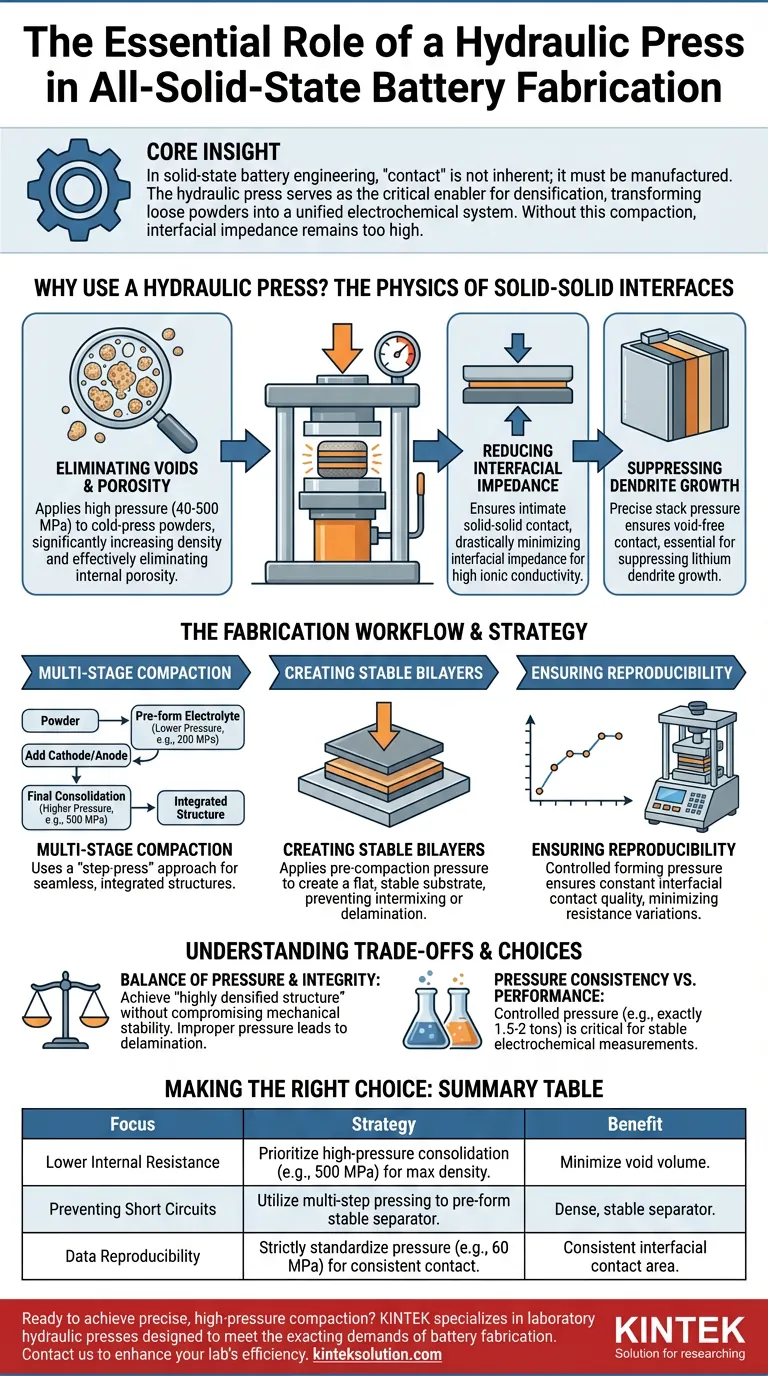
The Physics of Solid-Solid Interfaces
Eliminating Voids and Porosity
The fundamental challenge in solid-state batteries is the presence of air gaps between particles.
A hydraulic press is used to apply high pressure (often ranging from 40 to 250 MPa, or up to 500 MPa for final consolidation) to cold-press powdered materials. This process significantly increases the density of cathode and electrolyte pellets, effectively eliminating internal porosity.
Reducing Interfacial Impedance
Performance is dictated by how easily ions can move between layers.
By squashing the materials together, the press ensures intimate solid-solid contact between the active materials (like sulfur or lithium) and the solid electrolyte. This physical proximity drastically minimizes interfacial impedance (resistance), which is a prerequisite for high ionic conductivity and efficient electrochemical performance.
Suppressing Dendrite Growth
Mechanical pressure plays a role in safety and longevity.
Applying precise external stack pressure ensures void-free contact at the lithium metal electrode interface. This systematic application of pressure is essential for investigating and achieving the suppression of lithium dendrite growth, a common failure mode in high-energy batteries.
The Fabrication Workflow
Multi-Stage Compaction
Fabrication is rarely a single-step process; it requires distinct pressure strategies.
Researchers typically use a "step-press" approach. For example, a lower pressure (e.g., 200 MPa) might be used to pre-form the electrolyte powder into a separator. Subsequently, a significantly higher pressure (e.g., 500 MPa) is applied to consolidate the cathode and anode onto this layer, creating a seamless, integrated structure.
Creating Stable Bilayers
Layer integrity is crucial during assembly.
When creating bilayer structures, such as a composite cathode on a solid electrolyte, the press applies pre-compaction pressure to the first layer. This creates a flat, mechanically stable substrate, preventing intermixing or delamination when the second layer is added or during subsequent sintering.
Ensuring Reproducibility
Scientific validity depends on consistent manufacturing variables.
A laboratory hydraulic press allows for the control of forming pressure, ensuring that the interfacial contact quality remains constant across different cells. This consistency minimizes variations in resistance, allowing researchers to generate reliable, repeatable data regarding cycling performance and material properties.
Understanding the Trade-offs
The Balance of Pressure and Integrity
While high pressure is necessary for conductivity, the application must be precise.
The goal is to achieve a "highly densified structure" without compromising the mechanical stability of the layers. If the interface is not formed correctly—specifically regarding flatness during pre-compaction—there is a risk of delamination or poor contact during subsequent processing steps (like high-temperature sintering).
Pressure Consistency vs. Performance
The relationship between pressure and performance is direct but sensitive.
Variations in applied pressure lead to variations in interfacial resistance. Therefore, the press is not just a tool for force, but for standardization. Without controlled pressure (e.g., maintaining exactly 1.5 to 2 tons), electrochemical measurements become unstable, making it impossible to accurately evaluate the intrinsic properties of the battery materials.
Making the Right Choice for Your Goal
To maximize the effectiveness of your fabrication process, align your pressing strategy with your specific objectives:
- If your primary focus is lowering internal resistance: Prioritize high-pressure consolidation (e.g., 500 MPa) to maximize pellet density and minimize void volume.
- If your primary focus is preventing short circuits: Utilize a multi-step pressing process to pre-form a dense, mechanically stable separator layer before adding electrodes.
- If your primary focus is data reproducibility: strictly standardize the applied pressure (e.g., 60 MPa for cell stacks) to ensure consistent interfacial contact area across all test cells.
The hydraulic press acts as the bridge between theoretical material properties and realized electrochemical performance by enforcing the physical continuity required for ion flow.
Summary Table:
| Function | Benefit | Typical Pressure Range |
|---|---|---|
| Eliminate Voids & Porosity | Creates dense, continuous ion pathways | 40 - 500 MPa |
| Reduce Interfacial Impedance | Enables efficient ion transport & performance | Varies by layer (e.g., 60 MPa for stacks) |
| Suppress Dendrite Growth | Enhances safety and battery longevity | Application-specific |
| Ensure Reproducibility | Provides consistent, reliable data | Precisely controlled (e.g., 1.5-2 tons) |
Ready to achieve precise, high-pressure compaction for your solid-state battery research?
KINTEK specializes in laboratory hydraulic presses, including automatic and isostatic models, designed to meet the exacting demands of battery fabrication. Our presses deliver the uniform, high-intensity pressure required to eliminate voids, reduce interfacial resistance, and ensure reproducible results.
Contact us today using the form below to discuss how our solutions can enhance your lab's efficiency and accelerate your development cycle. Let's build the future of energy storage, together.
Visual Guide
Related Products
- Automatic High Temperature Heated Hydraulic Press Machine with Heated Plates for Lab
- Manual Heated Hydraulic Lab Press with Integrated Hot Plates Hydraulic Press Machine
- Heated Hydraulic Press Machine with Heated Plates for Vacuum Box Laboratory Hot Press
- Laboratory Hydraulic Press 2T Lab Pellet Press for KBR FTIR
- Laboratory Hydraulic Press Lab Pellet Press Machine for Glove Box
People Also Ask
- Function of a Laboratory Hydraulic Press with Heated Platens in SSE? Enhance Battery Density & Conductivity
- What are the requirements for electrode pressing with high-viscosity ionic liquids like EMIM TFSI? Optimize Performance
- How does a laboratory heated hydraulic press facilitate PBN sample prep for WAXS? Achieve Precise X-Ray Scattering
- What are the industrial applications of heated hydraulic presses? Master Heat & Force for Precision Manufacturing
- Why is a laboratory hydraulic press with heating plates required for PLA/TEC films? Achieve Precise Sample Integrity



















