
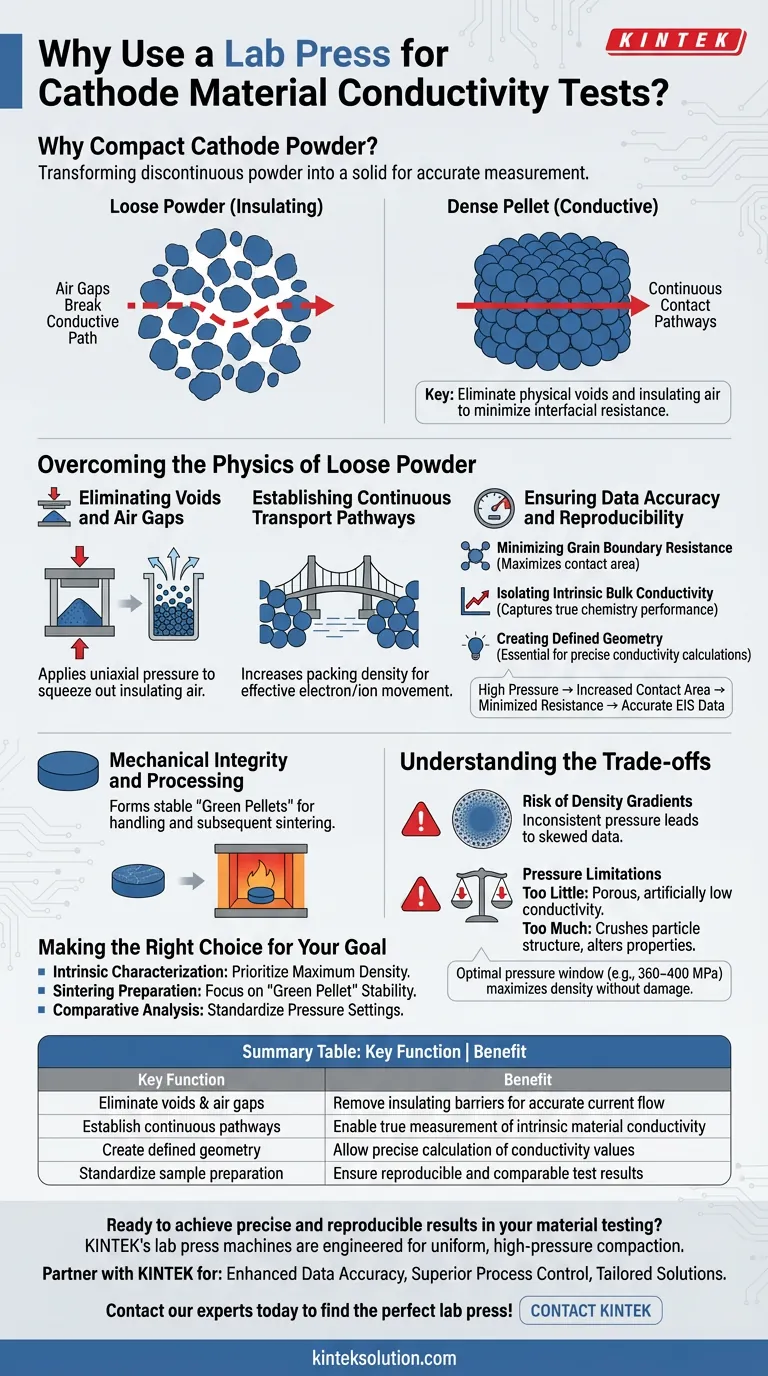
The primary function of a lab press in this context is to eliminate physical voids and insulating air gaps between loose powder particles. By compacting the cathode material into a high-density pellet, you transform a discontinuous powder into a solid geometric form with continuous contact pathways. This is essential to minimize interfacial resistance, allowing for the accurate measurement of the material's intrinsic electrical properties rather than the resistance of the air or poor contacts between grains.
Compacting powder into a dense pellet removes the variable of physical separation. It ensures that subsequent Electrochemical Impedance Spectroscopy (EIS) readings reflect the material's true bulk conductivity, rather than the high resistance caused by poor particle-to-particle contact.
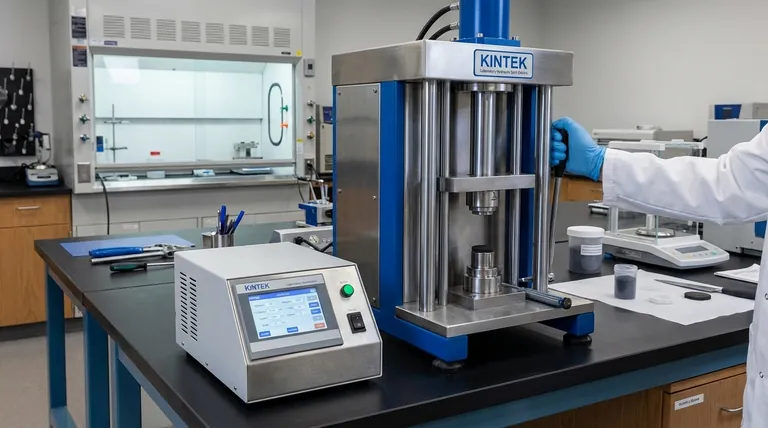
Overcoming the Physics of Loose Powder
To understand why a press is necessary, you must first understand the electrical limitations of a loose powder.
Eliminating Voids and Air Gaps
Loose cathode powder consists largely of empty space (voids) filled with air. Air is an electrical insulator.
If you attempt to test loose powder, the electrical current cannot travel effectively because the conductive path is broken by these air gaps.
The lab press applies uniaxial pressure (often hundreds of megapascals) to force particles together, physically squeezing out the air and closing the voids.
Establishing Continuous Transport Pathways
Conductivity relies on the movement of electrons (in cathodes) or ions (in electrolytes). This movement requires a continuous "bridge" of material.
Compaction increases the packing density of the material, often achieving high relative densities (e.g., above 80%).
This densification creates effective, continuous pathways for transport, ensuring the test current can actually traverse the sample.
Ensuring Data Accuracy and Reproducibility
The deep need behind using a press is not just to make a solid shape, but to ensure the data you collect is scientifically valid.
Minimizing Grain Boundary Resistance
Even when particles touch, the connection point can be very small, creating a "bottleneck" for current. This is known as contact or grain boundary resistance.
High-pressure compaction significantly increases the contact area between individual particles.
By maximizing this contact area, you minimize the interference of grain boundary resistance, preventing it from dominating the measurement.
Isolating Intrinsic Bulk Conductivity
Your goal is to measure the properties of the material, not the properties of how the material acts when it is fluffy.
A highly densified pellet minimizes porosity, ensuring the measurement current travels through the bulk of the material.
This allows analytical techniques like Electrochemical Impedance Spectroscopy (EIS) to capture the "intrinsic" conductivity—the true performance capability of the chemistry.
Creating Defined Geometry
Conductivity calculations require precise inputs regarding the sample's dimensions, specifically area and thickness.
A lab press creates a pellet with a geometrically uniform shape and a measurable thickness.
This geometric stability is necessary to mathematically convert raw resistance data into accurate conductivity values.
Mechanical Integrity and Processing
Beyond immediate testing, the press serves a structural role in the experimental workflow.
Forming Stable "Green Pellets"
For some workflows, the pressed pellet is a precursor to high-temperature sintering. This initial pressed form is called a "green pellet."
Applying precise pressure creates a pellet with sufficient mechanical strength to be handled without crumbling.
A uniform green pellet helps prevent defects like cracking or uneven shrinkage during subsequent heat treatments, which is critical for final ceramic electrolytes or dense cathodes.
Understanding the Trade-offs
While pressing is essential, it introduces variables that must be managed to maintain objectivity.
The Risk of Density Gradients
If the pressure is not applied uniformly, the pellet may be denser in the center than at the edges.
This density gradient can lead to inconsistent conductivity readings across the sample, skewing your data.
Pressure Limitations
Applying too little pressure results in a porous pellet that yields artificially low conductivity numbers due to remaining voids.
Conversely, excessive pressure (beyond the material's limit) can sometimes crush the particle structure itself, altering the material's crystallographic properties.
You must identify the optimal pressure window—such as the 360–400 MPa range noted for certain electrolytes—to maximize density without damaging the sample.
Making the Right Choice for Your Goal
The way you utilize the lab press should depend on your specific analytical objective.
- If your primary focus is Intrinsic Characterization: Prioritize maximizing density to eliminate all porosity, ensuring the data reflects the chemistry and not the sample preparation.
- If your primary focus is Sintering Preparation: Focus on creating a "green pellet" with uniform density and just enough mechanical strength to survive the furnace without cracking.
- If your primary focus is Comparative Analysis: Standardize your pressure settings (e.g., always 360 MPa) across all samples to ensure that differences in data are due to material changes, not pressure variations.
Ultimately, the lab press is not just a forming tool; it is a standardization device that reduces experimental noise to reveal the true signal of your material.
Summary Table:
| Key Function | Benefit |
|---|---|
| Eliminate voids & air gaps | Remove insulating barriers for accurate current flow |
| Establish continuous pathways | Enable true measurement of intrinsic material conductivity |
| Create defined geometry | Allow precise calculation of conductivity values |
| Standardize sample preparation | Ensure reproducible and comparable test results |
Ready to achieve precise and reproducible results in your material testing?
KINTEK's lab press machines—including automatic, isostatic, and heated models—are engineered to deliver the uniform, high-pressure compaction required for accurate electrical conductivity tests on cathode materials.
By partnering with KINTEK, you benefit from:
- Enhanced Data Accuracy: Eliminate experimental noise caused by air gaps and poor particle contact.
- Superior Process Control: Achieve consistent pellet density and geometry for reliable, repeatable outcomes.
- Tailored Solutions: Our presses are designed to meet the specific demands of laboratory research and development.
Don't let sample preparation variability compromise your findings. Contact our experts today to find the perfect lab press for your laboratory's needs!
Visual Guide
Related Products
- 24T 30T 60T Heated Hydraulic Lab Press Machine with Hot Plates for Laboratory
- Manual Heated Hydraulic Lab Press with Integrated Hot Plates Hydraulic Press Machine
- Laboratory Hydraulic Pellet Press for XRF KBR FTIR Lab Press
- Lab Infrared Press Mold for Laboratory Applications
- Laboratory Hydraulic Press Lab Pellet Press Machine for Glove Box
People Also Ask
- Function of a Laboratory Hydraulic Press with Heated Platens in SSE? Enhance Battery Density & Conductivity
- Why is a laboratory hydraulic press with heating plates required for PLA/TEC films? Achieve Precise Sample Integrity
- What role does a laboratory heated hydraulic press play in LTCC? Essential for High-Density Ceramic Lamination
- What is the primary function of a laboratory heated hydraulic press? Mastering Thermoplastic Carbon Fiber Composites
- What is the critical role of a laboratory heated hydraulic press? Mastering PVC Sample Prep for Testing



















