
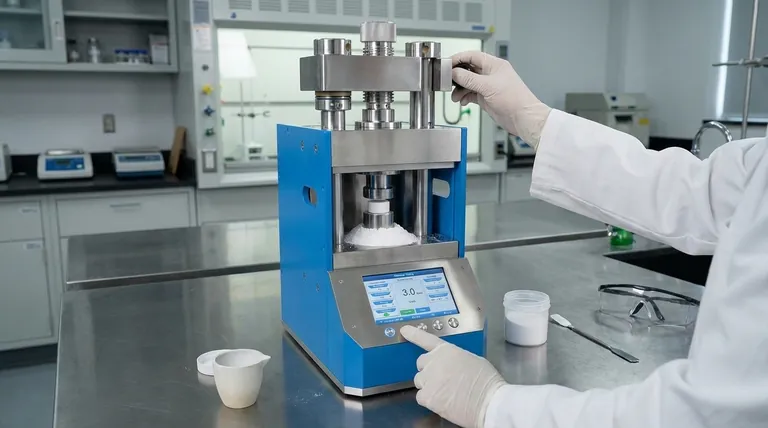
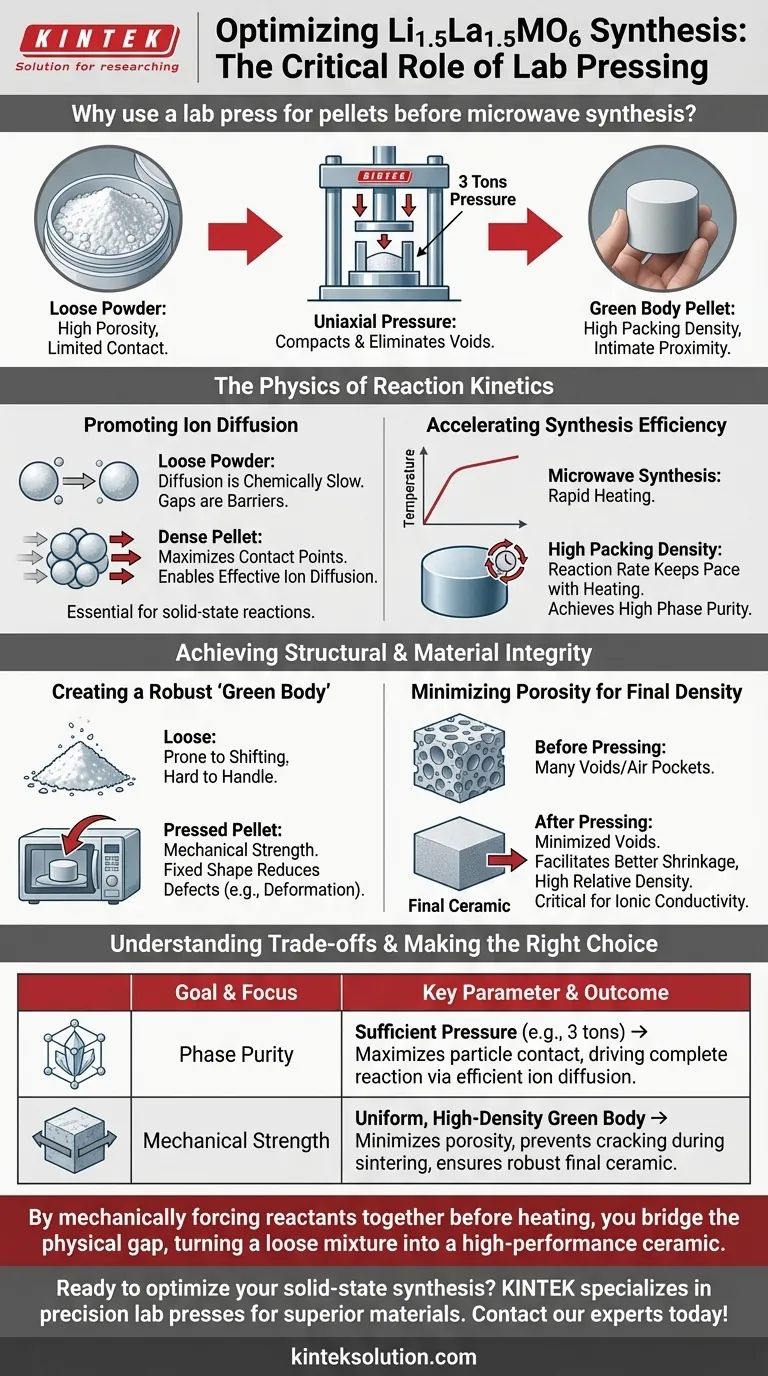
A lab press is utilized to compact Li1.5La1.5MO6 powder into dense pellets primarily to maximize particle-to-particle contact prior to heating. By applying uniaxial pressure (often around 3 tons), you eliminate inter-particle voids and force reactant particles into intimate proximity. This physical closeness is the fundamental requirement for enabling effective ion diffusion and accelerating reaction kinetics during the rapid heating cycles of microwave synthesis.
Solid-state reactions rely heavily on diffusion, which is chemically slow in loose powders. Pelleting creates a "green body" with high packing density, ensuring that when microwave energy triggers the reaction, ions can move efficiently between particles to form a pure, high-quality perovskite structure.
The Physics of Solid-State Reaction Kinetics
Promoting Ion Diffusion
In solid-state synthesis, chemicals do not mix freely as they would in a liquid solution; they remain rigid. For a reaction to occur, ions must physically travel from one particle to another.
The lab press compresses the powder to significantly increase the surface area contact points between these reactants. Without this mechanical force, the gaps between particles would act as barriers, halting the diffusion necessary to form the Li1.5La1.5MO6 structure.
Accelerating Synthesis Efficiency
Microwave synthesis is a rapid process compared to conventional heating. Because the temperature rises quickly, the material must be primed for an equally fast reaction.
The high packing density achieved by pressing ensures the solid-state reaction rate can keep pace with the microwave heating. This synchronization is essential for achieving high phase purity and synthesis efficiency in a short timeframe.
Achieving Structural and Material Integrity
Creating a Robust "Green Body"
Loose powders are difficult to handle and prone to shifting during the violent thermal ramp of microwave sintering.
Pressing creates a self-supporting "green pellet" with sufficient mechanical strength to be handled and loaded into the microwave crucible without crumbling. This fixed shape reduces the risk of macroscopic defects, such as deformation, during the synthesis process.
Minimizing Porosity for Final Density
The quality of the final ceramic is determined by the density of the starting pellet.
By applying precise pressure, the press minimizes voids (air pockets) within the material. A denser starting pellet facilitates better shrinkage during sintering, leading to a final product with low porosity and high relative density. This is critical for maximizing ionic conductivity in the final perovskite material.
Understanding the Trade-offs
The Importance of Uniformity
While pressure is vital, it must be applied uniformly to avoid creating density gradients within the pellet.
If the pressure is uneven, the pellet may develop internal stresses. According to processing principles, this can lead to cracking or warping during the high-temperature sintering stage as different parts of the pellet shrink at different rates.
Balancing Density and Defect Elimination
Ideally, the goal is a perfectly dense pellet, but the pressure must be optimized for the specific material fragility.
For brittle materials, applying excessive pressure without a binder could introduce micro-cracks before sintering begins. Conversely, insufficient pressure leaves too many pores, resulting in a weak ionic conduction pathway and poor electrochemical performance in the final application.
Making the Right Choice for Your Goal
To optimize your Li1.5La1.5MO6 synthesis, align your pressing parameters with your specific material requirements:
- If your primary focus is Phase Purity: Ensure sufficient pressure (e.g., 3 tons) to maximize particle contact points, which drives the diffusion required for a complete chemical reaction.
- If your primary focus is Final Mechanical Strength: Prioritize achieving a uniform, high-density green body to minimize porosity and preventing cracking during the sintering shrinkage phase.
By mechanically forcing reactants together before heating, you bridge the physical gap that usually limits solid-state chemistry, turning a loose mixture into a high-performance ceramic.
Summary Table:
| Goal | Key Pressing Parameter | Outcome in Microwave Synthesis |
|---|---|---|
| Phase Purity | Sufficient Pressure (e.g., 3 tons) | Maximizes particle contact points, driving complete chemical reaction via efficient ion diffusion. |
| Mechanical Strength | Uniform, High-Density Green Body | Minimizes porosity, prevents cracking during sintering, and ensures a robust final ceramic. |
Ready to optimize your solid-state synthesis of advanced materials like Li1.5La1.5MO6?
KINTEK specializes in precision lab press machines (including automatic, isostatic, and heated lab presses) designed to create the uniform, high-density pellets essential for successful microwave synthesis. Our equipment helps researchers like you achieve superior phase purity and mechanical strength in your final ceramics.
Contact our experts today to find the perfect lab press for your laboratory's specific needs and unlock higher efficiency in your material synthesis.
Visual Guide
Related Products
- XRF KBR Steel Ring Lab Powder Pellet Pressing Mold for FTIR
- XRF KBR Plastic Ring Lab Powder Pellet Pressing Mold for FTIR
- Lab XRF Boric Acid Powder Pellet Pressing Mold for Laboratory Use
- Manual Laboratory Hydraulic Pellet Press Lab Hydraulic Press
- Manual Cold Isostatic Pressing CIP Machine Pellet Press
People Also Ask
- What considerations are important regarding the die size of an XRF pellet press? Optimize for Your XRF Spectrometer and Sample
- Why are pellets used in XRF analysis, and what is their limitation? Boost Accuracy and Speed in Your Lab
- What is the general process for preparing a sample pellet for XRF? Master Consistency for Accurate Analysis
- What are the differences between manual and automatic XRF pellet presses? Choose the Right Press for Your Lab's Needs
- What are the different types of XRF pellet preparation methods available? Manual, Hydraulic, and Automated Presses Explained
















