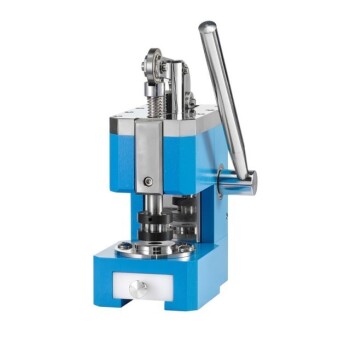
Laboratory-grade grinding and milling is essential for standardization. This mechanical process transforms dried whole insects into a uniform coarse powder, serving as a critical bridge between raw drying and final application. By altering the physical state of the insects, this equipment ensures the material is prepared for effective disinfection, accurate analysis, and seamless integration into feed products.
The conversion of whole insects into powder maximizes surface area, which is the prerequisite for uniform heat conduction during disinfection and essential for achieving homogeneity in feed mixing and nutritional analysis.
Optimizing Physical Properties
Creating a Uniform Coarse Powder
The immediate function of the machine is to reduce variable whole flies into a consistent particulate form. This eliminates the physical inconsistencies inherent in whole dried insects.
Maximizing Surface Area
Grinding significantly increases the total surface area of the biomass. This physical alteration is the fundamental enabler for all subsequent processing efficiencies.
Impact on Downstream Processing
Improving Heat Conduction
The increased surface area allows for superior heat transfer dynamics. When the material undergoes subsequent disinfection, heat can penetrate the powder more evenly than it would through whole insects. This ensures that sterilization temperatures are reached consistently throughout the batch.
Ensuring Mixing Homogeneity
For the end product to be commercially viable, it must be consistent. The coarse powder form ensures high homogeneity when mixed with other feed ingredients, preventing separation and ensuring a balanced diet in the final feed formulation.
Facilitating Nutritional Analysis
Accurate quality control relies on representative sampling. A milled, homogeneous powder allows for precise nutritional analysis, ensuring that any sample taken is truly representative of the entire batch's nutrient profile.
Operational Trade-offs
Equipment Precision vs. Cost
Utilizing laboratory-grade equipment implies a higher initial investment compared to standard industrial grinders. However, this cost is a trade-off for the precision required to achieve specific particle sizes necessary for consistent heat transfer and analysis.
Processing Steps vs. Product Quality
Adding a milling stage increases the total processing time and complexity. While this may seem like a bottleneck, skipping this step compromises the efficacy of the disinfection process and the reliability of nutritional data.
Making the Right Choice for Your Goals
To determine the specifications for your milling equipment, consider your primary outcome:
- If your primary focus is pathogen control: Prioritize milling consistency to maximize surface area, as this directly correlates to the uniformity of heat conduction during disinfection.
- If your primary focus is feed formulation: Focus on the machine's ability to produce a homogeneous mix, ensuring the insect protein integrates seamlessly with other ingredients.
Precision in the grinding phase is the hidden driver of safety and consistency in insect protein production.
Summary Table:
| Key Benefit | Impact on Insect Processing | Importance Level |
|---|---|---|
| Increased Surface Area | Enables rapid and uniform heat conduction for sterilization | Critical |
| Standardization | Converts inconsistent whole insects into a uniform coarse powder | Essential |
| Mixing Homogeneity | Prevents separation and ensures balanced nutrient distribution in feed | High |
| Analytical Accuracy | Provides representative samples for precise nutritional profiling | High |
| Pathogen Control | Facilitates consistent heat penetration during disinfection | Vital |
Elevate Your Insect Protein Quality with KINTEK Precision
Standardization is the cornerstone of reliable laboratory research and feed production. KINTEK specializes in comprehensive laboratory pressing and grinding solutions designed to meet the rigorous demands of material preparation. Whether you are conducting battery research or optimizing insect protein processing, our range of manual, automatic, heated, and multifunctional models—including specialized cold and warm isostatic presses—ensures your samples achieve the homogeneity required for accurate analysis and safety.
Ready to optimize your lab’s efficiency and product consistency? Contact KINTEK today to find the perfect solution for your application.
References
- Kortnee Van Nest, Phillip Shults. Assessing the feasibility, safety, and nutritional quality of using wild-caught pest flies in animal feed. DOI: 10.1093/jee/toad239
This article is also based on technical information from Kintek Solution Knowledge Base .
Related Products
- Laboratory Hydraulic Press Lab Pellet Press Machine for Glove Box
- Automatic Heated Hydraulic Press Machine with Heated Plates for Laboratory
- Laboratory Split Manual Heated Hydraulic Press Machine with Hot Plates
- 24T 30T 60T Heated Hydraulic Lab Press Machine with Hot Plates for Laboratory
- Lab Round Bidirectional Press Mold
People Also Ask
- How does a laboratory hydraulic press contribute to the preparation of Li3-3xScxSb samples? Optimize Ionic Conductivity
- What is the function of a laboratory hydraulic press in FT-IR of curcumin-coated MWCNTs? Achieve Optical Clarity.
- Why is a laboratory hydraulic press required for compression molding boron-siloxane? Solve High-Loading Density Challenges
- What role does a laboratory hydraulic press play in reaction pellets? Optimizing Lunar Soil and Metal Fuel Density
- What role does a laboratory hydraulic press play in the preparation of piezoelectric ceramic discs for DC-PG? | KINTEK