
A laboratory-grade hydraulic hot press is essential for PVDF separator fabrication because it provides the simultaneous, precise control of heat (140-185°C) and pressure (2 tons) required to engineer the film’s microstructure. Without this equipment, it is impossible to transform a raw PVDF film into a uniform, defect-free component capable of withstanding the internal environment of a battery.
Core Insight: The hydraulic hot press is not merely a shaping tool; it is a microstructural modification device. Its primary function is to eliminate voids and bond polymer particles through specific thermal and mechanical loads, directly determining the separator's porosity, thickness, and ultimate reliability.
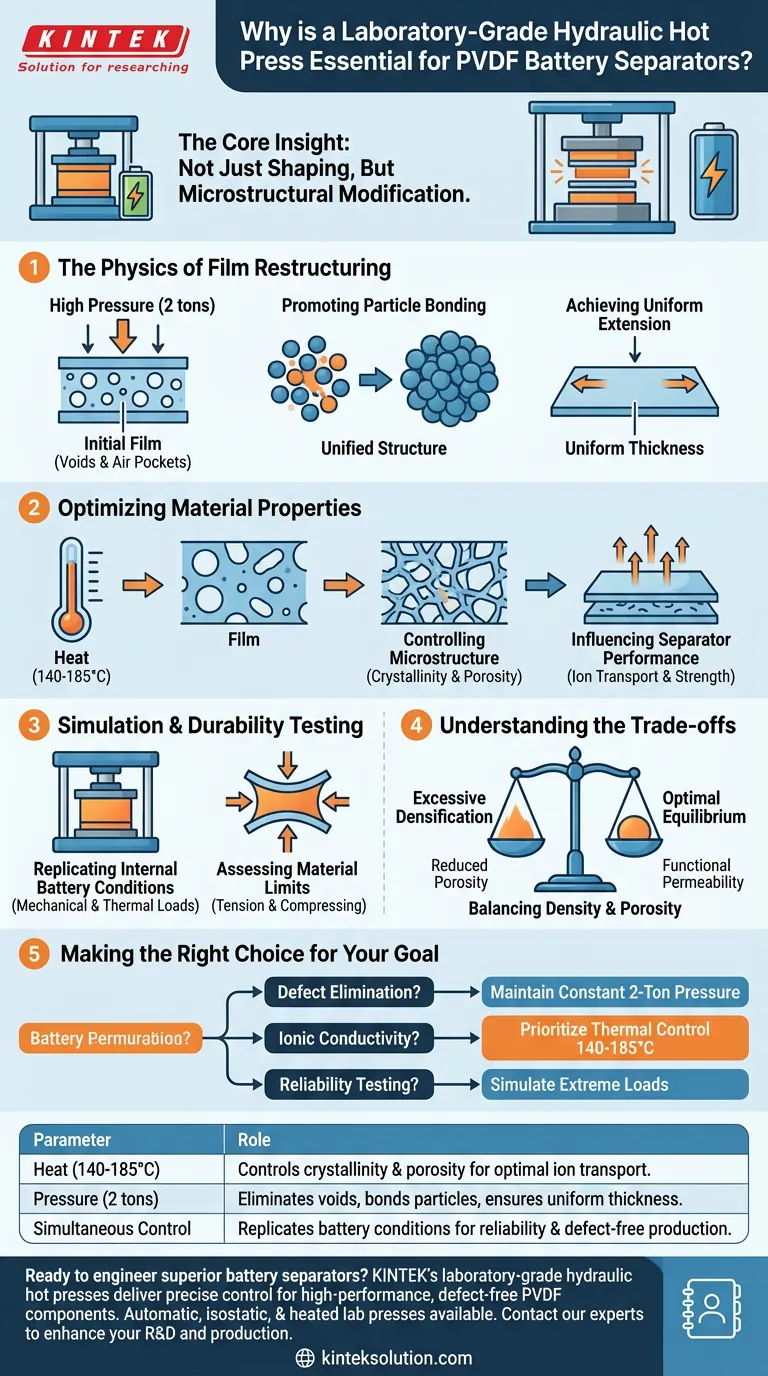
The Physics of Film Restructuring
The Necessity of High Pressure
The application of 2 tons of constant pressure is a critical threshold for physical restructuring. This force is required to mechanically eliminate voids and air pockets present in the initial, unprocessed film.
Promoting Particle Bonding
Pressure alone is insufficient; it must be combined with material flow. The hydraulic press promotes intimate bonding between polymer particles, forcing them to coalesce into a unified structure rather than remaining as a loose aggregate.
Achieving Uniform Extension
As the PVDF softens or melts, the hydraulic pressure ensures the material extends uniformly across the mold. This prevents localized thinning or pooling, resulting in a uniform thickness that is vital for consistent battery performance.
Optimizing Material Properties
Controlling Microstructure
The hot press allows you to intentionally modify the film's internal architecture. By manipulating the temperature within the 140-185°C range, you can tune the material's crystallinity and porosity.
Influencing Separator Performance
These microstructural changes directly impact the separator's critical characteristics. A properly pressed film balances mechanical strength with the ability to facilitate ion transport, optimizing the battery's overall efficiency.
Simulation and Durability Testing
Replicating Internal Battery Conditions
A distinct advantage of the laboratory hot press is its ability to simulate real-world conditions. The pressure and temperature applied during fabrication mimic the mechanical and thermal loads found inside an operating battery.
Assessing Material Limits
Beyond fabrication, this equipment is used to test the strength and durability of materials under extreme conditions. It allows researchers to investigate how the PVDF separator will behave under tension and compression before it is ever installed in a cell.
Understanding the Trade-offs
The Risk of Improper Parameters
While the hot press enables optimization, the process is highly sensitive. The references highlight that parameters must be carefully controlled; a deviation in pressure or temperature can lead to defective microstructure.
Balancing Density and Porosity
The goal of applying pressure is to eliminate voids and densify the film for strength. However, excessive densification could theoretically reduce the porosity needed for ion transport. The operator must find the precise equilibrium where defects are removed without compromising the material's functional permeability.
Making the Right Choice for Your Goal
To leverage a hydraulic hot press effectively for PVDF separators, align your processing parameters with your specific engineering objectives:
- If your primary focus is Defect Elimination: Ensure your equipment can maintain a constant 2-ton pressure to fully evacuate voids and ensure particle bonding.
- If your primary focus is Ionic Conductivity: Prioritize precise thermal control between 140-185°C to optimize crystallinity and porosity structure.
- If your primary focus is Reliability Testing: Utilize the press to simulate extreme mechanical loads, verifying the separator's durability prior to cell assembly.
The hydraulic hot press is the bridge between a raw polymer and a functional, safety-critical battery component.
Summary Table:
| Parameter | Role in PVDF Separator Fabrication |
|---|---|
| Heat (140-185°C) | Controls crystallinity and porosity for optimal ion transport. |
| Pressure (2 tons) | Eliminates voids, bonds polymer particles, and ensures uniform thickness. |
| Simultaneous Control | Replicates internal battery conditions for reliability testing and defect-free production. |
Ready to engineer superior battery separators?
KINTEK's laboratory-grade hydraulic hot presses deliver the precise control of heat and pressure required to transform raw PVDF films into high-performance, defect-free components. Our automatic lab presses, isostatic presses, and heated lab presses are engineered to help you optimize microstructure, ensure uniform thickness, and validate separator durability.
Contact our experts today to discuss how our solutions can enhance your battery R&D and production.
Visual Guide
Related Products
- 24T 30T 60T Heated Hydraulic Lab Press Machine with Hot Plates for Laboratory
- Automatic Heated Hydraulic Press Machine with Hot Plates for Laboratory
- Heated Hydraulic Press Machine with Heated Plates for Vacuum Box Laboratory Hot Press
- Automatic High Temperature Heated Hydraulic Press Machine with Heated Plates for Lab
- Laboratory Split Manual Heated Hydraulic Press Machine with Hot Plates
People Also Ask
- Function of a Laboratory Hydraulic Press with Heated Platens in SSE? Enhance Battery Density & Conductivity
- Why is a laboratory hydraulic press with heating plates required for PLA/TEC films? Achieve Precise Sample Integrity
- What role does a laboratory heated hydraulic press play in LTCC? Essential for High-Density Ceramic Lamination
- What is the primary function of a laboratory heated hydraulic press? Mastering Thermoplastic Carbon Fiber Composites
- What is the critical role of a laboratory heated hydraulic press? Mastering PVC Sample Prep for Testing



















