
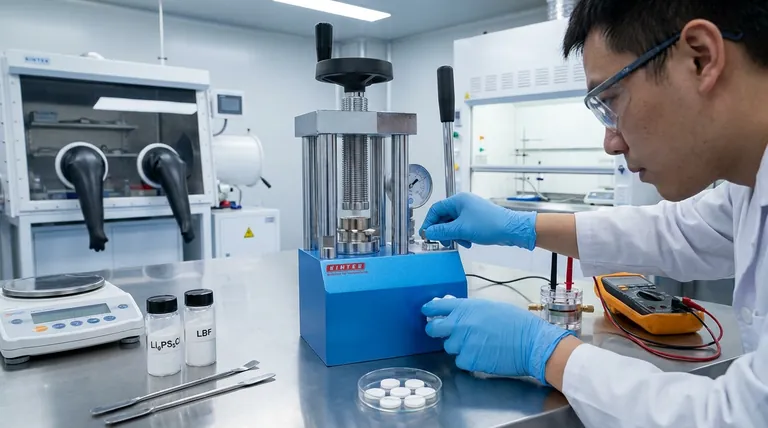
The fundamental necessity of a laboratory hydraulic press lies in its ability to transform loose chemical powders into a dense, functional component through the application of extreme force. For solid-state batteries, this equipment is not merely for shaping materials; it is the primary driver for creating the critical particle-to-particle contact required for lithium ions to move through the membrane.
Core Takeaway The viability of a solid-state battery depends entirely on density. A hydraulic press eliminates the microscopic voids between electrolyte particles that block ion flow, creating a continuous, robust pathway for conductivity while physically blocking the formation of battery-killing lithium dendrites.
The Physics of Densification
To understand why this equipment is essential, one must look at the microscopic structure of the electrolyte.
Eliminating Voids and Porosity
Solid-state electrolytes, such as sulfides (like Li₆PS₅Cl) or polymer-coated ceramics, begin as powders. In this state, the material is full of air gaps and voids. The hydraulic press utilizes cold-pressing to apply massive pressure (often exceeding 440 MPa), compacting the powder and significantly reducing internal porosity.
Establishing Ionic Pathways
Ions cannot travel through air; they require physical matter to conduct. By forcing particles into intimate contact, the press creates a continuous conduction network. This densification is the defining factor in maximizing the ionic conductivity of the final membrane.
Enhancing Mechanical Integrity
Beyond conductivity, the structural properties of the membrane determine the battery's lifespan and safety.
Suppressing Lithium Dendrites
A major failure mode in batteries is the growth of lithium dendrites—needle-like structures that puncture the electrolyte and cause short circuits. High-pressure fabrication creates a dense ceramic pellet with high mechanical strength. This density effectively inhibits the penetration and growth of these dendrites, securing the battery against failure.
Robust Pellet Formation
Materials like La0.95Ba0.05F2.95 (LBF) require specific pressures (e.g., 5 tons) to hold their shape. The press ensures the powder compacts into a mechanically stable pellet that can be handled and assembled without crumbling. This mechanical robustness is vital for the practical assembly of battery cells.
Ensuring Scientific Reproducibility
For researchers, the hydraulic press is a tool for standardization.
Controlling Interfacial Resistance
The press allows for the application of precise, uniform external stack pressure during testing. This ensures optimal contact between the lithium metal electrode and the electrolyte, minimizing interfacial impedance. Without this control, resistance would fluctuate wildly based on how well the layers are touching.
Eliminating Experimental Variables
Consistency is the bedrock of reliable data. By maintaining a consistent forming pressure, researchers ensure that the interfacial contact area remains constant across different samples. This allows for the acquisition of repeatable electrochemical data, such as impedance spectra, ensuring that observed changes are due to material properties, not assembly errors.
Understanding the Trade-offs
While essential, the use of hydraulic pressure introduces specific variables that must be managed to avoid common pitfalls.
The Risk of Pressure Gradients
Hydraulic presses typically apply uniaxial pressure (force from one direction). If the mold or powder distribution is uneven, this can lead to density gradients where some parts of the pellet are denser than others. Such inconsistencies can create weak points where dendrites may eventually penetrate.
Precision vs. Force
While these presses can exert massive force, precision is equally critical. Over-pressurizing can damage delicate mold setups or crush active material structures. The advantage of modern laboratory presses is their ability to fine-tune this force, but the operator must carefully calibrate pressure to the specific material limits (e.g., 480 MPa for sulfides) to avoid diminishing returns or damage.
Making the Right Choice for Your Goal
Selecting and utilizing a hydraulic press should be dictated by the specific requirements of your electrolyte material and research objectives.
- If your primary focus is High Ionic Conductivity: Prioritize a press capable of sustaining extremely high pressures (400+ MPa) to ensure maximum particle-to-particle contact and void elimination.
- If your primary focus is Data Reproducibility: Ensure your equipment offers fine-grained control and gauge precision to maintain identical forming pressures across every cell you assemble.
- If your primary focus is Dendrite Suppression: Focus on the uniformity of pressure application to create a homogenous, defect-free barrier that resists lithium penetration.
Ultimately, the hydraulic press acts as the bridge between theoretical material chemistry and a physically viable, high-performance battery cell.
Summary Table:
| Key Function | Benefit for Solid-State Batteries |
|---|---|
| Eliminates Voids & Porosity | Creates continuous pathways for high ionic conductivity. |
| Suppresses Lithium Dendrites | Enhances safety and lifespan by preventing short circuits. |
| Ensures Mechanical Integrity | Forms robust, handleable pellets for reliable cell assembly. |
| Provides Reproducible Data | Enables consistent, comparable results through precise pressure control. |
Ready to build superior solid-state batteries?
KINTEK's laboratory hydraulic presses are engineered to meet the precise demands of battery research and development. Our automatic lab presses, isostatic presses, and heated lab presses deliver the high pressure, uniformity, and control essential for creating dense, high-performance electrolyte membranes.
We help you:
- Achieve maximum ionic conductivity by eliminating microscopic voids.
- Enhance battery safety with dendrite-suppressing, homogenous membranes.
- Ensure reproducible and reliable experimental data.
Contact us today using the form below to discuss how our press solutions can power your innovation in next-generation energy storage.
Visual Guide

References
- Jaecheol Choi, Young-Gi Lee. Enhancing electrochemo-mechanical properties of graphite-silicon anode in all-solid-state batteries via solvent-induced polar interactions in nitrile binders. DOI: 10.1016/j.jechem.2025.02.012
This article is also based on technical information from Kintek Solution Knowledge Base .
Related Products
- Laboratory Hydraulic Press 2T Lab Pellet Press for KBR FTIR
- Automatic Laboratory Hydraulic Press for XRF and KBR Pellet Pressing
- Warm Isostatic Press for Solid State Battery Research Warm Isostatic Press
- Laboratory Hydraulic Pellet Press for XRF KBR FTIR Lab Press
- 24T 30T 60T Heated Hydraulic Lab Press Machine with Hot Plates for Laboratory
People Also Ask
- What is the role of a laboratory pressure machine and KBr in FTIR? Master Sample Preparation for Flame Retardants
- What is the role of a laboratory hydraulic press in high-loading NCM811 cathode prep for solid-state batteries?
- What role does a laboratory hydraulic press play in reaction pellets? Optimizing Lunar Soil and Metal Fuel Density
- Why is a laboratory hydraulic press necessary for sample preparation? Precise Pelleting for Spiro Heterocyclic Analysis
- What are the common uses of a laboratory hydraulic press? Precision Solutions for Materials Testing and R&D



















