
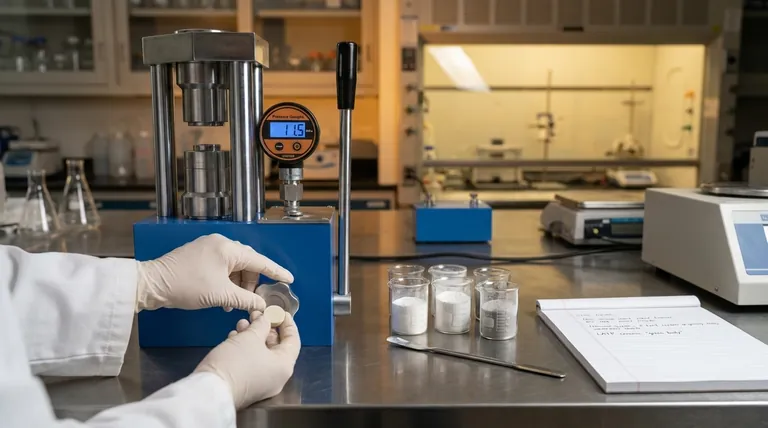
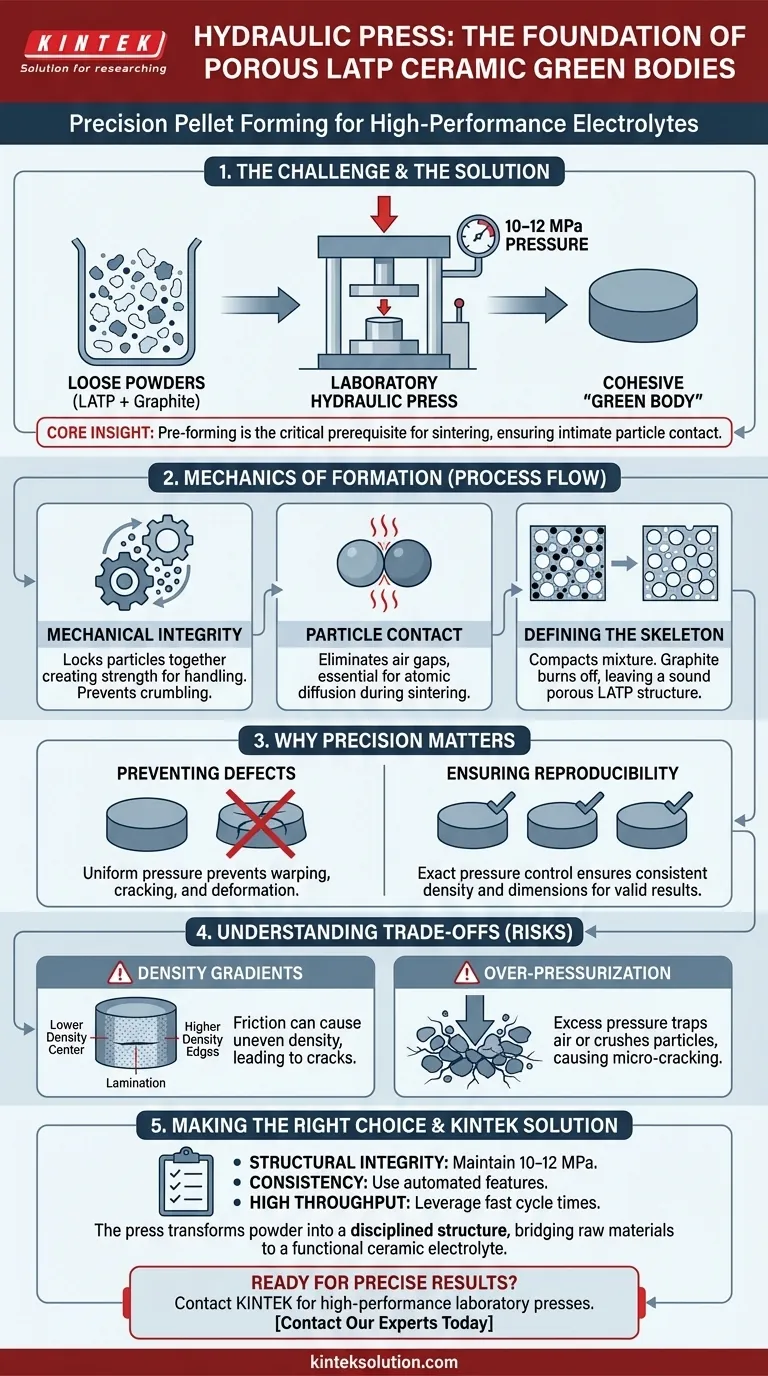
A laboratory hydraulic press acts as the foundational shaping tool used to consolidate loose LATP (Lithium Aluminum Titanium Phosphate) and graphite powders into a cohesive, solid form known as a "green body." By applying a precise, uniform pressure—typically in the range of 10 to 12 MPa for this specific application—the press ensures the material achieves the mechanical strength and geometric regularity necessary to survive handling and the subsequent high-temperature sintering process.
The Core Insight The hydraulic press does more than simply shape the powder; it forces the LATP and graphite particles into intimate contact. This "pre-forming" step is the critical prerequisite for sintering; without the high initial density provided by the press, the ceramic skeleton will fail to bond, leading to cracks, deformation, or structural collapse before the desired porous architecture is established.
The Mechanics of Green Body Formation
Establishing Mechanical Integrity
Loose ceramic powders lack the cohesion to hold a shape. The hydraulic press applies mechanical force to lock the particles together.
This creates a "green pellet" with sufficient mechanical strength to be moved, measured, and loaded into a furnace without crumbling.
Facilitating Particle Contact
For ceramics to sinter (densify and harden) correctly, the particles must be touching.
The press eliminates air gaps, forcing the LATP and graphite particles into close contact. This proximity is essential for the atomic diffusion that occurs during high-temperature sintering.
Defining the Ceramic Skeleton
In the preparation of porous LATP, a pore-forming agent (like graphite) is mixed with the ceramic powder.
The press compacts this mixture into a dense matrix. When the graphite burns off during heating, it leaves behind pores, but the LATP skeleton remains structurally sound because it was initially packed tightly by the press.
Why Precision Matters for LATP
Preventing Defects
Uniform pressure application is non-negotiable for high-performance electrolytes.
If the "green density" is inconsistent, the material will shrink unevenly during heating. This leads to warping, cracking, or deformation, rendering the final ceramic useless for ion conduction.
Ensuring Reproducibility
Laboratory research requires that every sample be comparable to the last.
Hydraulic presses allow for the exact control of pressure parameters. This ensures high reproducibility, meaning every pellet produced has the same density and dimensions, validating the results of your experiments.
Operational Advantages
High Force with Control
Hydraulic systems can generate immense force with minimal physical effort.
Despite this power, they offer granular control, allowing you to dial in the specific pressure (e.g., 12 MPa) required for LATP without over-compressing or crushing the particles.
Efficiency and Versatility
These presses are designed for the iterative nature of laboratory work.
They allow for rapid sample switching, making them cost-effective for batch production. They are also versatile enough to handle various die sizes and powder mixtures beyond just LATP.
Understanding the Trade-offs
While hydraulic presses are essential, they are not without limitations that can affect sample quality if ignored.
Density Gradients
In uniaxial pressing (pressure from top/bottom), friction against the die walls can cause uneven density.
The center of the pellet may be less dense than the edges. For very thick pellets, this density gradient can cause the sample to crack horizontally (lamination) during ejection or sintering.
Over-Pressurization Risks
More pressure is not always better.
Exceeding the optimal pressure range can trap compressed air within the matrix or crush the particles themselves. This can lead to micro-cracking in the green body that only becomes visible after sintering.
Making the Right Choice for Your Goal
To maximize the effectiveness of your hydraulic press in LATP preparation, consider your primary objective:
- If your primary focus is Structural Integrity: Ensure you maintain the specific pressure range (10–12 MPa) noted for LATP to balance particle contact with safe handling strength.
- If your primary focus is Consistency: Utilize the automated or gauge-controlled features of the press to ensure every single pellet in a batch receives the exact same dwell time and force.
- If your primary focus is High Throughput: Leverage the press's fast retraction and sample switching capabilities to process multiple green bodies efficiently without sacrificing safety.
Ultimately, the laboratory hydraulic press transforms undefined powder into a disciplined structure, serving as the critical bridge between raw materials and a functional, porous ceramic electrolyte.
Summary Table:
| Key Aspect | Benefit for LATP Pellet Forming |
|---|---|
| Mechanical Integrity | Creates a cohesive green body that can withstand handling before sintering. |
| Particle Contact | Forces LATP and graphite particles into intimate contact, essential for sintering. |
| Structural Definition | Defines the ceramic skeleton, enabling controlled porosity after graphite burnout. |
| Precision & Control | Applies specific pressures (e.g., 10-12 MPa) uniformly to prevent defects. |
| Reproducibility | Ensures consistent density and dimensions across all experimental samples. |
Ready to achieve precise and reproducible results in your ceramic research?
KINTEK specializes in high-performance laboratory press machines, including automatic, isostatic, and heated lab presses. Our equipment delivers the exact control and uniform pressure required for preparing flawless porous LATP green bodies and other advanced materials.
Contact our experts today to find the perfect press for your laboratory's needs and enhance your research efficiency.
Visual Guide
Related Products
- Automatic Laboratory Hydraulic Press Lab Pellet Press Machine
- Manual Laboratory Hydraulic Pellet Press Lab Hydraulic Press
- Automatic Laboratory Hydraulic Press for XRF and KBR Pellet Pressing
- Laboratory Hydraulic Press Lab Pellet Press Button Battery Press
- Laboratory Hydraulic Split Electric Lab Pellet Press
People Also Ask
- What is the primary purpose of manual lab hydraulic pellet presses? Achieve High-Precision Sample Preparation for Spectroscopy
- What is the primary purpose of a manual lab hydraulic pellet press? Ensure Accurate Sample Prep for XRF and FTIR
- What are the advantages of an automatic lab hydraulic press for Na-ion/Mg-ion battery development?
- What are the advantages of using an automatic laboratory hydraulic press? Enhance Precision in Sample Preparation
- What are the technical advantages of an automatic laboratory hydraulic press for biomimetic surfaces?



















