
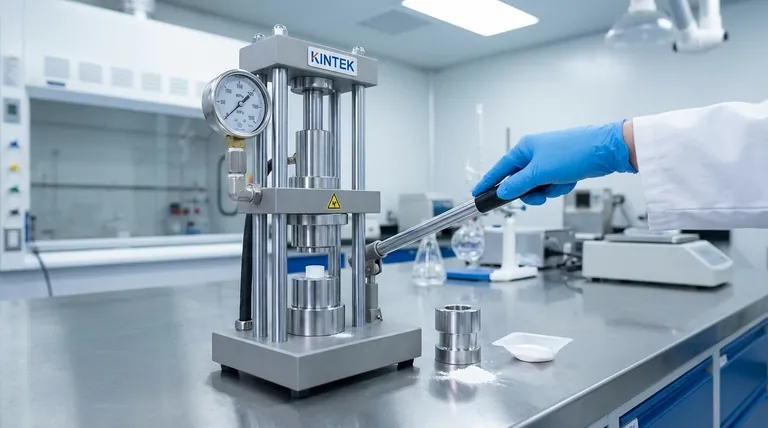
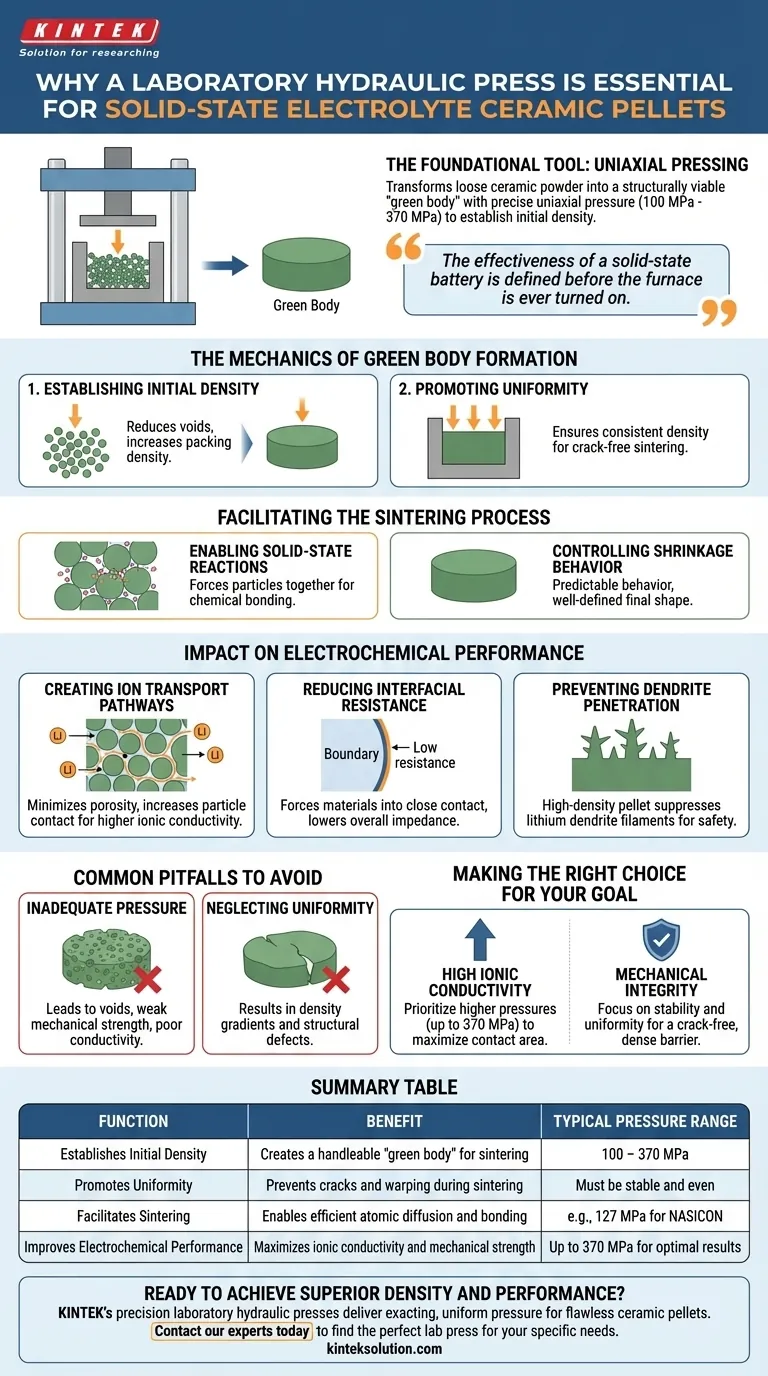
A laboratory hydraulic press serves as the foundational tool for transforming loose ceramic powder into a structurally viable "green body." By applying precise uniaxial pressure—typically ranging from 100 MPa to 370 MPa—the press mechanically interlocks powder particles to establish initial density. This step is not merely about shaping; it is a critical densification process that dictates the success of the subsequent sintering phase and the final electrochemical performance of the solid-state electrolyte.
The effectiveness of a solid-state battery is defined before the furnace is ever turned on. The hydraulic press maximizes particle-to-particle contact and minimizes void space in the cold stage, creating the essential microstructural conditions required for high ionic conductivity and mechanical resilience.
The Mechanics of Green Body Formation
Establishing Initial Density
The primary function of the hydraulic press is to compact loose electrolyte powder (such as LLZTO, LGPS, or NASICON) into a solid form known as a green pellet.
Without this compaction, the powder lacks the physical cohesion to be handled or processed further. The press reduces the volume of voids between particles, significantly increasing the packing density of the raw material.
Promoting Uniformity
Achieving a uniform density distribution is a prerequisite for a crack-free final product.
The hydraulic press must apply pressure evenly across the die. If the "green body" has inconsistent density, it will shrink unevenly during the high-temperature sintering process, leading to warping or structural failure.
Facilitating the Sintering Process
Enabling Solid-State Reactions
Sintering relies on atomic diffusion between particles. For this to occur efficiently, particles must be in intimate contact.
By applying high pressure (e.g., 127 MPa for NASICON), the press forces particles together, reducing the distance atoms must diffuse. This facilitates the solid-state reactions required to chemically bond the ceramic particles into a unified structure.
Controlling Shrinkage Behavior
A denser green body leads to more predictable behavior during heat treatment.
When the initial packing density is high, the relative shrinkage required to reach full density during sintering is minimized. This leads to a final ceramic pellet with a regular, well-defined shape and higher relative density.
Impact on Electrochemical Performance
Creating Ion Transport Pathways
The ultimate goal of a solid-state electrolyte is to move lithium ions efficiently.
Porosity acts as a barrier to ion movement. By compacting the powder (often up to 350-370 MPa), the press minimizes internal porosity and increases the contact area between particles. This creates continuous, efficient pathways for lithium-ion transport, directly resulting in higher ionic conductivity.
Reducing Interfacial Resistance
High pressure is essential for minimizing the resistance found at the boundaries between particles.
Whether for sintered ceramics or polymer-composite pellets, the press forces materials into close contact. This reduction in interfacial voids lowers the overall impedance of the electrolyte, which is fundamental for superior battery performance.
Preventing Dendrite Penetration
Mechanical strength is a key safety feature of solid-state batteries.
A high-density pellet, achieved through substantial uniaxial pressing, acts as a physical barrier. It suppresses the growth of lithium dendrites—metallic filaments that can penetrate porous separators and cause short circuits.
Common Pitfalls to Avoid
Inadequate Pressure Application
Applying insufficient pressure leaves excessive voids within the green body.
References indicate that specific pressure thresholds (often exceeding 100 MPa) are necessary. Falling below these requirements results in a porous sintered pellet that lacks both the mechanical strength to resist dendrites and the connectivity to conduct ions effectively.
Neglecting Uniformity
Pressure must be stable and uniform to be effective.
If the press applies force unevenly, the resulting pellet will possess density gradients. Upon sintering, these gradients transform into structural defects, such as cracks or distortions, rendering the electrolyte unusable for testing or commercial application.
Making the Right Choice for Your Goal
To maximize the utility of your laboratory hydraulic press, tailor your approach to your specific research objective.
- If your primary focus is High Ionic Conductivity: Prioritize higher pressures (up to 370 MPa) to maximize particle contact area and eliminate the porosity that impedes ion flow.
- If your primary focus is Mechanical Integrity: Focus on the stability and uniformity of the pressure application to ensure the green body creates a crack-free, dense barrier against lithium dendrites.
The hydraulic press is not just a shaping tool; it is the gatekeeper of microstructural quality that determines whether your ceramic electrolyte will perform or fail.
Summary Table:
| Function | Benefit | Typical Pressure Range |
|---|---|---|
| Establishes Initial Density | Creates a handleable "green body" for sintering | 100 - 370 MPa |
| Promotes Uniformity | Prevents cracks and warping during sintering | Must be stable and even |
| Facilitates Sintering | Enables efficient atomic diffusion and bonding | e.g., 127 MPa for NASICON |
| Improves Electrochemical Performance | Maximizes ionic conductivity and mechanical strength | Up to 370 MPa for optimal results |
Ready to achieve superior density and performance in your solid-state electrolyte research?
KINTEK's precision laboratory hydraulic presses (including automatic, isostatic, and heated models) are engineered to deliver the exacting, uniform pressure required to create flawless ceramic pellets. Our machines help you maximize ionic conductivity and build dendrite-resistant barriers, ensuring your battery materials meet the highest standards.
Contact our experts today to find the perfect lab press for your specific ceramic powder compaction needs.
Visual Guide
Related Products
- Laboratory Hydraulic Press Lab Pellet Press Machine for Glove Box
- Laboratory Hydraulic Press 2T Lab Pellet Press for KBR FTIR
- 24T 30T 60T Heated Hydraulic Lab Press Machine with Hot Plates for Laboratory
- Laboratory Hydraulic Press Lab Pellet Press Button Battery Press
- Laboratory Hydraulic Pellet Press for XRF KBR FTIR Lab Press
People Also Ask
- How does a laboratory hydraulic press contribute to the preparation of Li3-3xScxSb samples? Optimize Ionic Conductivity
- What is the function of a laboratory hydraulic press in FT-IR of curcumin-coated MWCNTs? Achieve Optical Clarity.
- Why is a laboratory hydraulic press required for compression molding boron-siloxane? Solve High-Loading Density Challenges
- What role does a laboratory hydraulic press play in reaction pellets? Optimizing Lunar Soil and Metal Fuel Density
- What role does a laboratory hydraulic press play in the preparation of piezoelectric ceramic discs for DC-PG? | KINTEK



















