
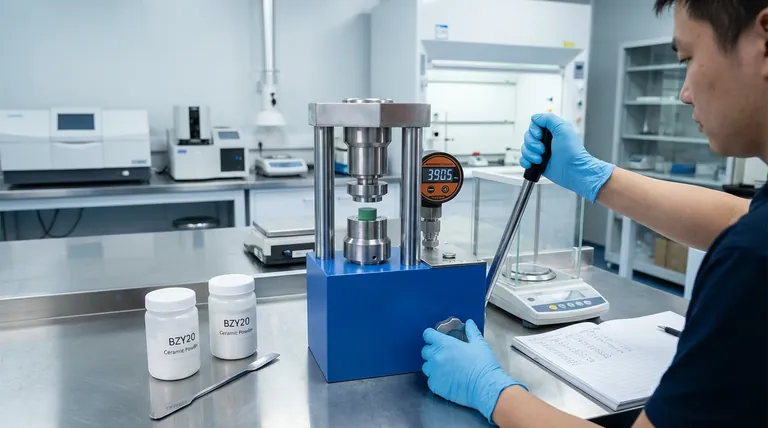
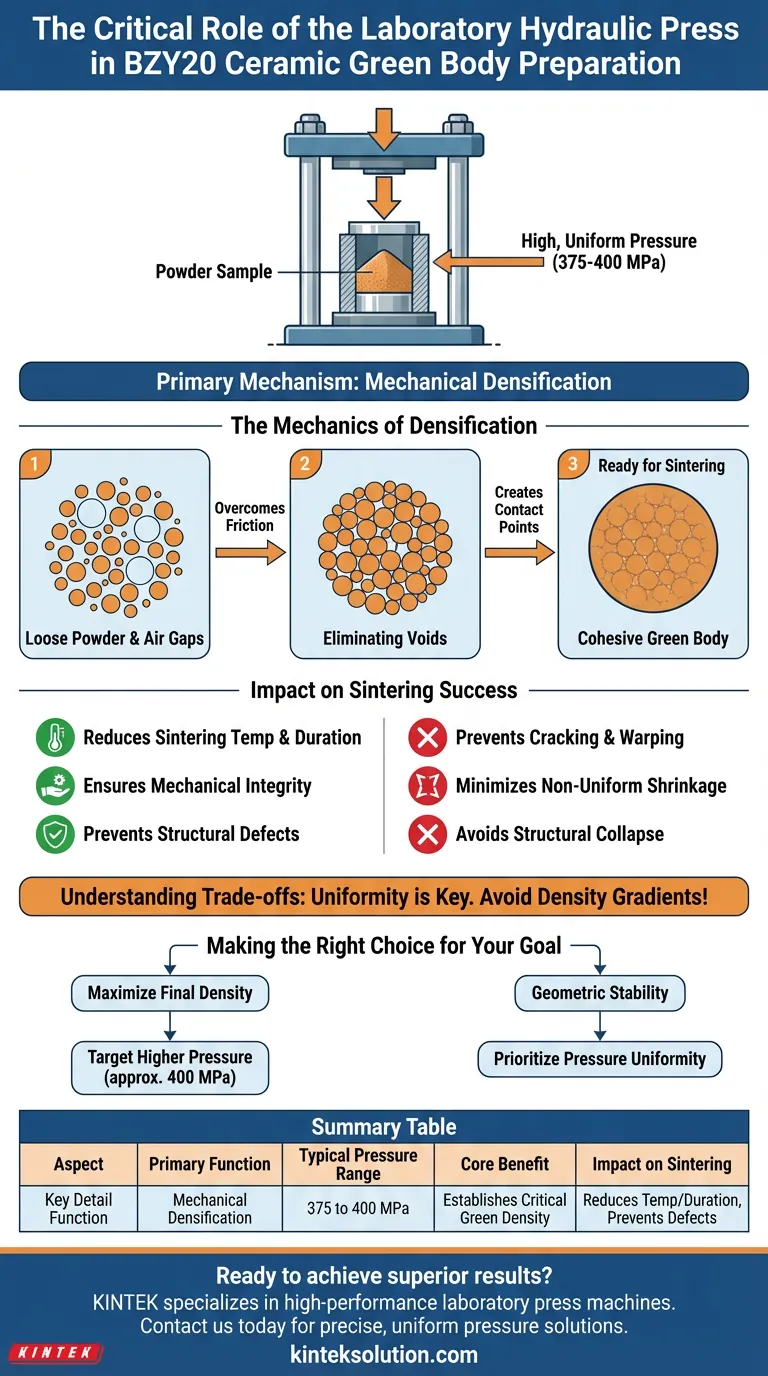
The laboratory hydraulic press serves as the primary mechanism for mechanical densification in the preparation of BZY20 ceramic green bodies. By applying high, uniform pressure—typically around 375 to 400 MPa—it forces loose powder particles to overcome friction and rearrange, transforming them into a cohesive, solid pellet with high initial density.
Core Insight: The hydraulic press does not merely shape the object; it establishes the critical "green density" required for the material to survive the sintering process. Without this intense initial compaction, the BZY20 ceramic would likely suffer from structural collapse, cracking, or incomplete densification during high-temperature firing.
The Mechanics of Densification
Overcoming Inter-Particle Friction
Loose BZY20 powder contains significant air gaps and experiences friction between particles. The hydraulic press applies force sufficient to overcome this friction.
Eliminating Voids
The application of high pressure (up to 400 MPa) physically collapses the voids between the powder grains. This mechanical rearrangement is the most efficient way to maximize the volume fraction of the solid material before heating begins.
Creating Points of Contact
The press increases the number of contact points between individual ceramic particles. These contact points are essential because they act as the "bridges" for material migration during the subsequent sintering phase.
The Impact on Sintering Success
Reducing Sintering Temperature and Duration
A high green density achieved through pressing reduces the thermodynamic work required during sintering. This allows the ceramic to fully densify at potentially lower temperatures or shorter holding times.
Preventing Structural Defects
If a green body is loosely packed, it will shrink drastically and unevenly when fired. High-pressure compaction minimizes total shrinkage, significantly reducing the risk of cracking, warping, or deformation in the final BZY20 product.
Ensuring Mechanical Integrity
The pressed "green body" possesses sufficient mechanical strength to be handled safely. This allows researchers to move, vacuum-seal, or further process the sample (e.g., Cold Isostatic Pressing) without it crumbling.
Understanding the Trade-offs
The Necessity of Uniformity
While high pressure is vital, the uniformity of that pressure is equally critical. If the hydraulic press applies force unevenly, it introduces density gradients within the pellet.
Risks of Non-Uniform Shrinkage
Density gradients created during pressing often remain invisible until sintering. During heating, low-density areas shrink faster than high-density areas, leading to catastrophic internal stresses and cracking.
Making the Right Choice for Your Goal
To maximize the quality of your BZY20 ceramics, align your pressing strategy with your specific experimental objectives.
- If your primary focus is maximizing final density: Target the higher end of the pressure range (approx. 400 MPa) to maximize particle packing and reduce porosity prior to sintering.
- If your primary focus is geometric stability: Prioritize the uniformity of the pressure application to ensure even shrinkage and prevent deformation during the firing process.
The hydraulic press is not just a forming tool; it is the foundational step that dictates the structural integrity and performance potential of the final ceramic material.
Summary Table:
| Aspect | Key Detail |
|---|---|
| Primary Function | Mechanical densification of powder into a cohesive green body |
| Typical Pressure Range | 375 to 400 MPa |
| Core Benefit | Establishes critical green density for successful sintering |
| Impact on Sintering | Reduces required temperature/duration and prevents structural defects |
Ready to achieve superior results in your ceramic research?
KINTEK specializes in high-performance laboratory press machines, including automatic lab presses and isostatic presses, designed to deliver the precise, uniform pressure required for preparing flawless BZY20 ceramic green bodies and other advanced materials. Our equipment helps you maximize density, ensure geometric stability, and prevent sintering defects.
Contact us today to discuss how our solutions can enhance your laboratory's capabilities and ensure the success of your materials preparation. Get in touch via our contact form to speak with an expert.
Visual Guide
Related Products
- Laboratory Hydraulic Press Lab Pellet Press Machine for Glove Box
- Laboratory Hydraulic Press 2T Lab Pellet Press for KBR FTIR
- 24T 30T 60T Heated Hydraulic Lab Press Machine with Hot Plates for Laboratory
- Laboratory Hydraulic Press Lab Pellet Press Button Battery Press
- Laboratory Hydraulic Pellet Press for XRF KBR FTIR Lab Press
People Also Ask
- How does a laboratory hydraulic press contribute to the preparation of Li3-3xScxSb samples? Optimize Ionic Conductivity
- What is the function of a laboratory hydraulic press in FT-IR of curcumin-coated MWCNTs? Achieve Optical Clarity.
- Why is a laboratory hydraulic press required for compression molding boron-siloxane? Solve High-Loading Density Challenges
- What role does a laboratory hydraulic press play in the preparation of piezoelectric ceramic discs for DC-PG? | KINTEK
- What role does a laboratory hydraulic press play in reaction pellets? Optimizing Lunar Soil and Metal Fuel Density



















