
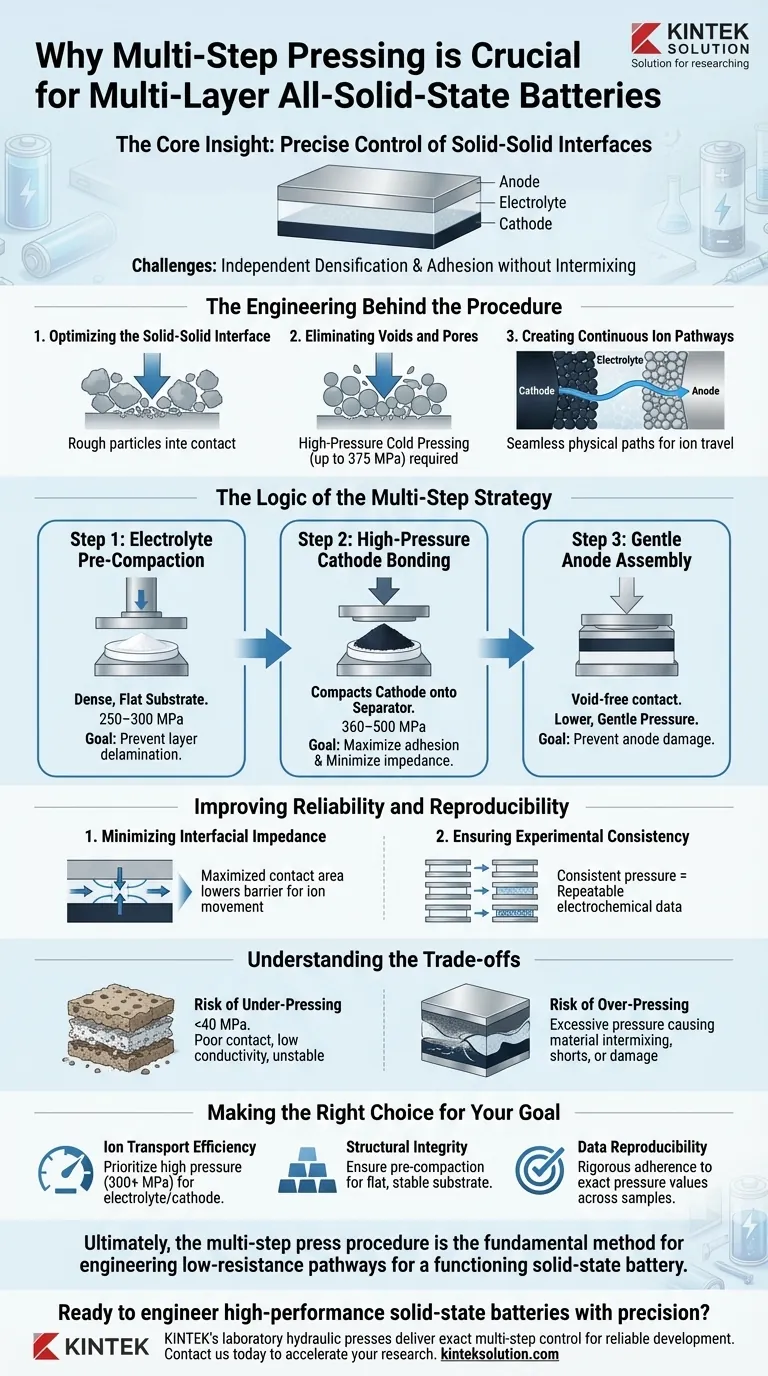
Precise control of solid-solid interfaces is the defining challenge in fabricating all-solid-state batteries. A multi-step pressing procedure is necessary because it allows for the independent densification of individual layers while ensuring they adhere to one another without material intermixing or structural damage.
The Core Insight A single, uniform press is insufficient for multi-layer cells because the electrolyte and electrodes have different mechanical requirements and compaction thresholds. A multi-step strategy allows you to create a dense, void-free electrolyte substrate first, then bond the electrode layers sequentially to maximize ionic transport and minimize interfacial resistance.
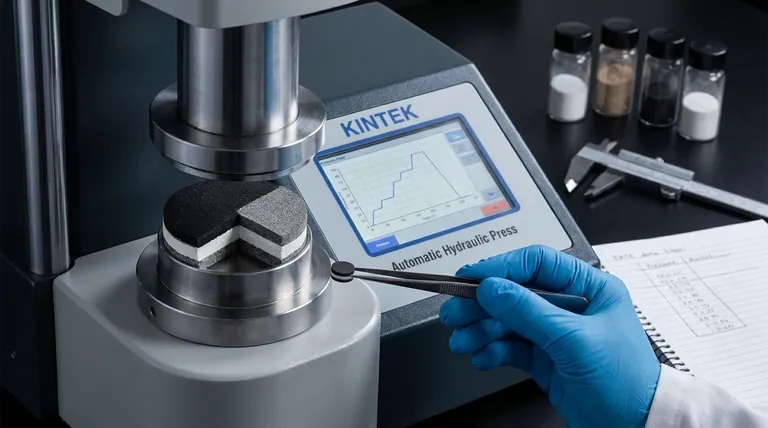
The Engineering Behind the Procedure
Optimizing the Solid-Solid Interface
In liquid batteries, the electrolyte naturally wets the electrode surfaces. In solid-state batteries, you must mechanically force solid materials to connect.
Eliminating Voids and Pores
The primary enemy of ion transport is porosity. High-pressure cold pressing (often up to 375 MPa) is required to crush particles together.
This eliminates microscopic voids between the active material and the solid electrolyte. Without this densification, ions cannot move efficiently, leading to high internal resistance.
Creating Continuous Ion Pathways
The goal is to create a seamless physical path. The press forces particles into "intimate contact," which creates continuous percolation networks for lithium ions to travel from the cathode, through the electrolyte, to the anode.
The Logic of the Multi-Step Strategy
Step 1: Pre-Compaction of the Electrolyte
The process typically begins by pressing the electrolyte powder alone into a dense pellet (e.g., at 250–300 MPa).
This creates a mechanically stable, flat substrate. As noted in the references, establishing this flat surface is crucial to prevent layer delamination or intermixing when subsequent layers are added.
Step 2: High-Pressure Cathode Bonding
Once the electrolyte substrate is formed, the cathode composite is added. A second, often higher pressure (e.g., 360–500 MPa) is applied.
This step compacts the cathode material onto the separator. The differential pressure ensures that the cathode adheres tightly to the already-dense electrolyte, minimizing the impedance at this specific junction.
Step 3: Gentle Anode Assembly
The final step involves adding the anode, such as lithium metal.
This stage often requires a significantly lower, "gentle" pressure. This prevents the soft anode material from extruding or being damaged, while still ensuring void-free contact with the electrolyte stack.
Improving Reliability and Reproducibility
Minimizing Interfacial Impedance
Resistance at the interface between layers (interfacial impedance) is a major bottleneck for performance.
By controlling the pressure at each stage, you ensure that the contact area is maximized. This directly lowers the barrier for ion movement, improving the battery's power capability.
Ensuring Experimental Consistency
For researchers, the hydraulic press acts as a standardization tool.
Maintaining consistent forming pressures ensures that the interfacial quality does not vary between samples. This allows for repeatable electrochemical data, ensuring that variations in performance are due to material properties, not assembly errors.
Understanding the Trade-offs
The Risk of Under-Pressing
If the pressure is too low (e.g., below 40 MPa for certain composites), the pellet will retain high porosity. This results in poor particle contact, low ionic conductivity, and mechanically unstable cells that may crumble during handling.
The Risk of Over-Pressing or Improper Sequencing
Applying maximum pressure to all layers simultaneously can be detrimental. It can cause material intermixing, where the cathode particles penetrate the electrolyte layer, potentially causing short circuits.
Furthermore, excessive pressure on the final stack can deform the anode or crack the brittle solid electrolyte layer. The multi-step approach mitigates this by applying the highest stresses only to the layers that require it for densification.
Making the Right Choice for Your Goal
To maximize the effectiveness of your hydraulic press procedure, tailor your approach to your specific objective:
- If your primary focus is Ion Transport Efficiency: Prioritize high pressure (300+ MPa) during the initial electrolyte and cathode steps to maximize density and eliminate pores.
- If your primary focus is Structural Integrity: Ensure you utilize a pre-compaction step for the electrolyte to create a flat, stable substrate before adding the cathode.
- If your primary focus is Data Reproducibility: rigorous adherence to exact pressure values and hold times across every sample is more critical than achieving the absolute highest density.
Ultimately, the multi-step press procedure is not just about compaction; it is the fundamental method for engineering the low-resistance pathways required for a functioning solid-state battery.
Summary Table:
| Pressing Step | Key Objective | Typical Pressure Range |
|---|---|---|
| Step 1: Electrolyte Pre-Compaction | Create a dense, flat substrate | 250–300 MPa |
| Step 2: Cathode Bonding | Maximize adhesion & eliminate voids | 360–500 MPa |
| Step 3: Anode Assembly | Ensure gentle, void-free contact | Lower, gentle pressure |
Ready to engineer high-performance solid-state batteries with precision?
KINTEK's laboratory hydraulic presses, including our automatic and heated lab presses, are engineered to deliver the exact multi-step control you need. Our equipment ensures the precise pressure sequencing and reproducibility critical for developing reliable all-solid-state batteries, helping you minimize interfacial resistance and maximize ion transport efficiency.
Contact us today to discuss how our lab press solutions can accelerate your research and development. Let's build the future of energy storage, together.
Get in touch with our experts now →
Visual Guide
Related Products
- Laboratory Hydraulic Press Lab Pellet Press Button Battery Press
- Laboratory Hydraulic Press 2T Lab Pellet Press for KBR FTIR
- Laboratory Hydraulic Press Lab Pellet Press Machine for Glove Box
- 24T 30T 60T Heated Hydraulic Lab Press Machine with Hot Plates for Laboratory
- Automatic Laboratory Hydraulic Press Lab Pellet Press Machine
People Also Ask
- How is a laboratory hydraulic press used for HAP composite gels? Master Mineral Substrate Standardization
- What role does a laboratory hydraulic press play in the preparation of piezoelectric ceramic discs for DC-PG? | KINTEK
- What role does a laboratory hydraulic press play in reaction pellets? Optimizing Lunar Soil and Metal Fuel Density
- Why is a laboratory hydraulic press required for PBAT and PLA sample preparation? Achieve Flawless Characterization
- What role does a laboratory hydraulic press play in the assembly of all-solid-state battery test cells? Expert Guide



















