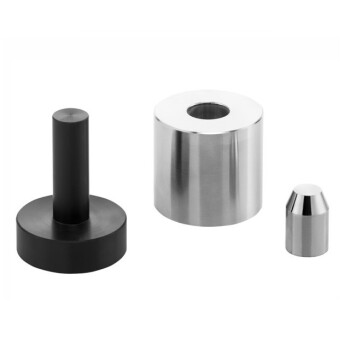
Precision hydraulic pressing is the fundamental step for converting raw chemical mixtures into functional electrode structures. It applies uniform axial pressure to mixtures of anode active materials, conductive carbon black, and binders, ensuring the resulting "green body" (the formed but uncured electrode) achieves the exact compaction density required for reliable testing.
The Core Takeaway In lithium metal battery research, the mechanical properties of the green body dictate the electrochemical potential of the final cell. Precision pressing is not merely about shaping materials; it is about strictly controlling the pore structure to maximize volumetric energy density and generate consistent microstructural data for analysis.
Defining the Green Body Structure
Achieving Ideal Compaction Density
To create a viable green body, you must compress a loose mixture of active materials, conductive agents, and binders. A precision hydraulic press ensures this mixture is compacted to a specific, uniform density, whether formed on a current collector or as a standalone pellet.
Controlling Pore Structure
The "green body" is not a solid block; it is a porous matrix that must accommodate ion transport. Precise mechanical forming allows you to dictate the size and distribution of these pores. This control is critical for balancing mechanical integrity with the ability of the material to absorb electrolyte.
The Impact on Performance Metrics
Increasing Volumetric Energy Density
High-precision pressing minimizes wasted space within the electrode material. By optimizing the packing of particles, you significantly increase the volumetric energy density, a key metric for the viability of lithium metal batteries in real-world applications.
Reducing Interfacial Impedance
While the primary focus is the green body itself, the quality of this compaction directly affects the interface. A well-compacted green body ensures tighter contact between active material particles and the current collector, drastically reducing contact resistance.
Enabling Advanced Research and Analysis
Facilitating Microstructure Analysis
Modern battery research often employs machine learning models to analyze how electrode microstructures evolve during cycling. These models require high-quality, consistent input data. Precision pressing ensures that every sample starts with a known, uniform structure, making the resulting data valid for computational analysis.
Reproducibility of Results
Inconsistent pressure leads to variable green body densities, which introduces noise into your experimental data. A precision press eliminates this variable, ensuring that differences in battery performance are due to material chemistry, not inconsistent fabrication.
Understanding the Trade-offs
The Risk of Over-Compaction
While pressure is necessary, excessive force can be detrimental. Over-compacting the green body can crush active material particles or close off the pore structure entirely, preventing electrolyte infiltration and choking off ion transport.
Equipment Calibration Dependencies
Precision is only as good as the machine's calibration. If the hydraulic press does not deliver the displayed force uniformly across the platen, you may create density gradients within a single sample, leading to localized failure points during battery cycling.
Making the Right Choice for Your Goal
To select the right pressing parameters for your research, consider your specific experimental targets:
- If your primary focus is volumetric energy density: Prioritize higher pressure settings to minimize void volume and maximize active material packing, ensuring you monitor for particle crushing.
- If your primary focus is machine learning and modeling: Prioritize extreme consistency and lower pressure tolerances to ensure every green body has an identical initial microstructure for reliable data training.
- If your primary focus is solid-state interfaces: Utilize higher pressures (25–75 MPa) to induce plasticity in the lithium, ensuring void-free contact between the green body and solid electrolytes.
Precision in the physical formation of the electrode is the prerequisite for precision in electrochemical performance.
Summary Table:
| Key Performance Factor | Impact on Lithium Metal Anode Research | Importance Level |
|---|---|---|
| Compaction Density | Maximizes volumetric energy density and ensures material integrity. | Critical |
| Pore Structure | Balances mechanical strength with efficient electrolyte infiltration. | High |
| Interfacial Impedance | Reduces contact resistance between active materials and current collectors. | High |
| Data Consistency | Provides uniform microstructures for accurate ML modeling and analysis. | Essential |
| Over-Compaction Risk | Prevents particle crushing and maintain ion transport pathways. | Caution Required |
Elevate Your Battery Research with KINTEK Precision
Achieving the perfect green body requires more than just force; it requires absolute control. KINTEK specializes in comprehensive laboratory pressing solutions designed for the rigorous demands of lithium metal battery R&D. Whether you are optimizing volumetric energy density or generating data for machine learning models, our equipment delivers the consistency you need.
Our specialized range includes:
- Manual & Automatic Presses for versatile lab workflows.
- Heated & Multifunctional Models for advanced material synthesis.
- Glovebox-Compatible & Isostatic Presses (Cold/Warm) for sensitive battery chemistries.
Ready to eliminate variables and maximize your cell performance? Contact KINTEK today to find the perfect press for your lab!
References
- Ying Wang. Application-oriented design of machine learning paradigms for battery science. DOI: 10.1038/s41524-025-01575-9
This article is also based on technical information from Kintek Solution Knowledge Base .
Related Products
- Laboratory Hydraulic Press Lab Pellet Press Button Battery Press
- Warm Isostatic Press for Solid State Battery Research Warm Isostatic Press
- Laboratory Hydraulic Press 2T Lab Pellet Press for KBR FTIR
- 24T 30T 60T Heated Hydraulic Lab Press Machine with Hot Plates for Laboratory
- Manual Laboratory Hydraulic Press Lab Pellet Press
People Also Ask
- How is a laboratory hydraulic press used for HAP composite gels? Master Mineral Substrate Standardization
- What role does a laboratory hydraulic press play in the preparation of piezoelectric ceramic discs for DC-PG? | KINTEK
- What role does a laboratory hydraulic press play in reaction pellets? Optimizing Lunar Soil and Metal Fuel Density
- Why is a laboratory hydraulic press required for PBAT and PLA sample preparation? Achieve Flawless Characterization
- What role does a laboratory hydraulic press play in the assembly of all-solid-state battery test cells? Expert Guide