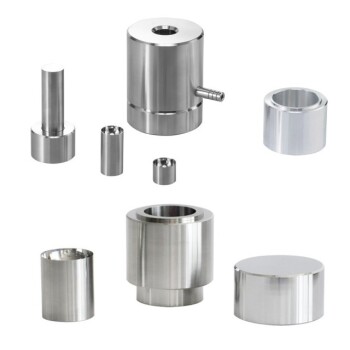
A precision pellet press is the critical enabler for converting loose sulfide (Li6PS5Cl) and chloride (Li3InCl6) powders into functional, high-performance solid electrolyte layers. It provides the stable, controllable force necessary to compact these materials into dense ceramic pellets, ensuring the physical continuity required for ion transport in silicon-based all-solid-state batteries.
Core Takeaway Solid electrolytes naturally suffer from high porosity and poor particle-to-particle contact, which act as roadblocks for lithium ions. A precision press overcomes this by applying extreme pressure to plastically deform the powder, creating a dense, continuous pathway that minimizes resistance and supports the cell structure without the need for constant external pressure during operation.
The Physics of Densification
Eliminating Internal Porosity
Loose electrolyte powders are filled with microscopic voids that block ionic movement. A precision press applies high axial pressure—often exceeding 370 MPa to 420 MPa—to mechanically force these particles together.
Inducing Plastic Deformation
Under this immense pressure, the solid electrolyte particles undergo plastic deformation. Instead of just touching, the particles physically deform and mold into one another, effectively erasing internal pores.
Creating Continuous Ion Pathways
The result of this deformation is a highly dense ceramic layer (often reaching >82% relative density). This transforms a pile of insulated particles into a single, continuous medium that allows lithium ions to move freely.
Minimizing Resistance at the Interface
Reducing Grain Boundary Resistance
The boundaries between individual powder particles are major sources of resistance (impedance). By maximizing density, the press significantly reduces grain boundary resistance, ensuring that ions do not lose energy crossing from one particle to the next.
Achieving Atomic-Level Contact
For silicon-based batteries to function, the electrolyte must maintain intimate contact with the electrode materials. Precision pressing forces these components into atomic-level close contact, eliminating interface gaps that would otherwise sever the ionic connection.
Improving Cycling Stability
Insufficient contact leads to "dead spots" where ions cannot travel, reducing the battery's lifespan. The dense, smooth surface created by the press ensures uniform contact, which optimizes charge storage and extends the cycle life of the battery.
Structural Integrity and Cell Assembly
Forming Freestanding Pellets
To build a practical cell, the electrolyte often needs to be a distinct, handleable layer. The press compacts the powder into a freestanding pellet with sufficient mechanical strength to serve as a physical separator between the anode and cathode.
Enabling Operation Without External Pressure
Many solid-state cells require heavy external clamping fixtures to work. However, a highly densified electrolyte layer created by a precision press establishes such tight internal bonding that it helps maintain efficient transport without relying heavily on external pressure during battery operation.
Understanding the Trade-offs
Precision vs. Brute Force
Simply applying heavy weight is not enough; the pressure must be stable and uniform. Uneven pressure distribution can lead to density gradients, where one part of the pellet is dense and another is porous, causing warping or cracking.
The Risk of Over-Densification
While high density is the goal, extreme pressures without precise control can potentially damage the crystallite structure of certain sensitive materials. The "precision" aspect of the press is vital to hit the exact target density (e.g., 82%) without degrading the material's inherent properties.
Making the Right Choice for Your Goal
To maximize the effectiveness of your solid electrolyte layers, align your processing approach with your specific research objectives:
- If your primary focus is Ion Transport Efficiency: Prioritize maximizing pressure (up to 420 MPa) to induce plastic deformation and eliminate internal porosity, thereby maximizing ionic conductivity.
- If your primary focus is Cell Assembly & Longevity: Focus on pressure uniformity and surface smoothness to ensure atomic-level contact at the electrode interface, which is critical for cycling stability.
Ultimately, the precision pellet press acts as the bridge between theoretical material properties and actual battery performance by mechanically enforcing the density required for ionic flow.
Summary Table:
| Feature | Impact on Solid Electrolyte (Li6PS5Cl / Li3InCl6) |
|---|---|
| High Axial Pressure | Eliminates internal porosity; achieves >82% relative density. |
| Plastic Deformation | Fuses particles into a continuous ceramic medium for ion flow. |
| Interface Contact | Establishes atomic-level contact, reducing grain boundary resistance. |
| Mechanical Strength | Creates freestanding pellets that act as robust separators. |
| Precision Control | Ensures uniform density to prevent warping, cracking, or material degradation. |
Elevate Your Battery Research with KINTEK Precision Solutions
To achieve the 420 MPa thresholds and high-density performance required for sulfide and chloride-based solid electrolytes, precision is non-negotiable. KINTEK specializes in comprehensive laboratory pressing solutions, offering a versatile range of manual, automatic, heated, multifunctional, and glovebox-compatible models, as well as cold and warm isostatic presses.
Whether you are focusing on maximizing ionic conductivity or improving cycling stability in silicon-based all-solid-state batteries, our equipment provides the stability and uniform force distribution necessary for high-performance results.
Ready to optimize your cell assembly? Contact us today to find the perfect press for your lab's specific needs!
References
- Zhiyong Zhang, Songyan Chen. Silicon-based all-solid-state batteries operating free from external pressure. DOI: 10.1038/s41467-025-56366-z
This article is also based on technical information from Kintek Solution Knowledge Base .
Related Products
- Manual Laboratory Hydraulic Pellet Press Lab Hydraulic Press
- Automatic Laboratory Hydraulic Press Lab Pellet Press Machine
- Laboratory Hydraulic Pellet Press for XRF KBR FTIR Lab Press
- Laboratory Hydraulic Split Electric Lab Pellet Press
- Automatic Laboratory Hydraulic Press for XRF and KBR Pellet Pressing
People Also Ask
- What is the primary purpose of manual lab hydraulic pellet presses? Achieve High-Precision Sample Preparation for Spectroscopy
- What is the primary purpose of a manual lab hydraulic pellet press? Ensure Accurate Sample Prep for XRF and FTIR
- What role does a lab hydraulic press play in researching squishy granular matter? Expert Insights into Material Physics
- What is the primary function of a laboratory hydraulic press in evaluating the ionic conductivity of Li6PS5X (LMSX)?
- What is the purpose of initial axial molding using a lab hydraulic press? Optimizing Electrolyte Green Bodies