
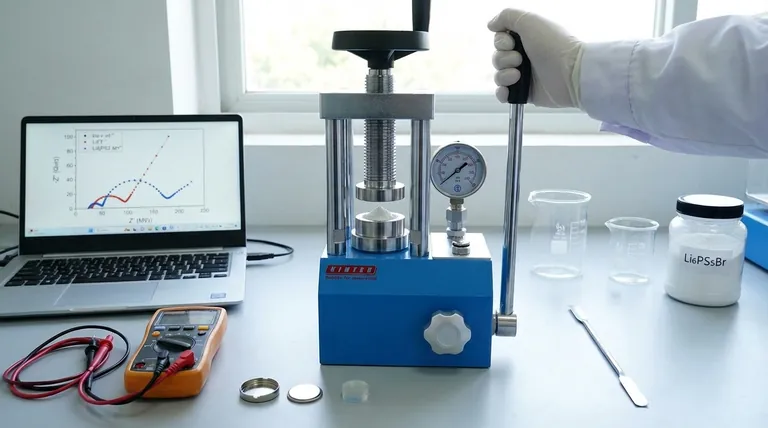
A uniaxial hydraulic press is the indispensable prerequisite for converting loose Li6PS5Br argyrodite powder into a testable solid electrolyte. Its primary function is to apply high specific pressure—often exceeding 250 MPa—to fuse loose particles into a consolidated, low-porosity pellet. Without this densification, accurate electrochemical measurements are impossible because the sensor would measure the resistance of air gaps rather than the material itself.
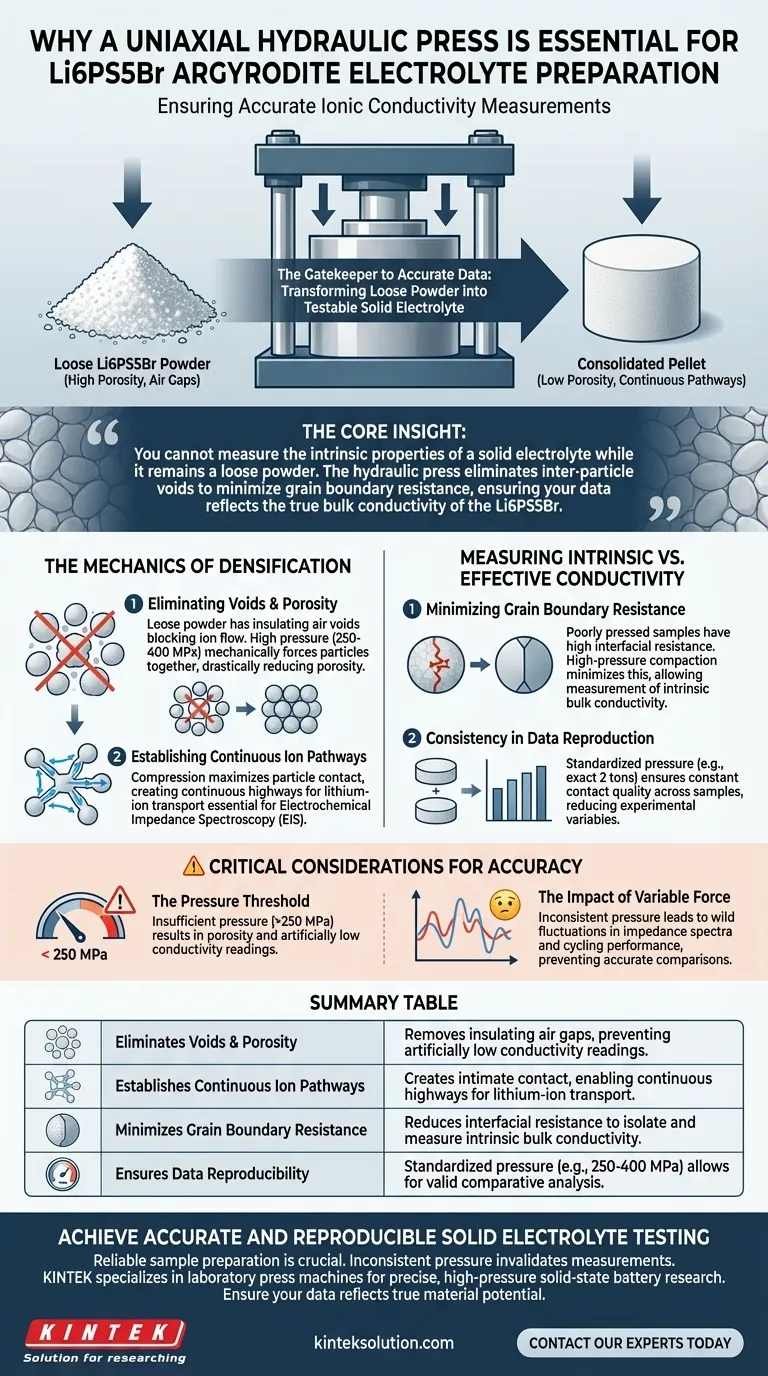
The Core Insight You cannot measure the intrinsic properties of a solid electrolyte while it remains a loose powder. The hydraulic press eliminates inter-particle voids to minimize grain boundary resistance, ensuring your data reflects the true bulk conductivity of the Li6PS5Br rather than the poor contact between grains.
The Mechanics of Densification
Eliminating Voids and Porosity
Loose Li6PS5Br powder consists of individual grains separated by air voids. These voids act as insulators that block the flow of ions.
A uniaxial hydraulic press applies significant force (references suggest ranges between 250 MPa and 400 MPa) to mechanically force these particles together. This "cold-pressing" process drastically reduces porosity, transforming a pile of dust into a dense, solid pellet.
Establishing Continuous Ion Pathways
For an electrolyte to function, lithium ions must have a continuous path to travel through the material.
By compressing the powder, you maximize the contact area between particles. This intimate physical contact creates effective, continuous highways for ion transport, allowing for the successful execution of Electrochemical Impedance Spectroscopy (EIS).
Measuring "Intrinsic" vs. "Effective" Conductivity
Minimizing Grain Boundary Resistance
In a loose or poorly pressed sample, the resistance at the interface between grains (grain boundary resistance) is dominant.
If this resistance is too high, it overwhelms the measurement, obscuring the actual performance of the crystal structure. High-pressure compaction minimizes this interfacial resistance, allowing you to isolate and measure the intrinsic bulk conductivity of the Li6PS5Br material.
Consistency in Data Reproduction
Scientific validity relies on reproducibility.
Using a hydraulic press allows you to apply a specific, quantified pressure (e.g., exactly 2 tons on a 10mm die) to every sample. This standardization ensures that the interfacial contact quality remains constant across different battery cells, reducing experimental variables.
Critical Considerations for Accuracy
The Pressure Threshold
Applying insufficient pressure is a common point of failure. References indicate that pressures in the range of 250 MPa to 400 MPa are often required to achieve the necessary density for various solid electrolytes.
If the pressure is too low, the pellet will retain too much porosity. This results in artificially low conductivity readings that reflect the sample preparation method rather than the material's potential.
The Impact of Variable Force
Inconsistency in forming pressure leads to variations in interfacial resistance.
If the pressure is not controlled and consistent from one sample to the next, impedance spectra and cycling performance data will fluctuate wildly. This makes it impossible to accurately compare different batches of Li6PS5Br or evaluate improvements in synthesis methods.
Making the Right Choice for Your Goal
To ensure your ionic conductivity measurements are defensible and accurate, apply the following principles:
- If your primary focus is determining material potential: Ensure you are reaching sufficiently high pressures (e.g., >250 MPa) to eliminate porosity so you are measuring the chemistry, not the voids.
- If your primary focus is comparative analysis: rigidly standardize the pressing force and duration across all samples to ensure that any difference in data is due to the material, not the pellet fabrication.
Ultimately, the hydraulic press is not just a shaping tool; it is the gatekeeper that allows you to access and verify the true performance limits of your solid electrolyte.
Summary Table:
| Key Function | Why It Matters for Li6PS5Br |
|---|---|
| Eliminates Voids & Porosity | Removes insulating air gaps that block ion flow, preventing artificially low conductivity readings. |
| Establishes Continuous Ion Pathways | Creates intimate contact between particles, enabling continuous highways for lithium-ion transport. |
| Minimizes Grain Boundary Resistance | Reduces interfacial resistance to isolate and measure the true intrinsic bulk conductivity of the material. |
| Ensures Data Reproducibility | Standardized pressure application (e.g., 250-400 MPa) allows for valid comparative analysis between samples. |
Achieve Accurate and Reproducible Solid Electrolyte Testing
Your research on materials like Li6PS5Br depends on reliable sample preparation. Inconsistent pressure or failure to achieve sufficient densification can invalidate your ionic conductivity measurements, wasting valuable time and resources.
KINTEK specializes in laboratory press machines—including automatic, isostatic, and heated lab presses—designed specifically for the precise, high-pressure demands of solid-state battery research. Our presses help researchers like you eliminate experimental variables by delivering the consistent, high pressure (≥ 250 MPa) required to create dense pellets and obtain defensible data.
Ready to ensure your conductivity measurements reflect your material's true potential?
Contact our experts today to find the perfect lab press for your solid electrolyte development workflow.
Visual Guide
Related Products
- Automatic Laboratory Hydraulic Press for XRF and KBR Pellet Pressing
- Automatic Laboratory Hydraulic Press Lab Pellet Press Machine
- Manual Laboratory Hydraulic Press Lab Pellet Press
- Manual Laboratory Hydraulic Pellet Press Lab Hydraulic Press
- Laboratory Hydraulic Split Electric Lab Pellet Press
People Also Ask
- Why is pressing powder into a pellet critical before sintering? Ensure Dense, Conductive Solid-State Electrolytes
- What is the role of a laboratory pressure machine and KBr in FTIR? Master Sample Preparation for Flame Retardants
- What are the advantages of using a laboratory automatic hydraulic press for HEA green compact forming?
- What are the advantages of using a lab automatic hydraulic press for HEA green body molding? Ensure Material Integrity
- What are the advantages of using an automatic laboratory hydraulic press? Enhance Precision in Sample Preparation



















