
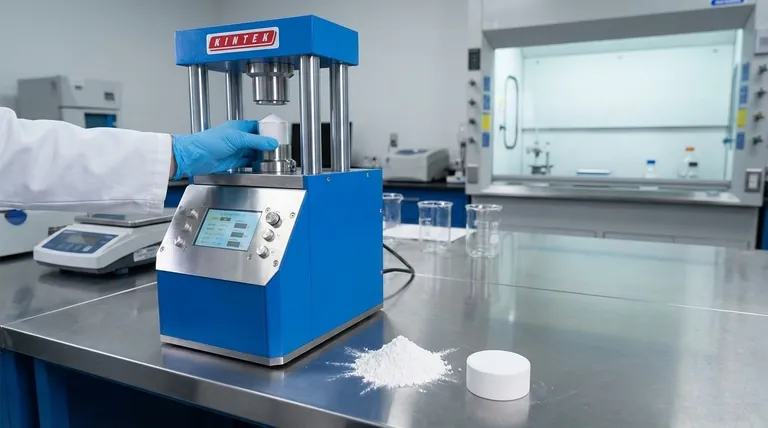
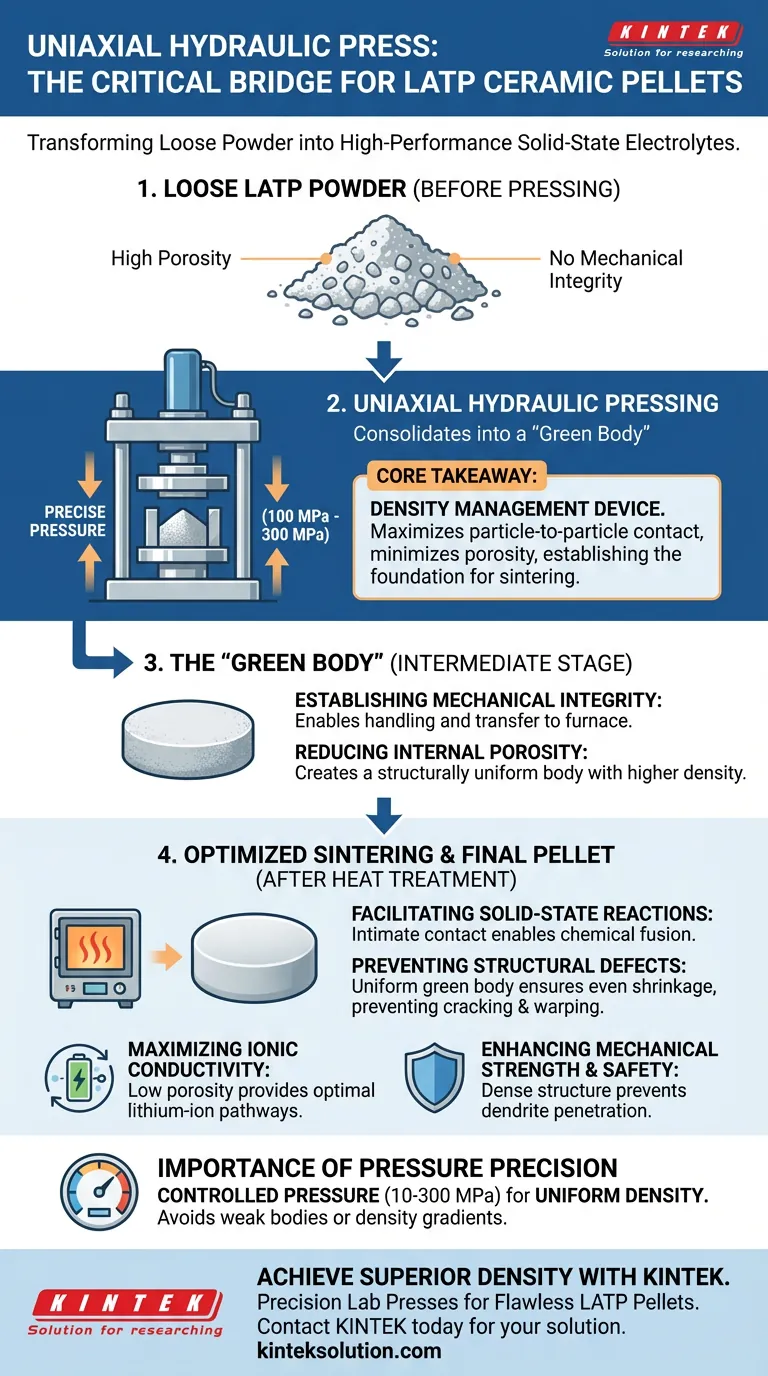
The uniaxial hydraulic press serves as the critical bridge between loose raw material and a functional solid-state electrolyte. Its primary function in preparing LATP (Lithium Aluminum Titanium Phosphate) pellets is to consolidate loose glass powder into a cohesive "green body" with sufficient mechanical integrity. By applying precise uniaxial pressure—often ranging from 100 MPa to 300 MPa—the press eliminates void space and forces particles into intimate contact, creating the physical foundation required for successful sintering.
Core Takeaway The hydraulic press is not just a shaping tool; it is a density management device. By maximizing particle-to-particle contact and minimizing porosity in the "green" stage, the press establishes the necessary conditions for high ionic conductivity and structural stability in the final sintered ceramic.
The Role of the "Green Body"
Establishing Mechanical Integrity
Before heat treatment, loose LATP powder lacks the structural cohesion to be handled or processed. The hydraulic press compacts this powder into a green pellet—a solid form that is not yet fully sintered but holds its shape.
This step ensures the material has enough initial strength to withstand transfer to a furnace without crumbling. Without this mechanical consolidation, the material would remain a loose aggregate, impossible to process into a functional component.
Reducing Internal Porosity
The immediate physical goal of the press is the reduction of air voids. Loose powder naturally contains significant space between particles.
Applying high pressure forces the particles to pack tightly together, drastically reducing the volume of these voids. This creates a structurally uniform body where the density is much higher than that of the loose powder, setting a baseline for the final ceramic density.
Optimizing the Sintering Process
Facilitating Solid-State Reactions
Sintering relies on atomic diffusion between particles; they must physically touch to fuse chemically. Reference data indicates that high compaction pressure ensures intimate contact between powder particles.
This contact is a fundamental prerequisite for the solid-state reactions that occur during heat treatment. If the particles are not pressed tightly enough, the diffusion distance is too great, and the material will fail to densify properly.
Preventing Structural Defects
A major risk during high-temperature sintering is uneven shrinkage, which leads to cracking, warping, or deformation.
By using a hydraulic press to create a uniform green body, you ensure that shrinkage occurs evenly across the pellet. This uniformity is the primary defense against cracking and deformation, ensuring the final pellet maintains the correct circular geometry and structural soundness.
Impact on Final Electrolyte Performance
Maximizing Ionic Conductivity
For an LATP pellet to function as a solid-state electrolyte, lithium ions must move freely through the material. Porosity acts as a barrier to this movement.
The high density achieved during pressing translates directly to a denser final product with low porosity. This provides an optimal, uninterrupted pathway for lithium-ion conduction, directly enhancing the electrochemical performance of the electrolyte.
Enhancing Mechanical Strength and Safety
A dense green body leads to a sintered pellet with high relative density and mechanical hardness.
This structural robustness is essential not just for durability, but for safety in battery applications. A dense, crack-free electrolyte is better equipped to prevent the penetration of lithium dendrites, which are a common cause of short circuits in solid-state batteries.
Understanding the Trade-offs
The Importance of Pressure Precision
While pressure is vital, simply applying maximum force is not the strategy; the pressure must be precise and controlled.
References suggest a wide range of operational pressures (from 10 MPa to 300 MPa) depending on the specific formulation and desired outcome. If pressure is too low, the green body will be weak and porous; if uncontrolled, it may introduce density gradients that cause the very warping you are trying to avoid. The goal is a uniform density profile, not just maximum compaction.
Making the Right Choice for Your Goal
To maximize the effectiveness of your hydraulic pressing stage, align your parameters with your specific material objectives:
- If your primary focus is Ionic Conductivity: Target higher pressure ranges (e.g., 200–300 MPa) to minimize porosity as much as possible, as denser pellets provide better conduction pathways.
- If your primary focus is Geometric Stability: Prioritize the uniformity of the pressure application to ensure even shrinkage and prevent warping during the sintering phase.
Ultimately, the uniaxial hydraulic press transforms a chemical potentiality into a physical reality, defining the upper limits of your ceramic's performance before heat is ever applied.
Summary Table:
| Role of the Hydraulic Press | Key Benefit for LATP Pellets |
|---|---|
| Consolidates loose powder into a 'green body' | Enables handling and transfer to the furnace |
| Maximizes particle-to-particle contact | Facilitates solid-state reactions during sintering |
| Reduces internal porosity and voids | Creates optimal pathways for high ionic conductivity |
| Ensures uniform density | Prevents cracking and warping during heat treatment |
| Establishes mechanical integrity | Enhances final pellet strength and safety |
Ready to achieve superior density and performance in your solid-state electrolyte research?
KINTEK specializes in precision lab press machines, including automatic and isostatic presses, designed to meet the exacting demands of laboratory ceramic preparation. Our hydraulic presses deliver the precise, uniform pressure (from 10 MPa to 300 MPa) required to create flawless LATP pellets with high ionic conductivity and structural stability.
Let our expertise help you optimize your powder compaction process. Contact KINTEK today to find the perfect lab press solution for your battery materials development.
Visual Guide
Related Products
- Automatic Laboratory Hydraulic Press Lab Pellet Press Machine
- Manual Laboratory Hydraulic Pellet Press Lab Hydraulic Press
- Automatic Laboratory Hydraulic Press for XRF and KBR Pellet Pressing
- Manual Laboratory Hydraulic Press Lab Pellet Press
- Laboratory Hydraulic Press Lab Pellet Press Machine for Glove Box
People Also Ask
- What is the primary purpose of a manual lab hydraulic pellet press? Ensure Accurate Sample Prep for XRF and FTIR
- What is the primary purpose of manual lab hydraulic pellet presses? Achieve High-Precision Sample Preparation for Spectroscopy
- Why are high-precision automatic hydraulic presses required for Martian ISRU? Ensure Reliable Regolith Forming
- How does an automatic laboratory hydraulic press improve KBr pellet preparation? Achieve Precision IR Spectroscopy
- What are the advantages of using an automatic laboratory hydraulic press? Enhance Precision in Sample Preparation



















