
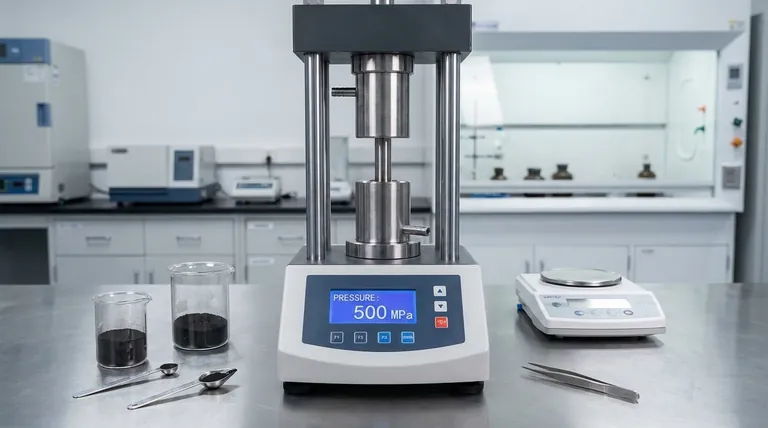
A uniaxial powder press machine is the fundamental tool for overcoming the lack of natural contact in solid-state systems. It functions by applying controlled, unidirectional force to compress the organic composite cathode mixture—consisting of active materials, solid-state electrolytes, and conductive agents—into a high-density electrode sheet. This mechanical compaction is not merely for shaping; it is the primary method for eliminating air voids and forcing solid particles into the intimate physical contact required for energy storage.
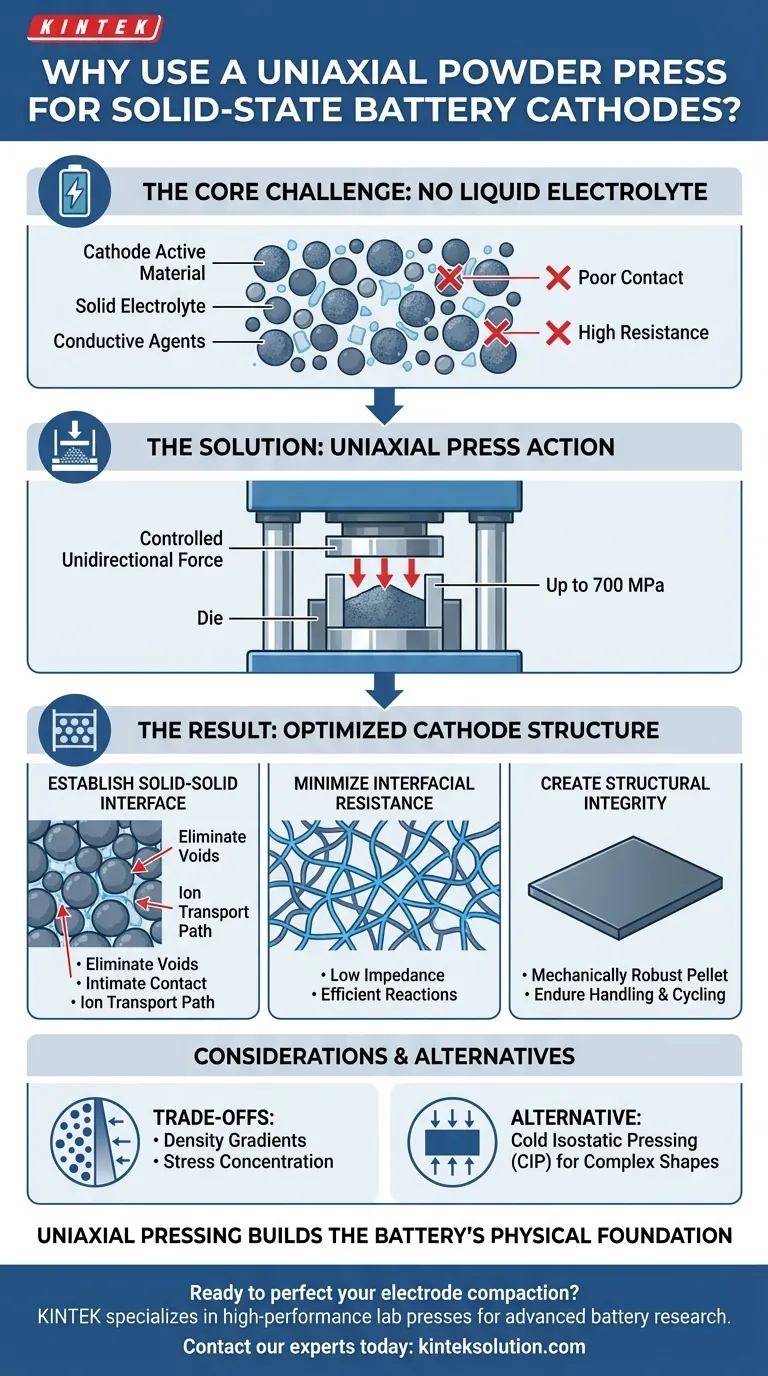
The Core Takeaway In solid-state batteries, there is no liquid electrolyte to flow into pores and "wet" the active materials. Uniaxial pressing substitutes this liquid action with mechanical force, crushing the solid components together to minimize interfacial resistance and establish the continuous pathways necessary for ion transport.
The Mechanics of Solid-State Compaction
Establishing the Solid-Solid Interface
In conventional batteries, liquid electrolytes naturally permeate the electrode. In an all-solid-state battery, the "wetting" process must be simulated physically.
The uniaxial press applies immense pressure—sometimes up to 700 MPa—to force the cathode active material and the solid electrolyte particles together.
This pressure eliminates the gaps (voids) between particles. Without this step, ions cannot move between the electrolyte and the cathode, rendering the battery non-functional.
Minimizing Interfacial Resistance
The primary enemy of solid-state battery performance is interfacial resistance.
If the solid particles are merely touching loosely, the resistance to electron and ion flow is too high.
By densifying the electrode sheet, the press ensures a tight, cohesive network. This maximizes the contact area between particles, drastically lowering impedance and enabling efficient electrochemical reactions.
Creating Structural Integrity
Before pressing, the composite cathode is essentially a loose powder mixture.
Uniaxial pressing transforms this powder into a mechanically robust pellet or sheet. This structural strength is vital for the battery to endure handling and the physical stresses of charge and discharge cycles.
It also allows for multi-step assembly, where a solid electrolyte layer (separator) can be pressed first (e.g., at 100 MPa), followed by the cathode layer pressed on top at higher pressures to bond the two distinct layers into a single unit.
Understanding the Trade-offs
Non-Uniform Density Distribution
While uniaxial pressing is effective for planar shapes, it applies force from only one direction (usually top-down).
This can lead to density gradients within the material. The parts of the electrode closer to the pressing ram may be denser than those further away, leading to uneven performance across the thickness of the cathode.
Stress Concentration and Defects
Because the pressure is not applied from all sides simultaneously, uniaxial pressing can induce internal stress concentrations.
References indicate that this can create a "green body" (the unfired compacted part) that is susceptible to cracking or deformation.
Advanced techniques like Cold Isostatic Pressing (CIP) are sometimes preferred over uniaxial pressing for complex shapes because CIP applies uniform pressure from all directions via a liquid medium, resulting in a more homogeneous microstructure.
Making the Right Choice for Your Goal
The uniaxial press is a critical instrument, but its parameters must be tuned to your specific material requirements.
- If your primary focus is reducing internal resistance: Ensure you are applying sufficient pressure (often >400 MPa) to eliminate voids at the cathode/electrolyte interface.
- If your primary focus is preventing structural cracking: Monitor the compaction for density gradients; if defects persist, consider if the unidirectional force is creating uneven stress distributions compared to isostatic methods.
Ultimately, the uniaxial press creates the physical foundation of the battery, determining whether ions have a highway or a roadblock to traverse.
Summary Table:
| Aspect | Role of Uniaxial Pressing |
|---|---|
| Primary Function | Applies unidirectional force to compress cathode powder into a dense sheet. |
| Key Benefit | Eliminates air voids, forcing solid particles into intimate contact to enable ion transport. |
| Typical Pressure Range | Up to 700 MPa, depending on material requirements. |
| Consideration | Can create density gradients; Cold Isostatic Pressing (CIP) may be preferred for complex shapes. |
Ready to perfect your solid-state battery electrode compaction?
KINTEK specializes in high-performance lab press machines, including automatic lab presses and isostatic presses, designed to meet the precise pressure and uniformity demands of advanced battery research. Our equipment helps you achieve the critical solid-solid interfaces needed for high-efficiency energy storage.
Contact our experts today to discuss how our presses can enhance your R&D process and accelerate your development timeline.
Visual Guide
Related Products
- Lab Round Bidirectional Press Mold
- XRF KBR Plastic Ring Lab Powder Pellet Pressing Mold for FTIR
- Lab Polygon Press Mold
- Automatic Laboratory Hydraulic Press for XRF and KBR Pellet Pressing
- Laboratory Hydraulic Press Lab Pellet Press Machine for Glove Box
People Also Ask
- What is the purpose of incorporating cartridge heaters into a lab press mold for MLCC block compression? Optimize Results
- What is the function of a pressing tool in thermoplastic panels? Master Precision Shaping & Fusion Bonding
- Why is precise cooling management of the lab press mold necessary? Protect Core Integrity in Thermoforming
- Why is a high-performance laboratory molding press critical for in-situ electrolyte formation? Unlock Battery Success
- How do the design and geometric precision of pressing molds and mandrels affect the quality of PTFE composite samples?




