
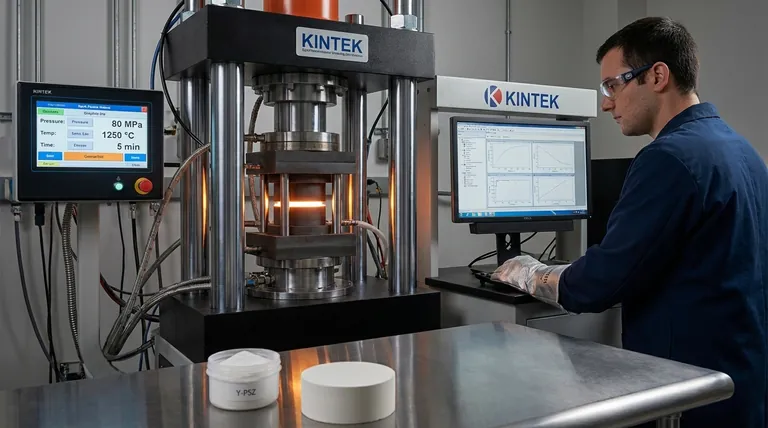
Applying 80 MPa of uniaxial pressure serves as the primary mechanical driving force for the rapid densification of Y-PSZ powder. By exerting this specific magnitude of force during Spark Plasma Sintering (SPS), you compel the powder particles to physically rearrange and plastically deform. This mechanical action works in concert with thermal energy to eliminate voids and maximize particle contact, enabling full densification at significantly lower temperatures and shorter hold times than traditional methods.
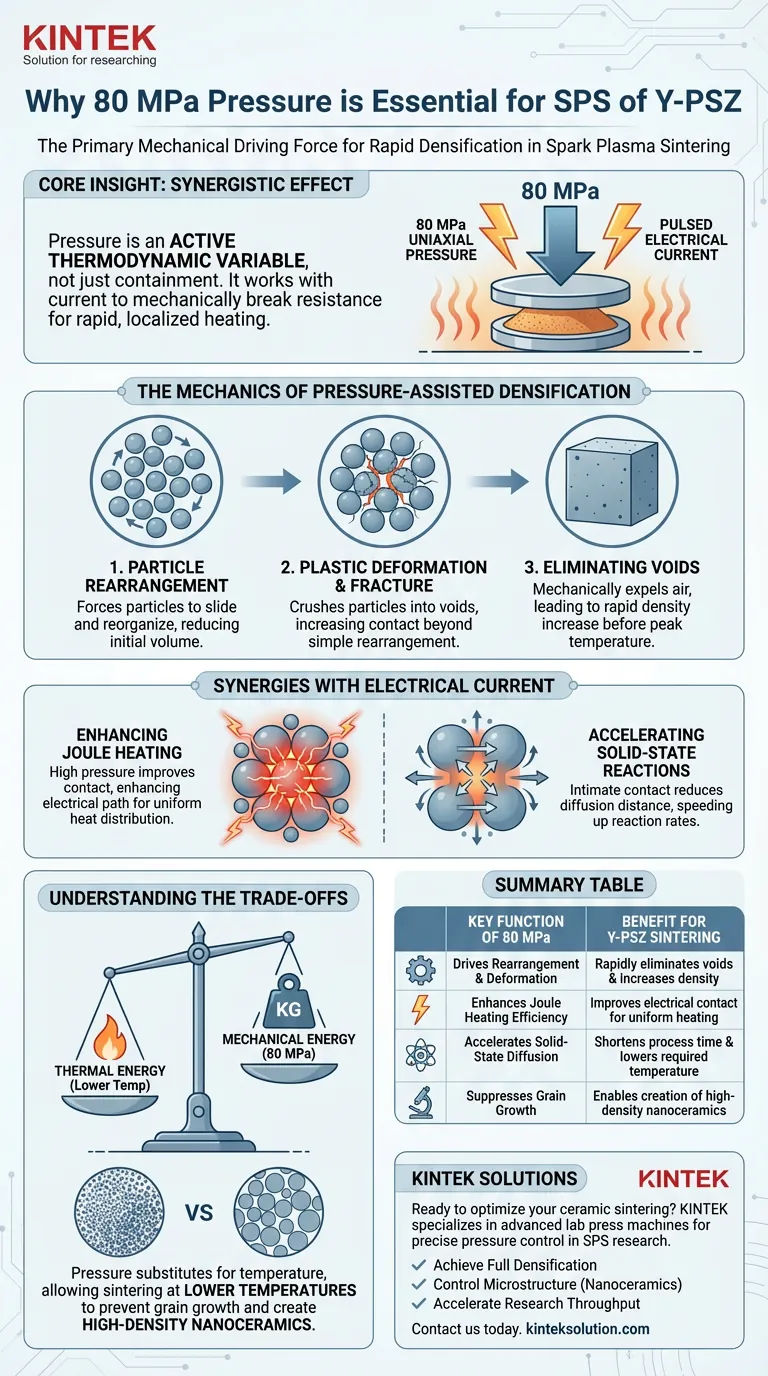
Core Insight: In Spark Plasma Sintering, pressure is not merely a method of containment; it is an active thermodynamic variable. The application of 80 MPa creates a "synergistic effect" with pulsed electrical current, mechanically breaking down sintering resistance while the current provides rapid, localized heating.
The Mechanics of Pressure-Assisted Densification
To understand why 80 MPa is essential, we must look at how it alters the physical behavior of the ceramic powder at the microscopic level.
Driving Particle Rearrangement
At the onset of the sintering process, the powder particles are loosely packed with significant gaps.
The application of 80 MPa forces these particles to slide past one another and reorganize. This mechanical rearrangement is the first step in reducing the volume of the powder compact.
Inducing Plastic Deformation and Fracture
As the process continues, simple rearrangement is no longer sufficient to increase density.
The high uniaxial pressure causes the Y-PSZ particles to undergo plastic deformation and fracture at contact points. This physically crushes the particles into voids that would otherwise require extreme temperatures to close.
Eliminating Voids
The ultimate goal of sintering is the removal of porosity.
By mechanically forcing particles into adjacent empty spaces, 80 MPa effectively expels the air and voids between particles. This leads to a rapid increase in relative density before the peak sintering temperature is even reached.
Synergies with Electrical Current
SPS is distinct because it utilizes a pulsed electrical current. The mechanical pressure plays a vital role in optimizing this electrical effect.
Enhancing Joule Heating
The efficiency of the pulsed current depends on how well the current can pass through the mold and the sample.
High pressure significantly increases the contact area between individual powder particles. Better contact improves the electrical path, enhancing the Joule heating effect and ensuring uniform heat distribution throughout the sample.
Accelerating Solid-State Reactions
Densification relies on diffusion and reaction between particles.
The pressure brings precursor particles into intimate contact, reducing the diffusion distance. This accelerates the rate of solid-state reactions, allowing the material to reach its final phase and density much faster.
Understanding the Trade-offs
While high pressure is beneficial, it fundamentally changes the sintering window compared to pressureless methods.
Pressure Substitutes for Temperature
In conventional sintering, you rely almost exclusively on thermal energy (heat) to drive densification.
In SPS with 80 MPa, mechanical energy substitutes for a portion of that thermal energy. This allows you to sinter at lower temperatures, but it requires precise control to ensure the tooling (graphite dies) can withstand the mechanical stress.
The "Nano" Advantage
One of the greatest challenges in sintering is preventing grain growth.
By using high pressure to achieve density rapidly, you avoid the prolonged exposure to high heat that causes grains to coarsen. This is critical for synthesizing high-density nanoceramics with superior mechanical properties.
Making the Right Choice for Your Goal
The application of 80 MPa is a calculated parameter designed to optimize the efficiency of the SPS process.
- If your primary focus is Speed and Efficiency: The application of 80 MPa is essential to mechanically drive rapid densification, significantly shortening the overall processing time.
- If your primary focus is Microstructure Control: High pressure allows you to lower the sintering temperature, which is critical for retaining fine grain sizes and nanostructures in the final Y-PSZ ceramic.
Summary: Applying 80 MPa provides the necessary mechanical leverage to overcome sintering resistance, enabling the production of fully dense ceramics with optimized microstructures in a fraction of the time required by conventional methods.
Summary Table:
| Key Function of 80 MPa Pressure in SPS | Benefit for Y-PSZ Sintering |
|---|---|
| Drives Particle Rearrangement & Plastic Deformation | Rapidly eliminates voids and increases density |
| Enhances Joule Heating Efficiency | Improves electrical contact for uniform, rapid heating |
| Accelerates Solid-State Diffusion | Shortens process time and lowers required temperature |
| Suppresses Grain Growth | Enables creation of high-density nanoceramics |
Ready to optimize your ceramic sintering process?
KINTEK specializes in advanced lab press machines, including automatic and heated lab presses ideal for Spark Plasma Sintering research. Our equipment provides the precise pressure control essential for achieving the rapid densification and fine microstructures discussed in this article.
Let us help you enhance your lab's capabilities:
- Achieve Full Densification: Utilize precise pressure control to eliminate porosity in advanced ceramics like Y-PSZ.
- Control Microstructure: Leverage pressure to sinter at lower temperatures and retain fine grain sizes.
- Accelerate Research: Benefit from rapid processing times to increase your lab's throughput.
Contact KINTEK today to discuss how our lab press solutions can meet your specific research and development goals.
Visual Guide
Related Products
People Also Ask
- Function of a Laboratory Hydraulic Press with Heated Platens in SSE? Enhance Battery Density & Conductivity
- What are the requirements for electrode pressing with high-viscosity ionic liquids like EMIM TFSI? Optimize Performance
- How does a laboratory heated hydraulic press facilitate PBN sample prep for WAXS? Achieve Precise X-Ray Scattering
- What are the industrial applications of heated hydraulic presses? Master Heat & Force for Precision Manufacturing
- Why is a laboratory hydraulic press with heating plates required for PLA/TEC films? Achieve Precise Sample Integrity
