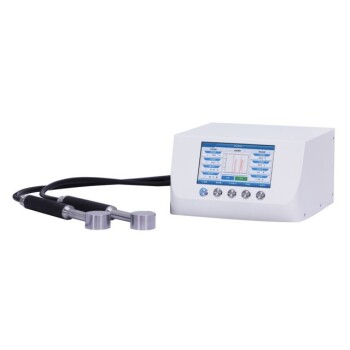
High-precision heating is the critical enabler for successful in-situ polymerization in solid-state battery fabrication. By providing a rigorously controlled thermal environment, this equipment ensures that the fluorinated polyether electrolyte forms a consistent structure. This precision is required to simultaneously achieve a uniform, conformal coating on both the cathode and anode surfaces.
Core Takeaway Precise thermal control is the mechanism that transforms a liquid precursor into a fully integrated solid electrolyte. This integration eliminates physical gaps at the electrode interface, directly minimizing resistance and maximizing the efficiency of ion transmission.
The Mechanics of Thermal Integration
Achieving Conformal Coatings
The primary function of high-precision heating is to guarantee thermal uniformity throughout the cell assembly. During the in-situ polymerization process, the heat must be distributed evenly to drive the reaction consistent across all surfaces.
This control ensures that the fluorinated polyether electrolyte creates a conformal coating. Rather than sitting loosely on top, the polymer forms simultaneously on both the cathode and anode, mirroring their microscopic topographies.
Creating Built-in Integration
Standard coating methods often struggle to adhere perfectly to electrode surfaces. High-precision heating facilitates "built-in integration."
Because the polymerization happens in-situ (in place) under controlled heat, the electrolyte bonds intimately with the electrodes as it forms. This creates a unified cell structure rather than a stack of separate, disjointed layers.
Impact on Electrochemical Performance
Optimizing Solid-Solid Contact
The most significant challenge in solid-state batteries is the solid-solid interface. If the contact between the solid electrolyte and the solid electrode is poor, performance suffers.
The uniform polymerization driven by precision heating ensures maximal physical contact points. It effectively "wets" the surface before solidifying, removing voids that typically plague solid-state interfaces.
Enhancing Ion Transmission
The direct result of improved contact is a reduction in interface resistance.
When the coating is uniform and conformal, ions have a clear, unobstructed path to move between the cathode and anode. This significantly enhances ion transmission efficiency, allowing the battery to charge and discharge more effectively.
Understanding the Risks of Imprecision
The Consequences of Thermal Gradients
If the heating equipment lacks precision, it introduces thermal gradients (hot and cold spots) during the polymerization phase.
This leads to non-uniform coatings. Some areas of the electrode may have too much electrolyte, while others have too little, creating bottlenecks for ion flow.
Elevated Interface Resistance
Without a controlled thermal environment, the electrolyte fails to form a conformal layer.
This results in poor integration with the anode and cathode. The lack of intimate contact increases interfacial impedance, effectively throttling the battery's power output and efficiency.
Prioritizing Process Control
To optimize the preparation of fluorinated polyether-based solid-state batteries, consider the following regarding your equipment choices:
- If your primary focus is reducing internal resistance: Ensure your heating equipment can maintain strict thermal uniformity to maximize solid-solid contact area.
- If your primary focus is process reproducibility: Prioritize equipment with high-precision feedback loops to guarantee the exact same polymerization conditions for every cell.
Ultimately, precise thermal management is not just a manufacturing step; it is the defining factor in establishing an efficient ion transport network.
Summary Table:
| Feature of Precision Heating | Impact on In-Situ Polymerization | Benefit to Battery Performance |
|---|---|---|
| Thermal Uniformity | Ensures consistent reaction across cathode/anode | Creates a seamless, conformal electrolyte coating |
| Controlled Reaction Rate | Facilitates deep "built-in" integration | Eliminates physical gaps and voids at the interface |
| High-Precision Feedback | Prevents thermal gradients and hot spots | Lowers interfacial impedance for faster charging |
| Consistent Process Control | Guarantees reproducible polymerization cycles | Enhances long-term stability and ion flow efficiency |
Elevate Your Battery Research with KINTEK Precision Solutions
Achieving the perfect solid-solid interface requires more than just heat; it requires absolute thermal control. KINTEK specializes in comprehensive laboratory pressing and heating solutions designed for the rigorous demands of solid-state battery fabrication.
Whether you are working on fluorinated polyether-based electrolytes or advanced electrode materials, our range of manual, automatic, heated, and glovebox-compatible presses, alongside our specialized isostatic presses, provide the uniform environment necessary to minimize resistance and maximize ion transmission.
Ready to optimize your in-situ polymerization process? Contact our laboratory experts today to find the ideal equipment for your research and development needs.
References
- Menglong Zhao, Guosheng Shao. An Integrated Interfacial Design for High‐Energy, Safe Solid‐State Batteries. DOI: 10.1002/eem2.70213
This article is also based on technical information from Kintek Solution Knowledge Base .
Related Products
- Infrared Heating Quantitative Flat Plate Mold for Precise Temperature Control
- Automatic High Temperature Heated Hydraulic Press Machine with Heated Plates for Lab
- Automatic Heated Hydraulic Press Machine with Heated Plates for Laboratory
- Automatic Heated Hydraulic Press Machine with Hot Plates for Laboratory
- Heated Hydraulic Press Machine With Heated Plates For Vacuum Box Laboratory Hot Press
People Also Ask
- How do precision temperature-controlled heating plates function in electrolyte thermal stability storage experiments?
- What is the importance of a precision temperature-controlled heating module? Ensure Aluminum-Cadmium Thermal Stability
- How does heating platen precision affect rubber specimens? Achieve uniform density and reliable testing results.
- How are thin polymer films produced for spectroscopic analysis? Expert Guide to Heat and Low-Pressure Methods
- What accessories and field services can be used to optimize the capabilities of presses? Maximize Your Lab Performance