
High pressure is applied to overcome the inherent roughness of solid materials.
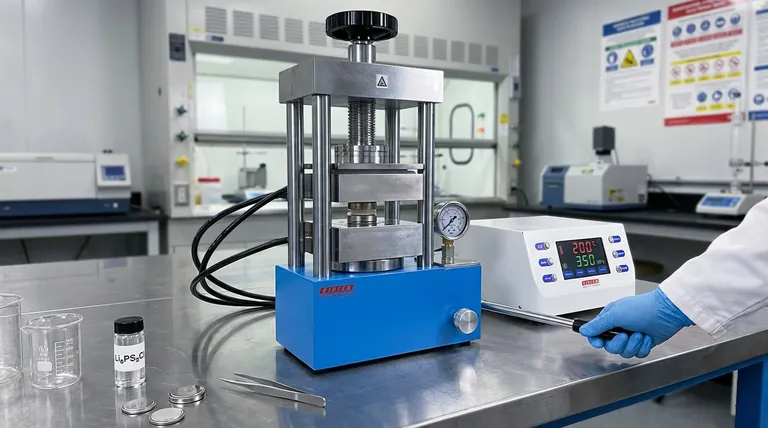
In solid-state battery assembly, applying pressure exceeding 250 MPa via a hydraulic press is a critical processing step designed to mechanically force rigid solids into a single, cohesive unit. This extreme pressure drives the plastic deformation of lithium metal and the densification of electrolyte powders, eliminating microscopic voids that would otherwise block ion transport and lead to battery failure.
The Core Insight Unlike liquid electrolytes that naturally "wet" surfaces to create perfect contact, solid-state components meet at rough, rigid interfaces full of microscopic air gaps. High pressure acts as a mechanical substitute for wettability, physically flowing the solid materials together to reduce interfacial impedance from prohibitive levels (e.g., >500 Ω) to functional levels (e.g., ~32 Ω).
The Engineering Challenge: The Solid-Solid Interface
The fundamental hurdle in solid-state batteries is the lack of physical conformity between components.
Eliminating Microscopic Irregularities
On a microscopic level, the surfaces of solid electrolytes and lithium anodes are rough. When placed together without force, they touch only at discrete points, leaving vast areas of non-contact (voids).
The Consequence of Low Contact
These voids act as insulators. If ions cannot physically cross from the anode to the electrolyte due to an air gap, the interfacial resistance spikes. This leads to uneven current distribution, which impairs battery performance and promotes failure mechanisms.
Why Pressures Exceeding 250 MPa Are Necessary
While lower pressures (around 25 MPa) can improve contact, pressures exceeding 250 MPa (specifically 360–500 MPa) are often required for specific assembly phases to ensure structural and electrochemical integrity.
Densifying Electrolyte Powders
When starting with solid electrolyte powders (such as Li6PS5Cl), extreme pressure is non-negotiable. As noted in your references, 500 MPa is used to compress loose powder into a dense, solid pellet.
This step eliminates porosity between the electrolyte particles themselves, ensuring a continuous path for ion migration through the bulk material.
Inducing Plastic Deformation and Creep
Lithium metal is relatively soft, but it still requires significant force to flow into the microscopic valleys of a hard ceramic electrolyte (like LLZO).
High pressure (e.g., 360 MPa for lamination) forces the lithium to undergo plastic deformation. This causes the metal to "creep" and fill surface irregularities, maximizing the effective contact area and creating a seamless, void-free interface.
Suppressing Dendrite Formation
High pressure does more than just lower resistance; it creates a mechanical barrier. By establishing a tight, void-free interface, high pressure helps suppress the penetration of lithium dendrites.
Furthermore, maintaining this pressure prevents the formation of voids during the "stripping" phase (when lithium leaves the anode), which is essential for the long-term cycling stability of the cell.
Understanding the Trade-offs
While high pressure is beneficial for assembly, it introduces complexities that must be managed to avoid diminishing returns or component failure.
Assembly Pressure vs. Stack Pressure
There is a distinction between the "peak" pressure used for fabrication and the "stack" pressure used during operation.
Fabrication pressures (250–500 MPa) are used to create the component (densification). However, during operation, a lower but constant external stack pressure is required to maintain contact as the electrodes expand and contract.
The Risk of Volume Changes
Solid-state batteries breathe. The electrodes change volume during cycling.
If the applied pressure is static or insufficient to counteract these changes, interfacial separation (delamination) occurs. Conversely, if the system is too rigid, the volume expansion can cause mechanical stress fractures in the ceramic electrolyte.
Uniformity is Critical
The pressure must be applied uniformly via the hydraulic press. Uneven pressure leads to uneven current distribution (hot spots), which accelerates degradation and significantly reduces the critical current density (the maximum current the battery can handle before shorting).
Making the Right Choice for Your Goal
The magnitude of pressure you apply should be dictated by the specific assembly stage you are targeting.
- If your primary focus is densifying electrolyte powder: Apply ultra-high pressure (~500 MPa) to compact the powder into a dense, non-porous pellet.
- If your primary focus is laminating the anode: Apply high pressure (~360 MPa) to force plastic deformation of the lithium, ensuring it fills surface pores for maximum contact area.
- If your primary focus is cycle testing: Maintain a consistent, moderate stack pressure to prevent delamination caused by volume changes and to suppress void formation during stripping.
Ultimately, high pressure is not just about holding parts together; it is a manufacturing tool used to mechanically alter the microstructure of the interface for efficient ion transport.
Summary Table:
| Pressure Application | Key Function | Target Outcome |
|---|---|---|
| ~500 MPa | Densify electrolyte powder | Create a non-porous, dense pellet |
| ~360 MPa | Laminate anode (Li metal) | Force plastic deformation for maximum contact |
| Moderate Stack Pressure | Maintain contact during cycling | Prevent delamination and suppress voids |
Ready to Optimize Your Solid-State Battery Assembly?
Building reliable solid-state batteries requires precise control over interfacial pressure. KINTEK's specialized lab press machines—including automatic, isostatic, and heated lab presses—are engineered to deliver the uniform, high-pressure conditions (>250 MPa) essential for densifying electrolytes and laminating electrodes.
Our equipment helps researchers like you overcome the challenges of solid-solid interfaces, enabling the creation of high-performance, durable batteries. Let us provide the reliable tooling you need to push the boundaries of energy storage.
Contact KINTEK today to discuss how our lab presses can advance your R&D.
Visual Guide

Related Products
- Laboratory Hydraulic Press Lab Pellet Press Machine for Glove Box
- Laboratory Hydraulic Press 2T Lab Pellet Press for KBR FTIR
- 24T 30T 60T Heated Hydraulic Lab Press Machine with Hot Plates for Laboratory
- Laboratory Hydraulic Press Lab Pellet Press Button Battery Press
- Laboratory Hydraulic Pellet Press for XRF KBR FTIR Lab Press
People Also Ask
- How does a laboratory hydraulic press contribute to the preparation of Li3-3xScxSb samples? Optimize Ionic Conductivity
- What is the function of a laboratory hydraulic press in FT-IR of curcumin-coated MWCNTs? Achieve Optical Clarity.
- Why is a laboratory hydraulic press required for compression molding boron-siloxane? Solve High-Loading Density Challenges
- What role does a laboratory hydraulic press play in reaction pellets? Optimizing Lunar Soil and Metal Fuel Density
- What role does a laboratory hydraulic press play in the preparation of piezoelectric ceramic discs for DC-PG? | KINTEK



















