
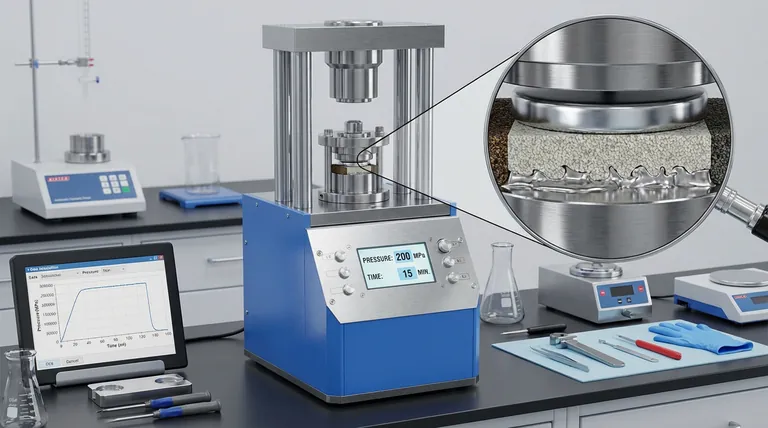
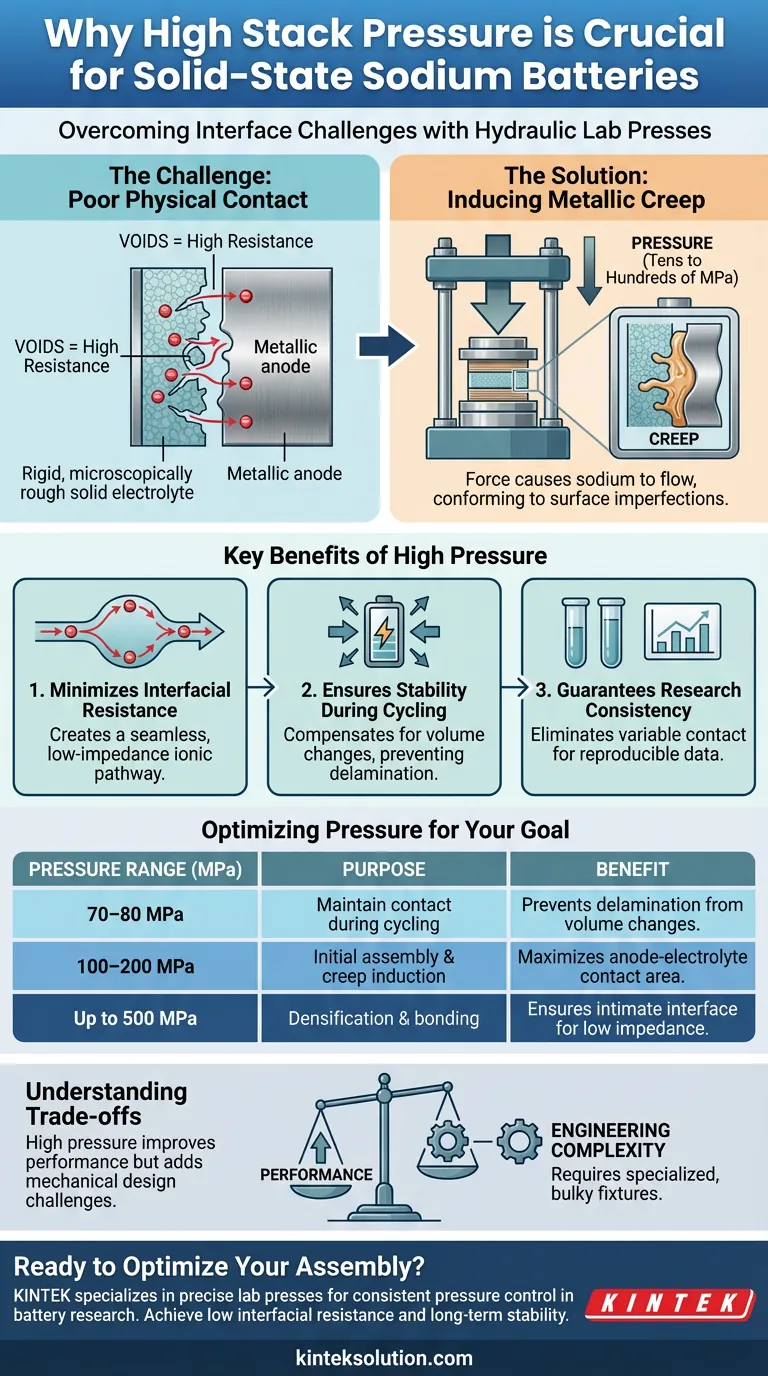
High stack pressure is fundamentally required to induce plastic deformation in the metallic sodium anode. Because solid-state electrolytes are rigid and microscopically rough, simply placing a sodium anode against them creates voids that block ion movement. You must apply significant force—often via a hydraulic press—to trigger "creep," causing the soft metal to flow into these surface imperfections and establish the intimate physical contact necessary for the battery to function.
The core challenge in solid-state batteries is overcoming the high resistance caused by poor contact between rigid layers. Hydraulic pressure solves this by mechanically forcing the anode to conform to the electrolyte's topography, transforming a discontinuous interface into a low-impedance pathway for ions.
Overcoming the Physical Limitations of Solids
The primary reason for using a hydraulic lab press is to manipulate the physical properties of the materials to create a viable interface. Unlike liquid electrolytes that naturally wet a surface, solid components remain distinct and separated unless forced together.
Inducing Metallic Creep
Metallic sodium is relatively soft, but it does not flow on its own.
By applying pressure in the range of tens to hundreds of megapascals (MPa), you exceed the yield strength of the sodium.
This forces the metal to undergo creep, behaving somewhat like a viscous fluid that presses into the microscopic pores and irregularities of the rigid solid electrolyte.
Minimizing Interfacial Resistance
The microscopic voids between the anode and electrolyte act as insulators.
If these voids remain, the effective contact area is low, leading to extremely high interfacial resistance (impedance).
High pressure eliminates these voids, creating a seamless, low-impedance solid-solid interface that allows lithium or sodium ions to transport efficiently.
Ensuring Stability During Operation
Pressure is not just required for initial assembly; it plays a critical role in the dynamic environment of a cycling battery.
Compensating for Volume Changes
During charge and discharge cycles, the active materials in the battery expand and contract.
Without external constraint, this "breathing" can cause the anode to detach from the electrolyte, breaking the ionic pathway.
Continuous external pressure (often 70–80 MPa or higher) accommodates these volumetric changes, forcing the layers to remain in contact even as they shift physically.
Maintaining Ionic Pathways
Long-term cycling stability depends on keeping the internal highways for ions open.
In-situ compression ensures that as interfacial stress relaxation occurs, the contact remains intimate.
References indicate that maintaining pressures around 200 MPa during cycling is key to achieving stable performance over hundreds of cycles.
The Role of Consistency in Research
For the technical advisor or researcher, the hydraulic press is also a tool for data integrity.
Eliminating Variable Contact
If pressure is applied unevenly or solely by hand, the contact area will vary wildly between different test cells.
This introduces a major variable—interfacial resistance—that skews electrochemical data.
Ensuring Reproducibility
Using a hydraulic press to maintain a consistent forming pressure ensures that the interface quality is identical across all samples.
This allows you to obtain repeatable impedance spectra and cycling data, ensuring that your results reflect the material properties rather than assembly variations.
Understanding the Trade-offs
While high pressure is beneficial for performance, it introduces mechanical complexity to the battery design.
Engineering Complexity
Implementing high stack pressure requires bulky, specialized testing fixtures capable of maintaining force (e.g., 1–17 MPa or up to 200 MPa) over long periods.
This moves the challenge from pure chemistry to mechanical engineering, as the setup must actively compensate for volume changes without losing pressure.
Risk of Material Stress
Applying immense pressure (up to 500 MPa for bonding) requires precise control to densify layers without damaging the structural integrity of the brittle solid electrolyte.
Making the Right Choice for Your Goal
The application of pressure is a tunable variable that changes based on what you are trying to optimize in your solid-state assembly.
- If your primary focus is lowering initial impedance: Use high forming pressure (hundreds of MPa) during assembly to maximize sodium creep and surface coverage.
- If your primary focus is long-term cycle life: Prioritize an in-situ compression setup that maintains continuous pressure (e.g., 70-80 MPa) to prevent delamination during volume expansion.
- If your primary focus is comparative research: Standardize your pressing protocol strictly to ensure that variations in performance are due to material differences, not inconsistent contact areas.
Ultimately, the hydraulic press is not just an assembly tool; it is the mechanism that bridges the gap between a collection of rigid parts and a cohesive, functioning electrochemical system.
Summary Table:
| Pressure Range (MPa) | Purpose | Benefit |
|---|---|---|
| 70–80 MPa | Maintain contact during cycling | Prevents delamination from volume changes |
| 100–200 MPa | Initial assembly and creep induction | Maximizes anode-electrolyte contact area |
| Up to 500 MPa | Densification and bonding | Ensures intimate interface for low impedance |
Ready to optimize your solid-state battery assembly with precise pressure control? KINTEK specializes in lab press machines, including automatic, isostatic, and heated lab presses, designed to meet the demanding requirements of battery research. Our hydraulic presses ensure consistent, reproducible pressure application—critical for achieving low interfacial resistance and long-term cycling stability in solid-state batteries with metallic sodium anodes. Contact us today to discuss how our solutions can enhance your laboratory's efficiency and accuracy!
Visual Guide
Related Products
- 24T 30T 60T Heated Hydraulic Lab Press Machine with Hot Plates for Laboratory
- Laboratory Hydraulic Press 2T Lab Pellet Press for KBR FTIR
- Automatic Laboratory Hydraulic Press Lab Pellet Press Machine
- Manual Heated Hydraulic Lab Press with Integrated Hot Plates Hydraulic Press Machine
- Laboratory Hydraulic Press Lab Pellet Press Machine for Glove Box
People Also Ask
- Function of a Laboratory Hydraulic Press with Heated Platens in SSE? Enhance Battery Density & Conductivity
- Why is a laboratory hydraulic press with heating plates required for PLA/TEC films? Achieve Precise Sample Integrity
- What role does a laboratory heated hydraulic press play in LTCC? Essential for High-Density Ceramic Lamination
- What role does a laboratory heated hydraulic press play in PI/PA based SPE membranes? Optimize Solid Battery Performance
- Why is a laboratory heated hydraulic press required? Ensure Precise Vulcanization for NBR/EPDM Nanocomposites



















