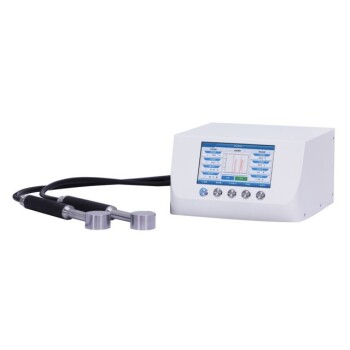
Precision is the defining factor in high-quality nanomaterial synthesis. High-temperature reaction equipment is required for thermal decomposition because the process demands a strictly controlled environment between 200 and 400 degrees Celsius. This equipment provides the necessary regulation of heating curves and reaction times, which is the only way to accurately manage the nucleation and growth rates of iron oxide nanoparticles.
Core Insight: The difference between a usable nanoparticle and a high-performance one lies in the separation of nucleation and growth. Precise temperature control allows you to dictate these phases, resulting in particles with high crystallinity and uniform physical properties.
The Mechanics of Thermal Decomposition
The Necessity of High Temperatures
Thermal decomposition synthesis is not a room-temperature process.
It typically requires a thermal environment ranging from 200 to 400 degrees Celsius.
This heat is necessary to activate the reaction between the precursors, coordinating solvents, and ligand stabilizers.
Regulating Heating Curves
Standard heating equipment often fluctuates or ramps up temperature unpredictably.
Specialized high-temperature equipment allows for the accurate regulation of heating curves.
You must be able to control exactly how fast the system heats up and how stable the temperature remains during the reaction time.
Why Precision Control Yields Quality
Controlling Nucleation and Growth
The formation of nanoparticles happens in two distinct stages: nucleation (the initial birth of the crystal) and growth (the increase in size).
Precise equipment allows you to strictly control the rates of both stages.
By managing these rates, you prevent them from overlapping chaotically, which is essential for synthesis success.
Achieving Narrow Size Distribution
When temperature control is loose, particles nucleate at different times, leading to a mix of large and small particles.
Strict control ensures the size distribution remains narrow.
This uniformity is a hallmark of high-quality synthesis.
Ensuring High Crystallinity
Temperature stability directly impacts the internal structure of the particle.
Precise thermal control results in high crystallinity.
This means the atoms within the iron oxide are arranged in a highly ordered structure, rather than a defective or amorphous one.
The Risks of Inadequate Control
The Consequence of Thermal Fluctuations
If the equipment cannot maintain the specific 200–400°C window accurately, the physicochemical properties of the output will vary.
You will lose the uniformity that makes these nanoparticles valuable for advanced applications.
Compromised Particle Integrity
Without the ability to regulate the heating curve, you cannot optimize the reaction time.
This leads to poor reproducibility between batches.
The final product may lack the uniform physicochemical properties required for reliable performance.
Making the Right Choice for Your Goal
To achieve the best results in iron oxide nanoparticle synthesis, align your equipment capabilities with your specific quality metrics.
- If your primary focus is Monodispersity: You must prioritize equipment that offers granular control over heating curves to separate nucleation from growth.
- If your primary focus is Structural Quality: You need a system capable of sustaining high temperatures (up to 400°C) without fluctuation to ensure high crystallinity.
Ultimately, the precision of your temperature control directly dictates the uniformity and quality of your final nanomaterial.
Summary Table:
| Feature | Requirement for Synthesis | Impact on Nanoparticles |
|---|---|---|
| Temperature Range | 200°C to 400°C | Activates precursors and stabilizers |
| Heating Curves | Accurate regulation | Separates nucleation from growth phases |
| Thermal Stability | Minimal fluctuation | Ensures high crystallinity and ordered structure |
| Process Control | Strict timing/ramping | Achieves narrow size distribution (monodispersity) |
Elevate Your Nanomaterial Research with KINTEK
Precision is the key to high-performance iron oxide nanoparticles. KINTEK specializes in comprehensive laboratory solutions, offering advanced heating and pressing equipment designed to meet the rigorous demands of thermal decomposition and battery research. Whether you require manual, automatic, or specialized isostatic presses, our equipment ensures the stability and control your synthesis demands.
Ready to achieve superior crystallinity and uniformity? Contact us today to find the perfect solution for your lab!
References
- Khin The Nu Aye, Glauco R. Souza. Advances in the application of iron oxide nanoparticles (IONs and SPIONs) in three-dimensional cell culture systems. DOI: 10.1016/j.slast.2024.100132
This article is also based on technical information from Kintek Solution Knowledge Base .
Related Products
- Automatic High Temperature Heated Hydraulic Press Machine with Heated Plates for Lab
- Laboratory Split Manual Heated Hydraulic Press Machine with Hot Plates
- Warm Isostatic Press for Solid State Battery Research Warm Isostatic Press
- 24T 30T 60T Heated Hydraulic Lab Press Machine with Hot Plates for Laboratory
- Manual Heated Hydraulic Lab Press with Integrated Hot Plates Hydraulic Press Machine
People Also Ask
- Function of a Laboratory Hydraulic Press with Heated Platens in SSE? Enhance Battery Density & Conductivity
- How does a laboratory heated hydraulic press facilitate PBN sample prep for WAXS? Achieve Precise X-Ray Scattering
- What are the requirements for electrode pressing with high-viscosity ionic liquids like EMIM TFSI? Optimize Performance
- What are the industrial applications of heated hydraulic presses? Master Heat & Force for Precision Manufacturing
- Why is a laboratory hydraulic press with heating plates required for PLA/TEC films? Achieve Precise Sample Integrity