
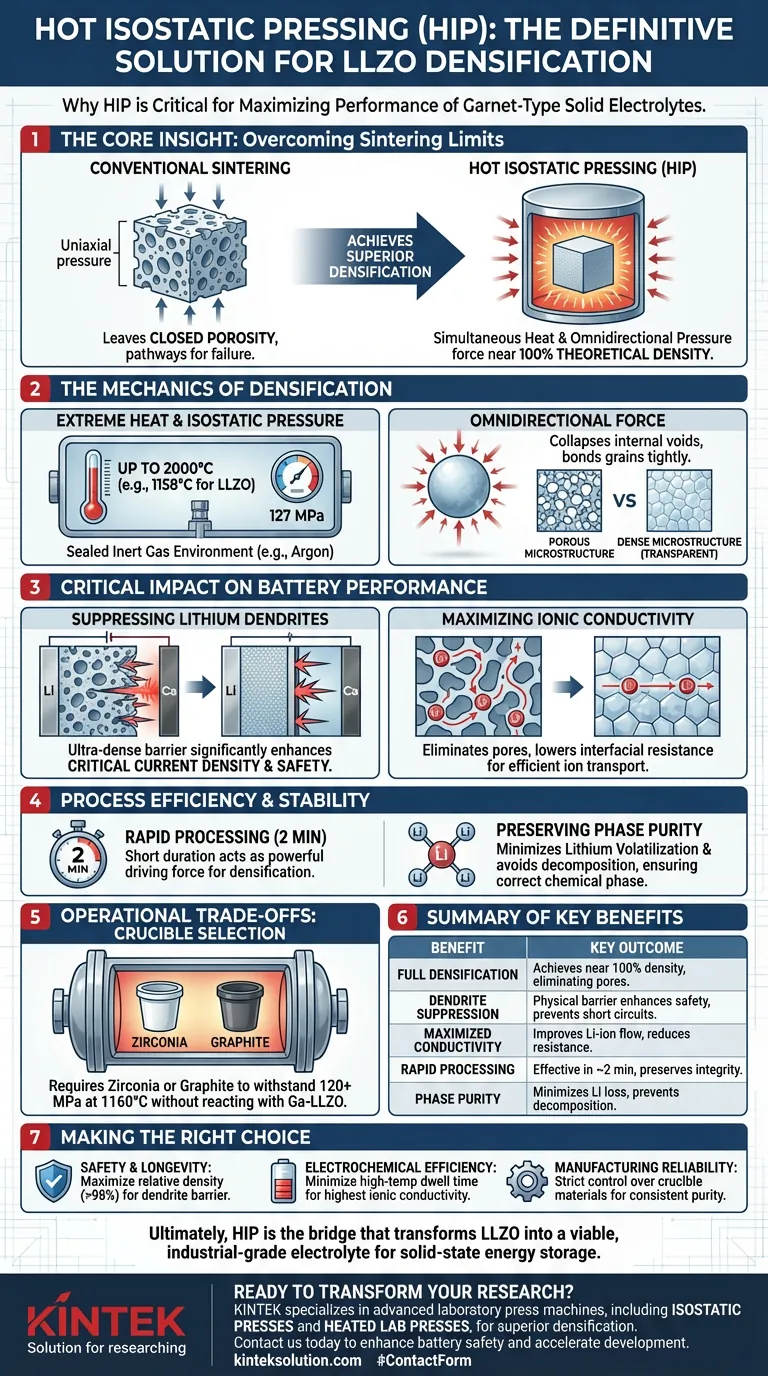
Hot Isostatic Pressing (HIP) is the definitive processing method for maximizing the performance of garnet-type solid electrolytes like LLZO. It addresses the critical limitation of conventional sintering by applying simultaneous high temperature and uniform gas pressure to eliminate microscopic defects that otherwise compromise battery safety and efficiency.
The Core Insight Conventional sintering often leaves closed porosity deep within ceramic structures, creating pathways for failure. HIP resolves this by forcing the material to near 100% theoretical density, which is the physical prerequisite for blocking lithium dendrites and maximizing ionic conductivity.
The Mechanics of Densification
Overcoming the Limits of Sintering
Standard pressureless sintering rarely achieves full density in hard ceramics. Residual internal micropores—specifically closed pores—often remain trapped within the microstructure.
HIP treats the component in a sealed environment using an inert gas, typically argon. It subjects the material to extreme heat (often around 1158°C for LLZO, but capable of up to 2000°C) and isostatic pressure (e.g., 127 MPa).
The Power of Isostatic Pressure
Unlike uniaxial pressing, which applies force from one direction, HIP applies omnidirectional, uniform pressure.
This synergistic action of heat and multi-directional force activates mass transport mechanisms. It collapses internal voids and forces ceramic grains to bond tightly, pushing the material density to approximately 98–100% of its theoretical maximum.
Critical Impact on Battery Performance
Suppressing Lithium Dendrites
The primary threat to solid-state batteries is the growth of lithium dendrites, which can penetrate the electrolyte and cause short circuits.
A HIP-treated electrolyte features an ultra-dense microstructure. This physical barrier effectively suppresses dendrite penetration, significantly enhancing the critical current density and the overall safety profile of the battery cell.
Maximizing Ionic Conductivity
Porosity acts as a barrier to ion flow. By eliminating pores and enhancing grain boundary bonding, HIP lowers the interfacial resistance within the ceramic.
This improved structural continuity allows for more efficient lithium-ion transport. In some cases, the reduction in porosity is so significant that the ceramic body becomes transparent, a visual indicator of its superior structural uniformity and phase purity.
Process Efficiency and Chemical Stability
The Advantage of Rapid Processing
Extended exposure to high heat can be detrimental to LLZO, leading to lithium volatilization (loss of lithium) or the formation of secondary impurity phases.
HIP is highly effective because it acts as a powerful driving force for rapid densification. Treatments can be effective in durations as short as 2 minutes.
Preserving Phase Purity
Because the dwell time at peak temperature is minimized, the chemical integrity of the material is preserved.
This short processing window avoids material decomposition. It ensures the final electrolyte retains the correct chemical phase required for high ionic conductivity, rather than degrading into non-conductive byproducts.
Operational Trade-offs and Requirements
Managing Material Reactivity
While HIP is effective, the extreme conditions require careful management of the processing environment to prevent contamination.
Crucible selection is critical. Materials like zirconia or graphite are required because they possess the thermal stability and mechanical strength to withstand 120+ MPa at 1160°C.
Ensuring Chemical Compatibility
These crucible materials are chemically stable and do not react with the Gallium-doped LLZO (Ga-LLZO) or embedding powders.
Using the correct containment prevents secondary contamination, ensuring the electrolyte remains pure. Using improper materials under these conditions would lead to reaction layers that degrade the electrolyte's performance.
Making the Right Choice for Your Goal
HIP is a high-effort, high-reward process. Use the following guide to determine where to focus your optimization efforts:
- If your primary focus is Safety and Longevity: Prioritize HIP parameters that maximize relative density (aiming for >98%) to create a physical barrier against dendrite propagation.
- If your primary focus is Electrochemical Efficiency: Focus on minimizing the high-temperature dwell time to prevent lithium loss, ensuring the highest possible ionic conductivity.
- If your primary focus is Manufacturing Reliability: strict control over crucible materials (Zirconia/Graphite) is essential to prevent batch contamination and ensure consistent phase purity.
Ultimately, HIP is the bridge that transforms LLZO from a promising ceramic into a viable, industrial-grade electrolyte capable of handling the rigors of solid-state energy storage.
Summary Table:
| Benefit | Key Outcome |
|---|---|
| Full Densification | Achieves near 100% theoretical density, eliminating internal pores. |
| Dendrite Suppression | Creates a physical barrier to prevent short circuits, enhancing safety. |
| Maximized Conductivity | Improves lithium-ion flow by reducing grain boundary resistance. |
| Rapid Processing | Effective densification in as little as 2 minutes, preserving material integrity. |
| Phase Purity | Minimizes lithium loss and prevents decomposition for optimal performance. |
Ready to transform your solid-state battery research with lab-scale precision?
KINTEK specializes in advanced laboratory press machines, including isostatic presses and heated lab presses, designed to meet the exacting demands of materials development for laboratories like yours. Our equipment delivers the controlled, high-pressure, high-temperature environment essential for replicating HIP processes and achieving the superior densification your ceramic electrolytes require.
Contact us today using the form below to discuss how our solutions can help you achieve maximum density, enhance battery safety, and accelerate your development timeline.
Visual Guide
Related Products
- Warm Isostatic Press for Solid State Battery Research Warm Isostatic Press
- Lab Isostatic Pressing Molds for Isostatic Molding
- Electric Lab Cold Isostatic Press CIP Machine
- Automatic Lab Cold Isostatic Pressing CIP Machine
- Electric Split Lab Cold Isostatic Pressing CIP Machine
People Also Ask
- Why must composite cathodes be sealed in vacuum lamination bags for WIP? Ensure Battery Stability and Density
- What is the function of elastic molds in warm isostatic pressing? Achieve Uniform Density in Composite Particles
- How do sacrificial volume materials (SVM) maintain microchannels in isostatic pressing? Ensure Structural Integrity
- How does Warm Isostatic Pressing differ from traditional pressing methods? Unlock Uniform Density for Complex Parts
- What is the significance of temperature control in Warm Isostatic Pressing? Unlock Uniform Densification and Process Stability



















