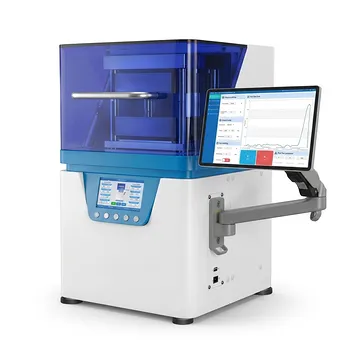
A safety guard serves as a critical physical barrier between the operator and the high loads applied during hydraulic press operations. It is the primary line of defense against catastrophic failures caused by unpredictable variables, such as gauge errors or material fatigue.
Even with skilled operation, the condition of the materials under pressure is often invisible. A safety guard acts as the ultimate failsafe, protecting the operator from the potential explosion of shattered components.
The Reality of Operational Risk
Protection Against the Unknown
Hydraulic presses exert massive force, often on tools or dies with histories that are difficult to verify. The die's prior usage history is a significant variable; invisible stress fractures or metal fatigue can lead to sudden failure under load. Because you cannot always know the integrity of the component, the guard ensures you remain protected if it breaks.
Mitigating Instrumentation Errors
Operators often rely on pressure gauges to stay within safe limits, but these instruments are not infallible. Gauge inaccuracies can lead to the inadvertent application of excessive force. If the pressure exceeds the structural limits of the die or workpiece, the resulting failure projects debris outward; the guard contains this energy.
The Necessity of a Physical Barrier
The guard provides a tangible separation between human and machine. It is designed to withstand impact, shielding the operator from high-velocity fragments. To function correctly, the guard must always be kept closed during the pressing cycle.
Common Safety Pitfalls
The Illusion of Consistency
A dangerous mindset is assuming that because a procedure worked safely once, it will do so again. Relying on "standard" pressure readings is risky because of the previously mentioned potential for gauge inaccuracy. Never let routine lull you into skipping the use of the guard.
Misunderstanding Safety Features
While hydraulic presses often include internal safety mechanisms like pressure relief valves, these are designed to protect the machine from overload. They do not protect the operator from flying debris if a die shatters. Do not confuse internal pressure regulation with external physical protection; the guard is irreplaceable.
Making the Right Choice for Safety
When operating or supervising the use of a hydraulic press, your approach should be dictated by the potential for failure.
- If your primary focus is Operator Safety: Ensure the guard is physically closed before any pressure is applied, regardless of how light the load appears to be.
- If your primary focus is Risk Mitigation: Treat every die and gauge as potentially faulty; rely on the guard as the only guarantee against injury from mechanical failure.
The guard is not just a compliance requirement; it is the only thing standing between you and the unpredictable physics of high-pressure failure.
Summary Table:
| Safety Concern | Role of the Safety Guard | Why It Is Essential |
|---|---|---|
| Material Fatigue | Contains debris from shattered dies | Stress fractures are often invisible to the eye. |
| Gauge Inaccuracy | Shields against unexpected over-pressure | Instruments can fail or provide false readings. |
| Operator Protection | Provides a physical barrier | Prevents high-velocity fragments from causing injury. |
| Machine Safety Valves | Complements internal systems | Internal valves protect the machine; guards protect the person. |
Maximize Your Lab Safety with KINTEK Solutions
Don’t leave your operator safety to chance. KINTEK specializes in comprehensive laboratory pressing solutions, offering manual, automatic, heated, and multifunctional models designed with rigorous safety standards. Whether you are performing battery research or material testing, our equipment—including glovebox-compatible, cold, and warm isostatic presses—provides the reliability and protection your facility deserves.
Ready to upgrade your laboratory safety and precision? Contact our experts today to find the perfect pressing solution for your application.
Related Products
- Laboratory Hydraulic Press Lab Pellet Press Machine for Glove Box
- Laboratory Hydraulic Press 2T Lab Pellet Press for KBR FTIR
- Automatic Heated Hydraulic Press Machine with Heated Plates for Laboratory
- Automatic Hydraulic Hot Press with Large Plate and Precision Temperature Control for Advanced Material Sample Preparation and Industrial Research
- Laboratory Hydraulic Pellet Press for XRF KBR FTIR Lab Press
People Also Ask
- How does a laboratory hydraulic press contribute to the preparation of Li3-3xScxSb samples? Optimize Ionic Conductivity
- What is the function of a laboratory hydraulic press in FT-IR of curcumin-coated MWCNTs? Achieve Optical Clarity.
- Why is a laboratory hydraulic press required for compression molding boron-siloxane? Solve High-Loading Density Challenges
- What role does a laboratory hydraulic press play in the preparation of piezoelectric ceramic discs for DC-PG? | KINTEK
- What role does a laboratory hydraulic press play in reaction pellets? Optimizing Lunar Soil and Metal Fuel Density