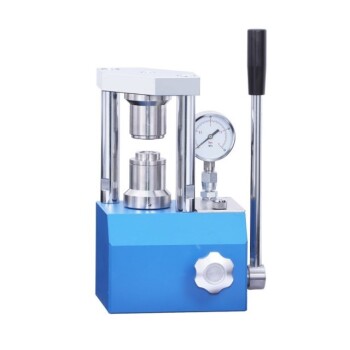
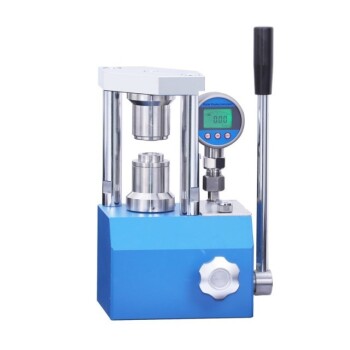
Applying a precise pressure of 10N is a fundamental requirement when assembling solid-state lithium batteries in Swagelok-type cells. Because solid components cannot naturally flow to fill gaps like liquid electrolytes, this specific mechanical force is necessary to create intimate physical contact between the cathode, solid electrolyte, and lithium anode. Without this pressure, microscopic voids would sever the ionic pathway, leading to high internal resistance and unreliable test data.
The core challenge in solid-state batteries is that rigid interfaces do not inherently bond. Applying 10N of pressure mechanically forces these solid layers together, minimizing interfacial impedance and ensuring the efficient ion transport necessary for valid electrochemical testing.
The Physics of Solid-Solid Interfaces
Overcoming the Lack of Fluidity
In traditional batteries, liquid electrolytes easily wet the electrode surfaces, filling every pore and ensuring ionic conductivity. Solid-state electrolytes lack this fluidity.
Without external force, the "contact" between the solid electrolyte and the electrodes is merely points touching points, leaving significant gaps. Applying 10N ensures these rigid particles are pressed into a continuous, active interface.
Minimizing Interfacial Resistance
The primary enemy of battery performance is internal resistance (impedance). In solid-state cells, the majority of this resistance occurs at the interfaces between layers.
By applying 10N, you maximize the effective contact area. This directly lowers the interfacial resistance, allowing lithium ions to transport smoothly across the boundary between the anode, electrolyte, and cathode.
Ensuring Test Validity
Standardizing the pressure at 10N removes a critical variable from your experiments. If pressure varies between cells, differences in performance might be due to contact quality rather than the material properties you are trying to test.
The Role of Pressure in Cell Integrity
Sealing and Environmental Isolation
Beyond ionic conductivity, the pressure in a Swagelok cell contributes to the hermetic seal of the assembly.
A properly calibrated press isolates internal components from external air and moisture. This is vital because many solid electrolytes and lithium metal anodes are highly reactive and will degrade instantly if exposed to the atmosphere.
Compensating for Volume Changes
During the charging and discharging process (cycling), electrode materials—particularly lithium metal—undergo expansion and contraction.
While Swagelok cells provide a static constraint, the initial 10N pressure helps suppress the formation of new voids during these volume changes. It helps maintain contact even as the internal geometry of the cell shifts slightly during operation.
Understanding the Trade-offs
The Risk of Over-Pressurization
While pressure is essential, more is not always better. Excessive pressure (significantly beyond the optimized 10N for this cell type) can induce material degradation.
Thermodynamic analysis suggests that over-pressurization can trigger unwanted phase changes in the materials. Furthermore, excessive force can mechanically damage the separator or electrolyte, potentially leading to short circuits.
Static vs. Dynamic Pressure limits
It is important to recognize that a Swagelok cell applies a fixed mechanical constraint, unlike advanced setups that use hydraulic frames to apply constant pressure (e.g., 15-80 MPa) that adapts to expansion.
Therefore, while 10N is perfect for initial contact in this hardware, it relies on the elasticity of the cell components to maintain that contact over long-term cycling.
Making the Right Choice for Your Goal
When setting up your solid-state battery testing, the application of pressure is as critical as the chemistry itself.
- If your primary focus is reducing impedance: Ensure the 10N force is applied uniformly to maximize contact area and facilitate ion transport.
- If your primary focus is data reproducibility: Use a calibrated torque wrench or press to ensure every single cell is assembled with exactly 10N, eliminating assembly variation.
Precise mechanical control is the bridge that turns raw materials into a functioning, testable solid-state electrochemical system.
Summary Table:
| Feature | Impact of 10N Pressure on Swagelok Cells |
|---|---|
| Interfacial Contact | Eliminates microscopic voids between rigid solid layers |
| Ionic Conductivity | Minimizes impedance by maximizing the effective contact area |
| Test Consistency | Standardizes assembly variables for reproducible research data |
| Cell Integrity | Assists in hermetic sealing against moisture and air |
| Volume Management | Compensates for electrode expansion during charge/discharge cycles |
Elevate Your Battery Research with KINTEK Precision
Achieving the perfect 10N contact is just the beginning. KINTEK specializes in comprehensive laboratory pressing solutions designed for the rigorous demands of solid-state battery assembly. Whether you need manual, automatic, heated, or glovebox-compatible models, our equipment ensures the precise mechanical control necessary for valid electrochemical testing.
From high-pressure cold and warm isostatic presses to specialized Swagelok assembly tools, we provide the stability your research deserves. Contact KINTEK today to discover how our laboratory solutions can enhance your lab's efficiency and data accuracy.
Related Products
- Manual Button Battery Sealing Machine for Battery Sealing
- Lab Button Battery Disassembly and Sealing Mold
- Lab Cylindrical Press Mold for Laboratory Use
- Button Battery Sealing Machine for Button Batteries
- Laboratory Hydraulic Split Electric Lab Pellet Press
People Also Ask
- Why is a laboratory hydraulic press or battery sealing machine essential? Ensure Coin Cell Data Integrity
- How do laboratory battery sealing machines ensure performance consistency? Master Your Lithium and LFP Battery Assembly
- Why is stable pressure control necessary when assembling SC-NCM83/PLM-3/Li batteries? Optimize Solid-State Interfaces
- How does the mechanical pressure provided by a laboratory crimper affect the performance of assembled 2032-type coin cells?
- What role does a laboratory press perform for CR2032 coin cell assembly? Ensure Precision in Battery Research