
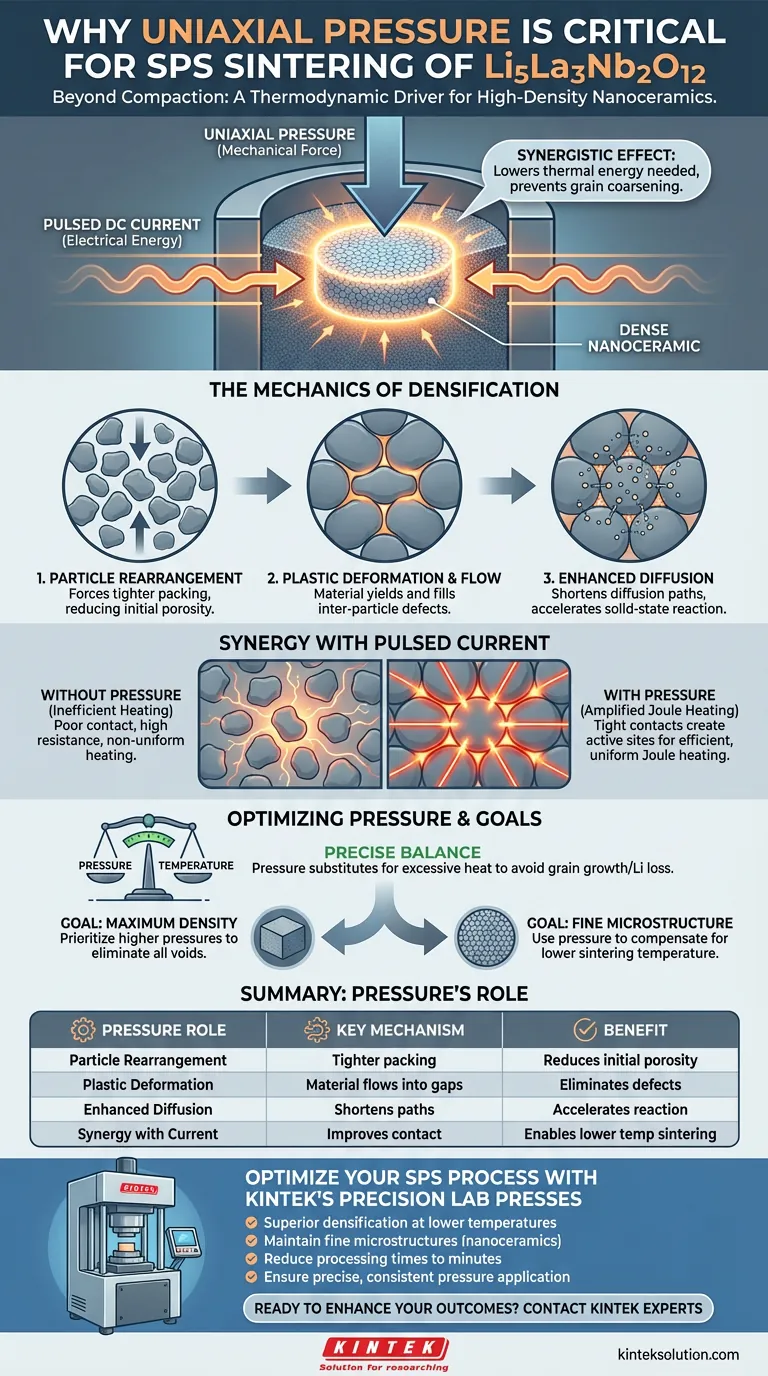
Applying uniaxial pressure during Spark Plasma Sintering (SPS) is not merely about compaction; it is a critical thermodynamic driver. For Li5La3Nb2O12 powder, this pressure mechanically forces particle rearrangement and plastic deformation while simultaneously enhancing the efficiency of the pulsed current to close voids. Without this pressure, the rapid densification at lower temperatures—the primary advantage of SPS—would be impossible.
The Core Takeaway Pressure in SPS acts as a catalyst that lowers the thermal energy required for sintering. By mechanically forcing particles together, you create a "synergistic effect" with the pulsed current, allowing you to achieve high-density nanoceramics in minutes rather than hours, effectively preventing grain coarsening.
The Mechanics of Densification
The primary role of uniaxial pressure (typically 37.5–70 MPa in SPS) is to physically eliminate porosity before and during the heating phase.
Particle Rearrangement and Plastic Flow
When pressure is applied, loose powder particles are physically shoved into a tighter packing configuration. This forces particle rearrangement, reducing the initial volume of voids.
As temperature rises, the pressure induces plastic deformation at the contact points. The material yields and flows into remaining gaps, eliminating inter-particle pores that would otherwise remain as defects.
Enhancing Material Diffusion
Densification relies on mass transport—moving atoms from one place to another to bond particles.
Pressure increases the contact area between individual grains. This close contact shortens the diffusion path, promoting rapid material migration and ensuring the solid-state reaction is completed quickly.
The Synergistic Effect with Pulsed Current
SPS is unique because it combines mechanical force with electrical current. The pressure is essential for optimizing the electrical side of this equation.
Amplifying Joule Heating
The pulsed direct current generates heat internally (Joule heating). Uniaxial pressure ensures tight contact points between particles.
These contact points become active sites for plasma discharge and localized heating. Enhanced contact ensures the current passes through the powder bed efficiently, leading to uniform heat conduction throughout the sample.
Lowering the Sintering Threshold
Pressure acts as a driving force that works in parallel with heat.
By adding mechanical energy, you reduce the amount of thermal energy required to overcome sintering resistance. This allows for the formation of high-density ceramics at significantly lower temperatures and in shorter times than conventional sintering methods.
Understanding the Trade-offs
While pressure is beneficial, the references highlight the need for precise mechanical pressure.
The Balance of Force and Temperature
Pressure serves as a substitute for excessive heat. If you rely solely on temperature to densify Li5La3Nb2O12, you risk grain growth and lithium loss due to prolonged heating.
However, the pressure must be optimized (e.g., 50 MPa). It must be high enough to expel voids and drive plastic flow, but controlled enough to maintain the structural integrity of the die and the sample during the rapid heating phase.
Making the Right Choice for Your Goal
When setting your SPS parameters for Li5La3Nb2O12, your pressure strategy should align with your specific material objectives.
- If your primary focus is Maximum Density: Prioritize higher pressures (up to the limit of your die) to mechanically eliminate all macroscopic defects and air voids during the plastic flow stage.
- If your primary focus is Fine Microstructure (Nanoceramics): Use pressure to compensate for a lower sintering temperature, which will inhibit grain growth while still achieving full consolidation.
Success in SPS comes from leveraging pressure to achieve full density before the thermal budget degrades your material's microstructure.
Summary Table:
| Pressure Role | Key Mechanism | Benefit for Li5La3Nb2O12 |
|---|---|---|
| Particle Rearrangement | Forces tighter packing | Reduces initial porosity |
| Plastic Deformation | Material flows into gaps | Eliminates inter-particle defects |
| Enhanced Diffusion | Shortens atomic diffusion paths | Accelerates solid-state reaction |
| Synergy with Current | Improves contact for Joule heating | Enables lower temperature sintering |
| Microstructure Control | Compensates for lower temperatures | Inhibits grain coarsening |
Optimize Your SPS Process with KINTEK's Precision Lab Presses
Struggling to achieve high-density nanoceramics like Li5La3Nb2O12 without compromising microstructure? KINTEK's specialized lab press machines (including automatic lab press, isostatic press, and heated lab press systems) provide the precise uniaxial pressure control required for successful Spark Plasma Sintering applications.
Our equipment helps researchers and laboratories:
- Achieve superior densification at lower temperatures
- Maintain fine microstructures by preventing grain growth
- Reduce processing times from hours to minutes
- Ensure consistent results with precise pressure application
Ready to enhance your ceramic sintering outcomes? Contact our SPS experts today to discuss how our lab press solutions can advance your materials research!
Visual Guide
Related Products
People Also Ask
- Function of a Laboratory Hydraulic Press with Heated Platens in SSE? Enhance Battery Density & Conductivity
- What are the requirements for electrode pressing with high-viscosity ionic liquids like EMIM TFSI? Optimize Performance
- How does a laboratory heated hydraulic press facilitate PBN sample prep for WAXS? Achieve Precise X-Ray Scattering
- What are the industrial applications of heated hydraulic presses? Master Heat & Force for Precision Manufacturing
- Why is a laboratory hydraulic press with heating plates required for PLA/TEC films? Achieve Precise Sample Integrity
