
Pressing $Li_xScCl_{3+x}$ powder into a pellet is a fundamental prerequisite for valid data collection, not just a sample preparation step.
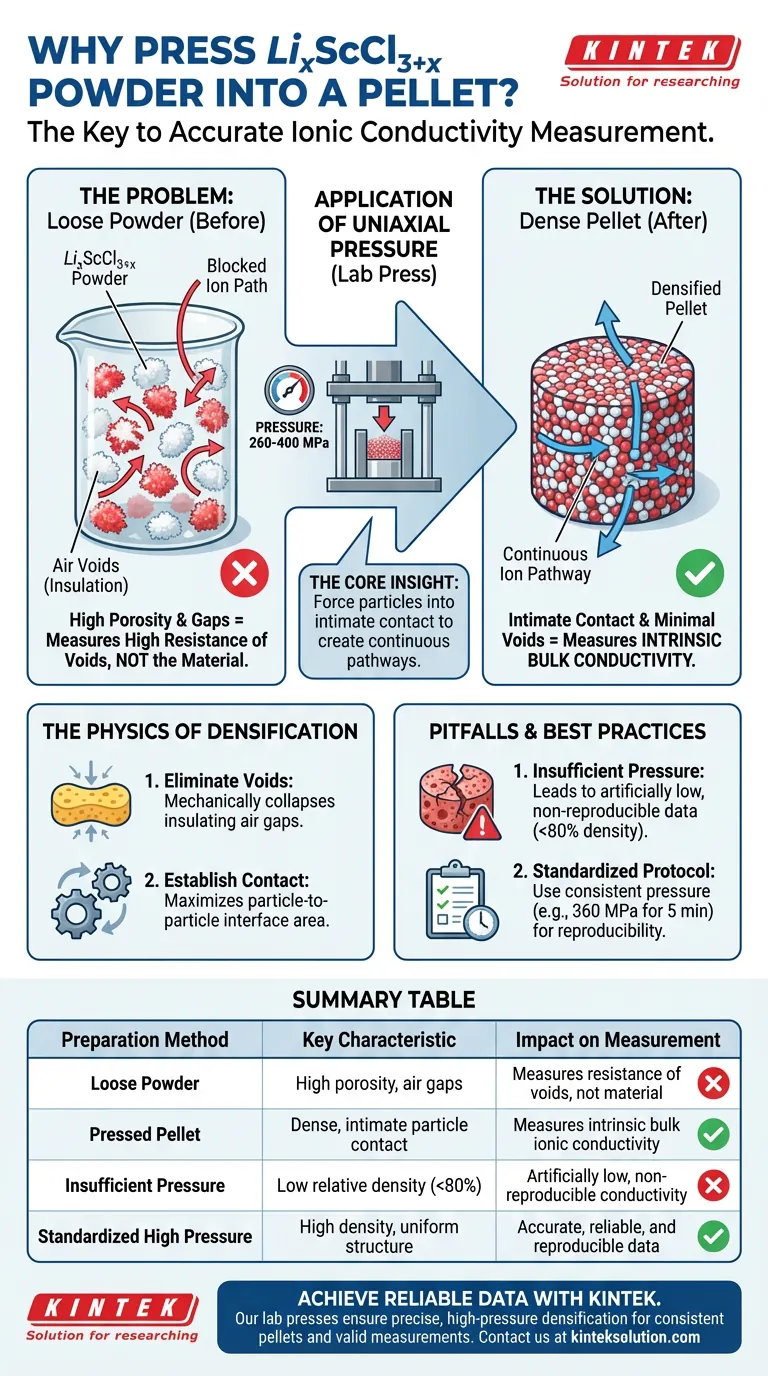
You must use a laboratory press to transform the loose powder into a dense solid because loose particles are separated by air voids, which are electrically insulating. If you attempt to measure the powder without densification, your results will reflect the high resistance of the gaps between particles rather than the actual ionic conductivity of the $Li_xScCl_{3+x}$ material itself.
The Core Insight
Loose powder introduces massive "grain boundary resistance" that masks the material's true performance. By applying uniaxial pressure, you mechanically force particles into intimate contact, creating continuous pathways for lithium ions. This allows Electrochemical Impedance Spectroscopy (EIS) to isolate and measure the intrinsic bulk conductivity of the electrolyte.
The Physics of Densification
Eliminating Voids and Porosity
Solid-state electrolyte powders, including halides like $Li_xScCl_{3+x}$, are naturally porous when loose.
The spaces between these particles act as dead ends for ion transport. A laboratory press applies significant force (often between 260 MPa and 400 MPa depending on the specific protocol) to mechanically collapse these voids. This creates a geometrically dense sample where ions can move freely.
Establishing Intimate Particle Contact
For an ion to move from one grain of powder to another, the grains must be physically touching.
Cold-pressing increases the "packing density" of the sample. This forces the particles together, maximizing the contact area at their interfaces. Without this pressure, the contact points are too few and too weak to support a reliable current.
Why Density Dictates Accuracy
Reducing Grain Boundary Resistance
In solid electrolytes, resistance comes from two sources: the material itself (bulk) and the interfaces between grains (grain boundary).
In a loose powder, the grain boundary resistance is exponentially high due to air gaps. Pressing the pellet minimizes this specific type of resistance. It ensures that the resistance you measure is not dominated by poor contact.
Revealing Intrinsic Properties
Your goal is to measure the "intrinsic" properties of the $Li_xScCl_{3+x}$ structure.
If the sample is not densified, the impedance data will be distorted by surface effects. A highly dense pellet ensures the measurement current travels primarily through the bulk material, providing a conductivity value that represents the true capability of the chemistry.
Common Pitfalls in Pellet Preparation
The Risk of Insufficient Pressure
Applying pressure is not enough; you must apply sufficient pressure to reach a high relative density (often targeting >80%).
If the pressure is too low, the pellet will remain porous. This leads to artificially low conductivity readings that discredit the material's actual potential.
Inconsistent Densification
The pressure applied must be uniform (uniaxial).
If the pressing process is uneven, the pellet may have localized areas of high resistance. This results in noisy data and poor reproducibility across different samples of the same material.
Making the Right Choice for Your Goal
To ensure your ionic conductivity measurements are defensible and accurate, consider the following approach regarding your pressing parameters:
- If your primary focus is Material Characterization: Apply the maximum safe pressure for your die set (e.g., 300–400 MPa) to minimize porosity and isolate the material's maximum theoretical conductivity.
- If your primary focus is Process Reproducibility: Establish a strict, standardized pressure protocol (e.g., exactly 360 MPa for 5 minutes) to ensure that variations in data are due to chemical synthesis, not sample preparation.
Ultimately, the validity of your conductivity data is directly proportional to the density of your pellet.
Summary Table:
| Preparation Method | Key Characteristic | Impact on Measurement |
|---|---|---|
| Loose Powder | High porosity, air gaps | Measures resistance of voids, not material |
| Pressed Pellet | Dense, intimate particle contact | Measures intrinsic bulk ionic conductivity |
| Insufficient Pressure | Low relative density (<80%) | Artificially low, non-reproducible conductivity |
| Standardized High Pressure | High density, uniform structure | Accurate, reliable, and reproducible data |
Ready to achieve reliable and reproducible solid-state electrolyte data?
Your research on materials like LixScCl3+x depends on high-quality sample preparation. KINTEK specializes in laboratory press machines, including automatic, isostatic, and heated lab presses, designed to deliver the precise, high-pressure densification your work requires.
We help researchers like you eliminate grain boundary resistance and obtain accurate ionic conductivity measurements by providing equipment that ensures consistent, high-density pellets every time.
Contact us today to discuss how our lab presses can enhance your material characterization workflow and ensure the validity of your data. #ContactForm
Visual Guide
Related Products
- Laboratory Hydraulic Split Electric Lab Pellet Press
- Automatic Laboratory Hydraulic Press for XRF and KBR Pellet Pressing
- Warm Isostatic Press for Solid State Battery Research Warm Isostatic Press
- Lab XRF Boric Acid Powder Pellet Pressing Mold for Laboratory Use
- Manual Cold Isostatic Pressing CIP Machine Pellet Press
People Also Ask
- What are the emerging trends in the design and materials of lab pellet presses? Modernize Your Lab Efficiency
- How do lab pellet presses support customization and flexibility? Optimize Your Sample Prep for Any Material
- What are common lab pellet press issues? Expert Troubleshooting Guide for Reliable Material Research
- What are the common operational types of lab pellet presses? Choosing the Right Manual, Automatic, or Hydraulic System
- Why use a laboratory pellet press for solid-state battery evaluation? Ensure Accuracy in Interface Stability Testing















