
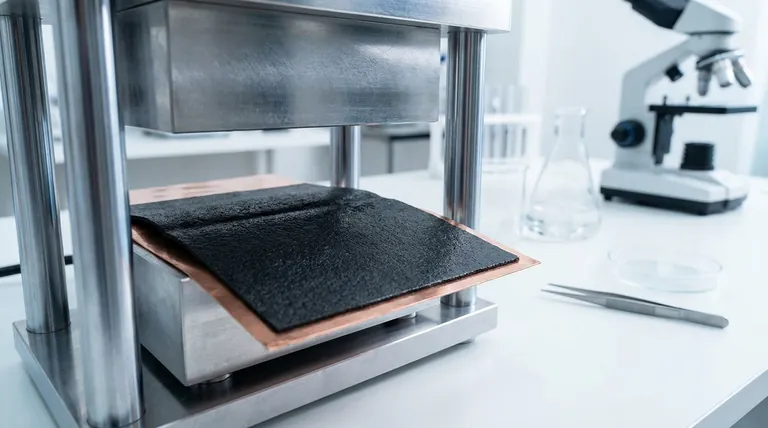
The use of a hydraulic press is a fundamental requirement for converting coated recycled graphite into a functional battery electrode. This process, technically known as calendering, applies precise mechanical force to compact the electrode material, which is essential for maximizing energy density, ensuring structural integrity, and minimizing electrical resistance.
Core Takeaway Simply coating the graphite is insufficient; the material remains too porous and loosely bound for efficient operation. A hydraulic press is required to physically densify the electrode, eliminating microscopic voids to ensure the battery creates a stable, high-energy, and low-resistance electrical circuit.
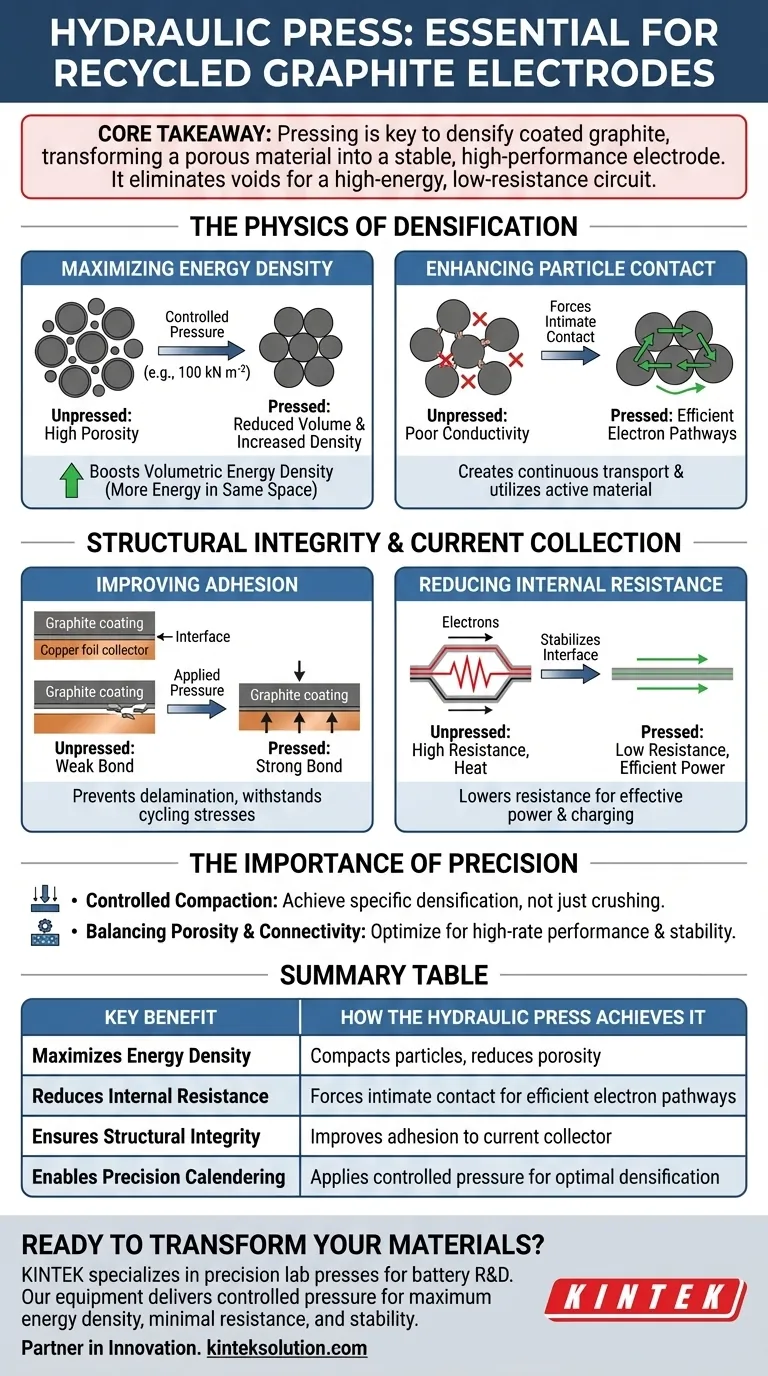
The Physics of Electrode Densification
Maximizing Volumetric Energy Density
The primary role of the hydraulic press is to compact the graphite particles within the coated layer. By applying controlled pressure (such as 100 kN m⁻²), you significantly reduce the volume of the electrode without changing its mass.
This reduction in porosity increases the overall density of the electrode. Consequently, this directly boosts the battery's volumetric energy density, allowing it to store more energy in the same amount of physical space.
Enhancing Particle-to-Particle Contact
In an unpressed state, active material particles often have gaps between them, leading to poor conductivity. The hydraulic press forces these particles into intimate contact with one another.
This creates continuous, efficient pathways for electron transport throughout the coating. By eliminating voids, you ensure that the active material is fully utilized during electrochemical reactions.
Structural Integrity and Current Collection
Improving Adhesion to the Current Collector
The hydraulic press performs a critical mechanical function at the interface between the graphite and the copper foil. The applied pressure significantly improves the adhesion between the active material layer and the current collector.
This ensures good mechanical integrity, preventing the coating from delaminating or flaking off. A robust mechanical bond is vital for the electrode to withstand the physical stresses of repeated battery cycling.
Reducing Internal Resistance
High internal resistance is a primary cause of efficiency loss and heat generation in batteries. The calendering process effectively lowers this resistance by stabilizing the interface between the particles and the copper foil.
By ensuring a tight, low-resistance electrical contact, the press facilitates efficient electron transport. This allows the battery to deliver power more effectively and charge more efficiently.
The Importance of Precision
Controlled Compaction
While pressure is necessary, the references highlight the need for applying a precise pressure. The goal is not merely to crush the material, but to achieve a specific level of densification.
Balancing Porosity and Connectivity
The process is about optimization. You are using the press to minimize unnecessary porosity while creating a dense, interconnected network. This balance is fundamental to achieving high-rate performance and electrochemical stability.
Making the Right Choice for Your Goal
To optimize your recycled graphite electrodes, consider your specific performance targets when determining pressure settings:
- If your primary focus is Energy Capacity: Prioritize high-pressure calendering to maximize the compaction of graphite particles, thereby increasing the volumetric energy density.
- If your primary focus is Cycle Life and Efficiency: Focus on achieving uniform adhesion to the current collector to lower internal resistance and ensure mechanical stability over time.
Ultimately, the hydraulic press transforms a loose coating into a high-performance component capable of efficient energy storage and delivery.
Summary Table:
| Key Benefit | How the Hydraulic Press Achieves It |
|---|---|
| Maximizes Energy Density | Compacts graphite particles to reduce porosity, storing more energy in the same space. |
| Reduces Internal Resistance | Forces particles into intimate contact, creating efficient pathways for electron transport. |
| Ensures Structural Integrity | Improves adhesion to the current collector, preventing delamination during cycling. |
| Enables Precision Calendering | Applies controlled, specific pressure (e.g., 100 kN m⁻²) for optimal densification. |
Ready to transform your coated materials into high-performance electrodes?
At KINTEK, we specialize in precision lab press machines, including automatic and heated hydraulic presses, designed specifically for the exacting demands of battery research and development. Our equipment delivers the controlled pressure you need to achieve maximum energy density, minimal internal resistance, and long-term structural stability in your recycled graphite electrodes.
Let KINTEK be your partner in innovation. Contact our experts today to discuss how our lab presses can optimize your electrode calendering process and accelerate your battery development projects.
Visual Guide
Related Products
- Automatic Laboratory Hydraulic Press for XRF and KBR Pellet Pressing
- Laboratory Hydraulic Pellet Press for XRF KBR FTIR Lab Press
- Laboratory Hydraulic Press 2T Lab Pellet Press for KBR FTIR
- Laboratory Hydraulic Split Electric Lab Pellet Press
- Manual Laboratory Hydraulic Pellet Press Lab Hydraulic Press
People Also Ask
- Why is pressing powder into a pellet critical before sintering? Ensure Dense, Conductive Solid-State Electrolytes
- What is the role of a laboratory pressure machine and KBr in FTIR? Master Sample Preparation for Flame Retardants
- What are the advantages of using a laboratory automatic hydraulic press for HEA green compact forming?
- What are the advantages of using a lab automatic hydraulic press for HEA green body molding? Ensure Material Integrity
- What are the advantages of using an automatic laboratory hydraulic press? Enhance Precision in Sample Preparation


















