
Compacting electrolyte powder into a dense pellet is a prerequisite for successful solid-state synthesis, not merely a shaping procedure.
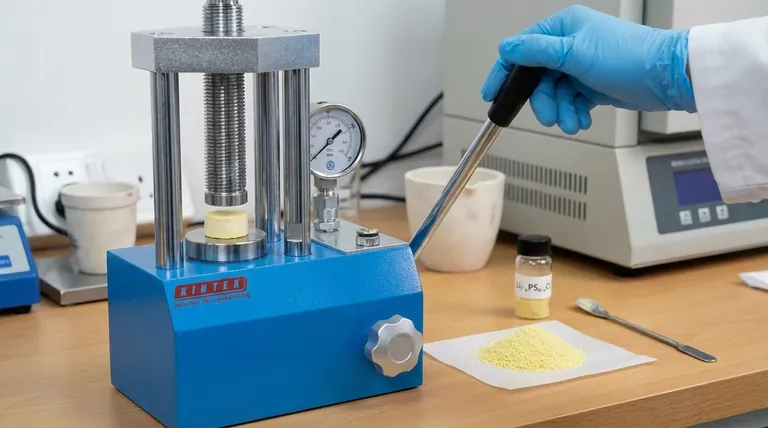
The use of a laboratory hydraulic press is necessary to transform the loose $Li_{7−x}PS_{6−x}Cl_x$ powder into a "green pellet" with intimate particle-to-particle contact. Without this mechanical compression, the subsequent annealing process will fail to facilitate the necessary atomic diffusion, resulting in a material that lacks phase purity and structural uniformity.
Core Takeaway In solid-state synthesis, chemical reactions rely entirely on physical contact points rather than fluid mixing. Pressing the powder eliminates air voids and bridges the reactants, creating the essential diffusion pathways required to crystallize a highly conductive, argyrodite-type electrolyte during heat treatment.
The Physics of Solid-State Synthesis
Maximizing Contact Area
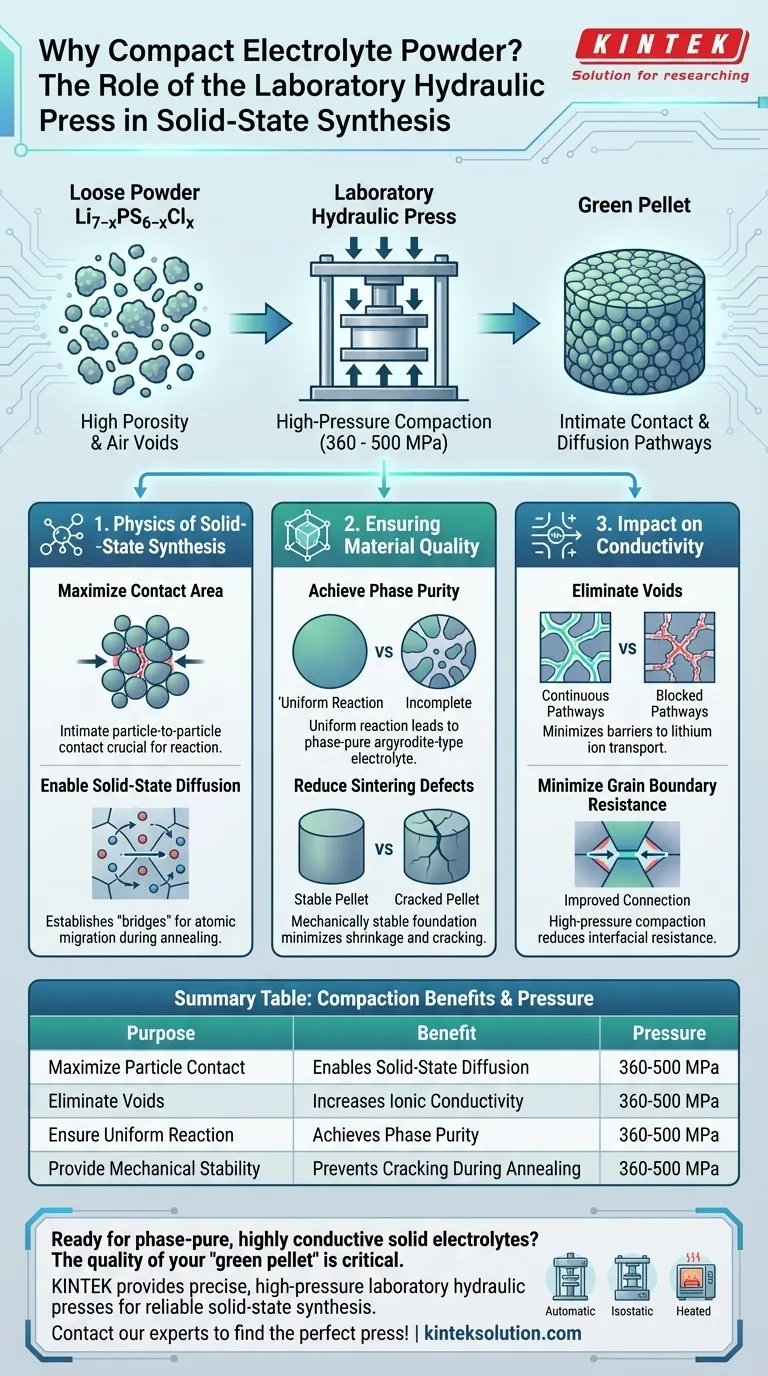
Loose powder contains significant void space filled with air. A laboratory hydraulic press applies high pressure (often ranging from 360 to 500 MPa) to mechanically force particles together.
This creates intimate physical contact between reactant particles. This proximity is the fundamental requirement for the chemical reaction to occur efficiently.
Enabling Solid-State Diffusion
Unlike liquid reactions where ingredients mix freely, solid-state reactions require atoms to physically migrate from one particle to another. This process is known as solid-state diffusion.
Compacting the pellet establishes the "bridges" that allow atoms to diffuse across grain boundaries during the annealing process. Without high-density compaction, the diffusion distance is too great, and the reaction remains incomplete.
Ensuring Material Quality
Achieving Phase Purity
For argyrodite-type electrolytes like $Li_{7−x}PS_{6−x}Cl_x$, achieving the correct crystal structure is critical.
A well-compacted pellet ensures the reaction proceeds uniformly throughout the material. This leads to a high reaction conversion rate, resulting in a final product that is phase-pure rather than a mixture of unreacted precursors and unwanted byproducts.
Reducing Sintering Defects
The "green pellet" formed by the press provides a mechanically stable foundation for the heat treatment.
Starting with a high initial density significantly reduces the amount of shrinkage that occurs during annealing. This prevents mechanical failures such as cracking or deformation, ensuring the final ceramic retains its structural integrity.
The Impact on Conductivity
Eliminating Voids
The primary enemy of ionic conductivity is porosity. Voids act as barriers that block the movement of lithium ions.
By minimizing voids before the material is even heated, the hydraulic press sets the stage for a final product with high relative density. This creates continuous pathways for ion transport, which is essential for battery performance.
Minimizing Grain Boundary Resistance
Ionic resistance often spikes at the interface between particles (grain boundaries).
High-pressure compaction improves the connection at these boundaries. By reducing the grain boundary resistance, the intrinsic properties of the material are realized, leading to higher overall ionic conductivity and better high-rate performance.
Understanding the Trade-offs
Mechanical Stability vs. Handling
While the green pellet is compacted, it is not yet sintered. It possesses specific mechanical strength derived from cold pressing, but it remains relatively fragile compared to the final ceramic.
Operators must handle these pellets with care to avoid introducing micro-cracks before the annealing step, which would negate the benefits of the compaction.
Uniformity of Pressure
Applying pressure uniaxially (from one direction) can sometimes lead to density gradients, where the top of the pellet is denser than the bottom.
If the pressure is not applied uniformly or is insufficient, the resulting electrolyte may exhibit inconsistent conductivity measurements. This makes the specific pressure settings (e.g., 360 MPa vs 500 MPa) a critical variable in your experimental protocol.
Making the Right Choice for Your Goal
Whether you are synthesizing new materials or assembling test cells, the compaction step dictates your success.
- If your primary focus is Phase Purity: Ensure high pressure is used to maximize particle contact, which is the primary driver for complete solid-state diffusion during annealing.
- If your primary focus is Ionic Conductivity: Prioritize achieving the highest possible density (minimizing voids) to reduce grain boundary resistance and establish continuous ion pathways.
- If your primary focus is Structural Integrity: Focus on consistent pressure application to prevent differential shrinkage and cracking during the high-temperature heat treatment.
A high-quality green pellet is the single most important predictor of a high-performance solid electrolyte.
Summary Table:
| Purpose of Compaction | Key Benefit | Typical Pressure Range |
|---|---|---|
| Maximize Particle Contact | Enables Solid-State Diffusion | 360 - 500 MPa |
| Eliminate Voids | Increases Ionic Conductivity | 360 - 500 MPa |
| Ensure Uniform Reaction | Achieves Phase Purity | 360 - 500 MPa |
| Provide Mechanical Stability | Prevents Cracking During Annealing | 360 - 500 MPa |
Ready to achieve phase-pure, highly conductive solid electrolytes in your lab? The quality of your 'green pellet' is the most critical factor for success. KINTEK specializes in laboratory hydraulic presses (including automatic, isostatic, and heated lab presses) designed to deliver the precise, uniform high pressure (up to 500 MPa) required for reliable solid-state synthesis. Our machines help researchers like you eliminate voids, maximize diffusion pathways, and ensure consistent results. Contact our experts today to find the perfect lab press for your solid-state battery development!
Visual Guide
Related Products
- Automatic Laboratory Hydraulic Press for XRF and KBR Pellet Pressing
- Manual Laboratory Hydraulic Pellet Press Lab Hydraulic Press
- Laboratory Hydraulic Pellet Press for XRF KBR FTIR Lab Press
- Laboratory Hydraulic Split Electric Lab Pellet Press
- Automatic Laboratory Hydraulic Press Lab Pellet Press Machine
People Also Ask
- Why is pressing powder into a pellet critical before sintering? Ensure Dense, Conductive Solid-State Electrolytes
- What is the role of a laboratory pressure machine and KBr in FTIR? Master Sample Preparation for Flame Retardants
- What are the advantages of using a laboratory automatic hydraulic press for HEA green compact forming?
- What are the advantages of using a lab automatic hydraulic press for HEA green body molding? Ensure Material Integrity
- How does an automatic laboratory hydraulic press improve KBr pellet preparation? Achieve Precision IR Spectroscopy



















