
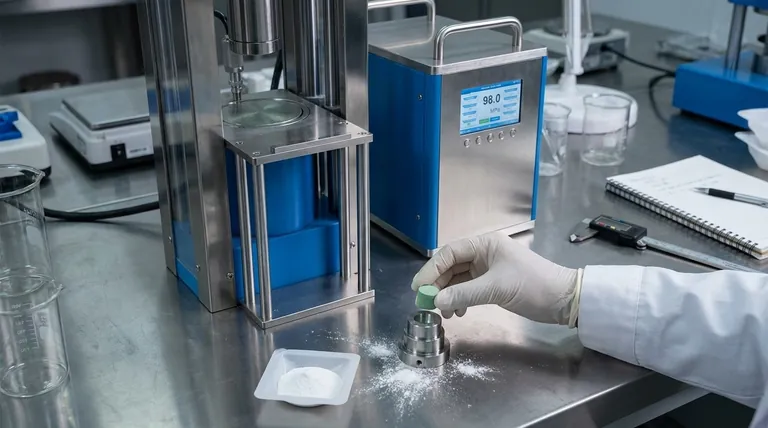
Applying a precise pressure of 98 MPa is the critical cold-pressing step required to transform loose electrolyte powder into a cohesive "green pellet." This specific pressure level is necessary to compact the LLZ-CaSb particles into a solid form with sufficient mechanical strength to be handled without crumbling during the transition to the sintering furnace.
Core Takeaway While the immediate goal of using a laboratory press is to shape the powder, the deeper objective is to establish the internal microstructure of the material. The 98 MPa pressure creates intimate particle-to-particle contact and minimizes voids, serving as the absolute prerequisite for achieving a fully dense, defect-free ceramic electrolyte with high ionic conductivity after sintering.
The Mechanics of Green Pellet Formation
Establishing Mechanical Integrity
The primary function of the laboratory press in this context is to create a "green pellet"—a pre-sintered compact. Without this initial compression, the loose powder lacks the structural cohesion to maintain its shape.
Applying 98 MPa ensures the powder particles interlock sufficiently. This provides the pellet with adequate mechanical strength, allowing researchers to remove it from the mold and transfer it to the sintering stage without the sample disintegrating.
Achieving Uniform Packing Density
Uniformity is just as important as the total force applied. A laboratory press applies uniaxial pressure to ensure the density is consistent throughout the entire volume of the pellet.
This reduction of internal voids is critical. If the packing density is uneven or too low at this stage, the material cannot densify evenly during the heating process.
The Impact on Electrochemical Performance
Maximizing Ionic Conductivity
The ultimate goal of a solid-state electrolyte is to transport ions efficiently. High pressure during the green pellet phase significantly increases the contact area between particles.
By reducing interstitial voids, you create continuous physical pathways for lithium ions. A dense, low-porosity layer is fundamental for achieving high overall ionic conductivity in the final cell.
Facilitating Successful Sintering
The green pellet stage sets the boundary conditions for the subsequent high-temperature sintering. The 98 MPa pressure provides the "intimate contact" required for the material to fuse correctly at low temperatures.
This pre-densification helps eliminate defects before they become permanent. A well-pressed green body is far less likely to suffer from cracking, deformation, or residual porosity after the final thermal treatment.
Understanding the Trade-offs
The Importance of Precision Control
It is not enough to simply apply "heavy" pressure; the pressure must be precise and controlled. The references highlight that this process creates a uniform density gradient.
If the pressure is uncontrolled or non-uniform, internal stresses can develop. These stresses often manifest as warping or microscopic cracks during the sintering phase, rendering the electrolyte useless despite the high force applied.
Balancing Porosity and Density
While high density is the goal, the process relies on the elimination of voids. The 98 MPa benchmark is specific to achieving the optimal balance for LLZ-CaSb.
Deviating significantly from this pressure could lead to under-compaction (resulting in a porous, weak conductor) or issues with the mechanical integrity of the green body itself.
Making the Right Choice for Your Goal
To ensure your solid-state electrolyte performs as intended, consider your primary objective when configuring your press:
- If your primary focus is Handling and Processing: Ensure the 98 MPa pressure is held long enough to maximize mechanical interlocking, preventing the pellet from breaking during transfer.
- If your primary focus is Ionic Conductivity: Prioritize the uniformity of the pressure application to minimize internal voids, as these are the primary bottlenecks for ion transport.
The laboratory press is not just a shaping tool; it is the instrument that defines the potential connectivity and efficiency of your final energy storage material.
Summary Table:
| Objective | Role of 98 MPa Pressure | Key Outcome |
|---|---|---|
| Green Pellet Formation | Compacts powder for handling strength | Cohesive pellet that survives transfer to sintering |
| Microstructure Setup | Creates intimate particle contact | Prerequisite for a dense, defect-free final ceramic |
| Electrochemical Performance | Minimizes voids and internal porosity | Maximizes ionic conductivity for efficient ion transport |
| Successful Sintering | Provides uniform density for even fusion | Prevents cracking and warping during thermal treatment |
Ready to achieve precise and uniform pressure for your solid-state electrolyte research?
KINTEK's automatic lab presses are engineered to deliver the exact, controlled pressure—like the critical 98 MPa for LLZ-CaSb—required to create dense, high-performance pellets. Our heated lab presses and isostatic presses ensure uniform density and minimal voids, setting the foundation for superior ionic conductivity in your final product.
Don't let inconsistent compaction limit your battery's potential. Contact KINTEK today to find the perfect lab press for your laboratory's needs and elevate your materials fabrication process.
Visual Guide

Related Products
- Manual Laboratory Hydraulic Press Lab Pellet Press
- Automatic Laboratory Hydraulic Press Lab Pellet Press Machine
- Automatic Laboratory Hydraulic Press for XRF and KBR Pellet Pressing
- Lab Ring Press Mold for Sample Preparation
- Laboratory Hydraulic Press Lab Pellet Press Machine for Glove Box
People Also Ask
- How does a laboratory manual hydraulic press assist in powder canning? Maximize Density and Structural Integrity
- What is the primary objective of using a laboratory manual hydraulic press at 20 MPa? Achieve Perfect Green Body Shaping
- What is the primary purpose of a manual lab hydraulic pellet press? Ensure Accurate Sample Prep for XRF and FTIR
- What is the primary purpose of manual lab hydraulic pellet presses? Achieve High-Precision Sample Preparation for Spectroscopy
- How do lab pellet presses support customization and flexibility? Optimize Your Sample Prep for Any Material



















