
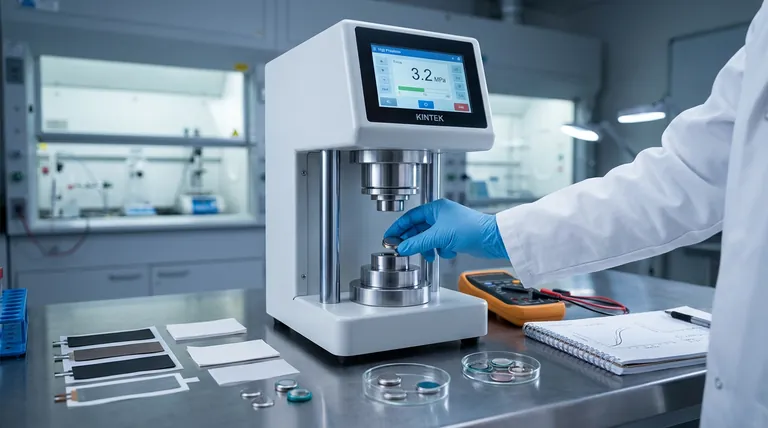
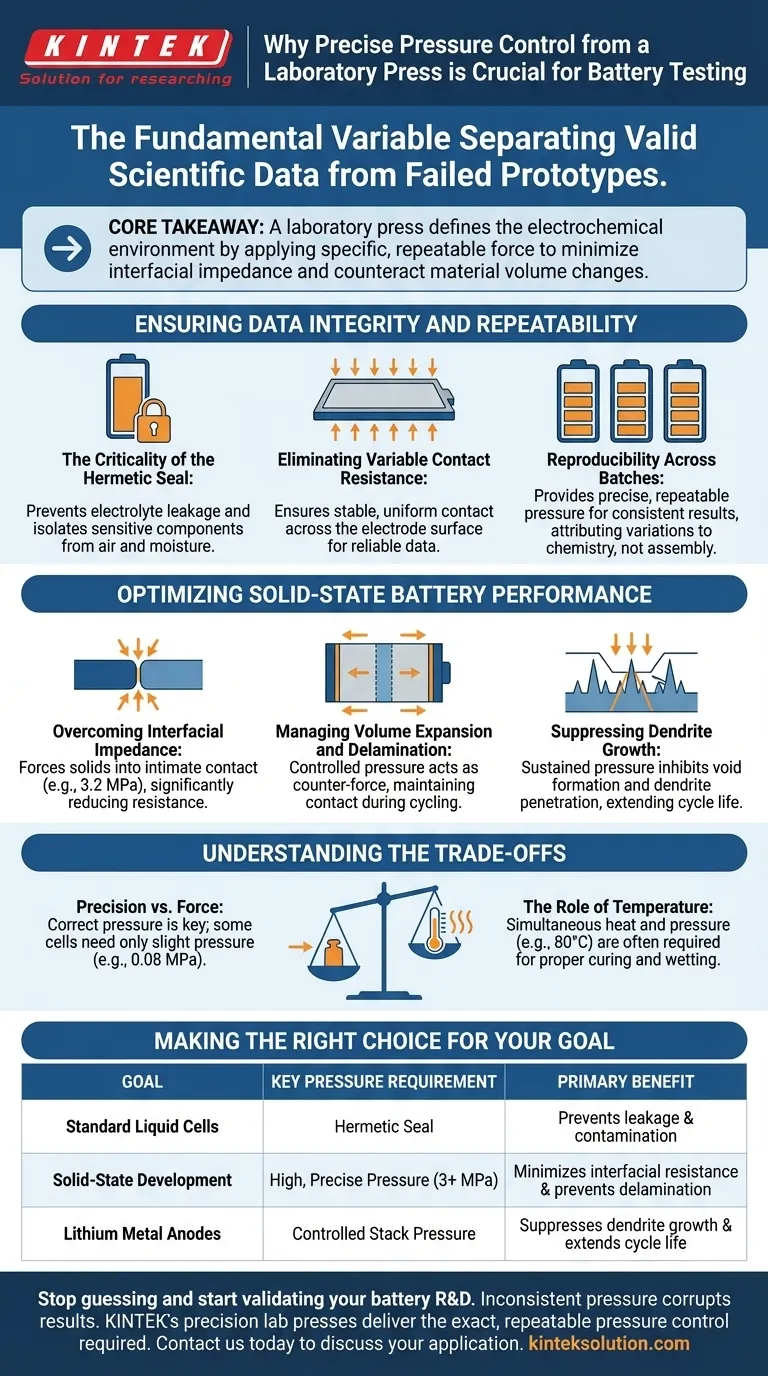
Precise pressure control during battery assembly is the fundamental variable separating valid scientific data from failed prototypes. It ensures the creation of a hermetic seal to isolate reactive components from the environment while establishing the uniform internal contact required for ion transport. Without a calibrated laboratory press, inconsistencies in force lead to variable interfacial resistance and structural gaps, rendering electrochemical performance comparisons impossible.
Core Takeaway A laboratory press does more than mechanically close a cell; it defines the electrochemical environment. By applying specific, repeatable force, it minimizes interfacial impedance and counteracts material volume changes, ensuring that test results reflect the chemistry's true potential rather than assembly defects.
Ensuring Data Integrity and Repeatability
The Criticality of the Hermetic Seal
For any battery chemistry, the first requirement of assembly is isolation. A laboratory press applies the force necessary to crimp or seal the casing components (anode, cathode, and separator) into a unified structure.
This ensures a high-quality seal that prevents electrolyte leakage, which would compromise the cell's safety. Equally important, it isolates sensitive internal components from external air and moisture, which causes immediate degradation in lithium-based systems.
Eliminating Variable Contact Resistance
Test data is only reliable if the physical contact between components is uniform. Irregular pressure results in "hot spots" of low resistance and areas of high resistance where contact is poor.
A precision press ensures stable, uniform contact pressure across the entire electrode surface. This uniformity is required to validate test results; without it, you cannot determine if a failure is due to the chemical material or simply a loose assembly.
Reproducibility Across Batches
In prototype development, repeatability is paramount. Researchers must be able to replicate a cell build exactly to verify findings.
Using a laboratory press provides precise, repeatable mechanical pressure that manual assembly cannot match. This consistency ensures that data variations between batches are attributable to chemical changes, not assembly inconsistencies.
Optimizing Solid-State Battery Performance
Overcoming Interfacial Impedance
In solid-state batteries (SSBs), liquid electrolytes are replaced by solid materials. The interface between a solid electrode and a solid electrolyte is naturally rough and resistive, creating a bottleneck for ion transport.
Applying precise pressure (e.g., around 3.2 MPa) forces these solids into intimate, seamless physical contact. This significantly reduces interfacial resistance, facilitating efficient lithium-ion transport and improving high-rate performance.
Managing Volume Expansion and Delamination
Battery materials expand and contract during charge and discharge cycles. In solid-state systems, this "breathing" can cause layers to separate (delaminate), leading to a loss of capacity.
Controlled external pressure acts as a counter-force, maintaining continuous contact between particles despite volume changes. References show that cells with sufficient pressure maintain cycling stability, whereas those with minimal spring pressure (e.g., < 0.2 MPa) suffer from rapid capacity decay.
Suppressing Dendrite Growth
In sulfide-based and lithium-metal systems, voids at the interface can lead to the formation of lithium dendrites—sharp metallic growths that cause short circuits.
Sustained, precise stack pressure suppresses the formation of these voids during lithium stripping and plating. This physical constraint inhibits dendrite penetration, significantly extending the cycle life and enhancing the safety profile of the battery.
Understanding the Trade-offs
Precision vs. Force
Ideally, "more pressure" is not always the answer; the goal is the correct pressure. For example, assembly of Li|LLZTO|Li cells often requires a heated press to apply only "slight pressure" (e.g., 0.08 MPa) to wet a polymer glue layer without damaging the ceramic electrolyte.
The Role of Temperature
Many advanced assembly protocols require simultaneous heat and pressure. A heated laboratory press allows for curing and wetting at the interface (e.g., at 80°C).
Failing to control the temperature variable while applying pressure can lead to poor adhesion or incomplete curing, negating the benefits of the mechanical force.
Making the Right Choice for Your Goal
To ensure your assembly process supports your specific research objectives, consider these distinct requirements:
- If your primary focus is Standard Liquid Cells: Prioritize a press that guarantees a hermetic seal to prevent leakage and moisture contamination for safety and baseline data validity.
- If your primary focus is Solid-State Development: Prioritize a press capable of sustaining high, precise pressures (3+ MPa) to minimize interfacial resistance and prevent delamination.
- If your primary focus is Lithium Metal Anodes: Ensure your setup allows for controlled stack pressure to physically suppress dendrite growth and void formation during cycling.
Mastering pressure control transforms the laboratory press from a simple tool into a critical instrument for electrochemical success.
Summary Table:
| Goal | Key Pressure Requirement | Primary Benefit |
|---|---|---|
| Standard Liquid Cells | Hermetic Seal | Prevents leakage and contamination for safety and baseline data. |
| Solid-State Development | High, Precise Pressure (3+ MPa) | Minimizes interfacial resistance and prevents delamination. |
| Lithium Metal Anodes | Controlled Stack Pressure | Suppresses dendrite growth and extends cycle life. |
Stop guessing and start validating your battery R&D.
Inconsistent pressure during assembly introduces variables that corrupt your test results, wasting time and resources. KINTEK's precision lab presses—including automatic, isostatic, and heated models—are engineered to deliver the exact, repeatable pressure control required for reliable hermetic sealing, uniform interfacial contact, and stable cycling performance.
Whether you are developing next-generation solid-state batteries or optimizing standard liquid cells, our expertise ensures your assembly process supports your scientific goals.
Contact us today to discuss your specific application and ensure your data reflects your chemistry's true potential.
Visual Guide
Related Products
- Laboratory Hydraulic Press Lab Pellet Press Button Battery Press
- Laboratory Hydraulic Press 2T Lab Pellet Press for KBR FTIR
- Laboratory Hydraulic Press Lab Pellet Press Machine for Glove Box
- Laboratory Split Manual Heated Hydraulic Press Machine with Hot Plates
- Laboratory Hydraulic Pellet Press for XRF KBR FTIR Lab Press
People Also Ask
- How is a laboratory hydraulic press used for HAP composite gels? Master Mineral Substrate Standardization
- What role does a laboratory hydraulic press play in the preparation of piezoelectric ceramic discs for DC-PG? | KINTEK
- What role does a laboratory hydraulic press play in reaction pellets? Optimizing Lunar Soil and Metal Fuel Density
- Why is a laboratory hydraulic press required for PBAT and PLA sample preparation? Achieve Flawless Characterization
- What role does a laboratory hydraulic press play in the assembly of all-solid-state battery test cells? Expert Guide



















