
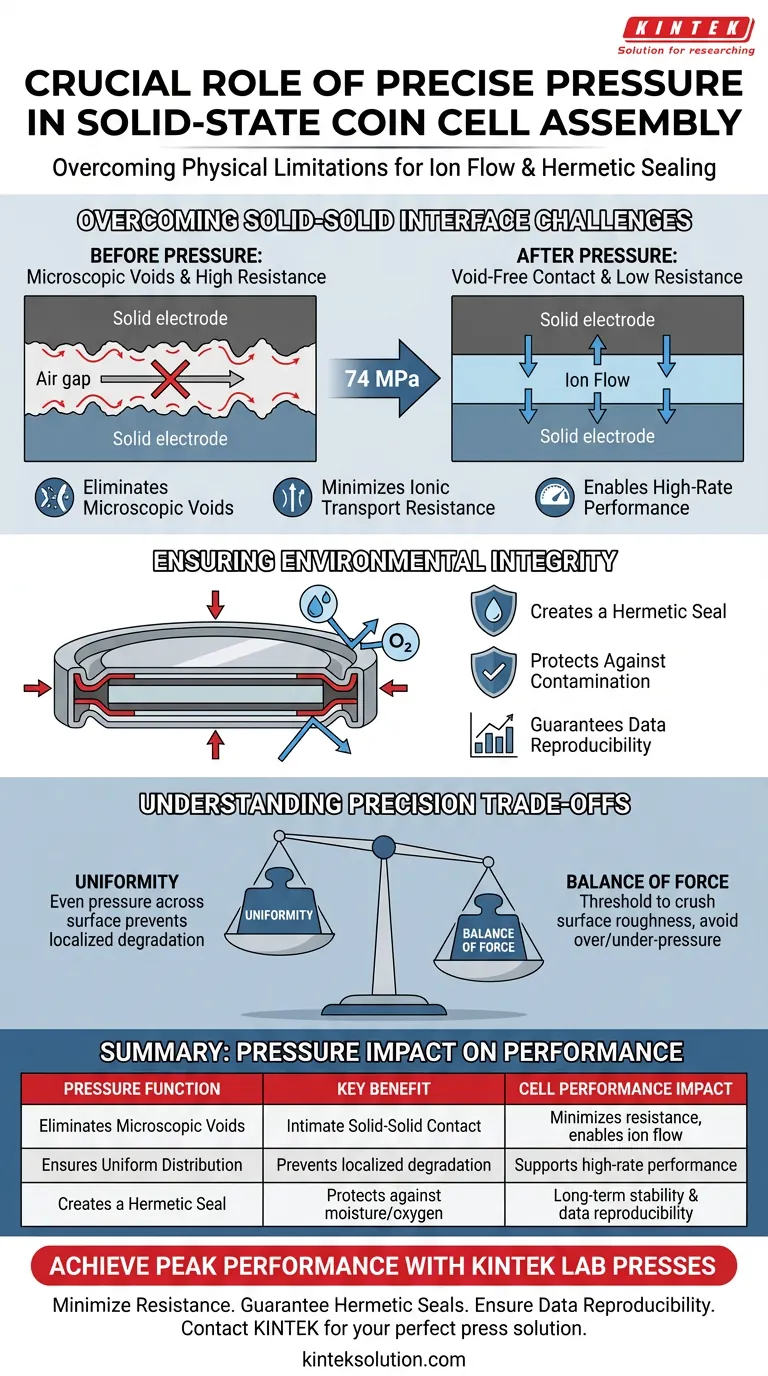
The application of precise and uniform pressure is the fundamental mechanic that overcomes the physical limitations of solid materials during battery assembly. It serves two distinct but vital functions: forcing rigid components into intimate contact to permit ion flow, and hermetically sealing the casing to prevent environmental contamination.
In solid-state batteries, ions cannot traverse air gaps. External pressure is required to eliminate microscopic voids at solid-solid interfaces, minimizing internal resistance and ensuring the electrochemical reliability of the cell.
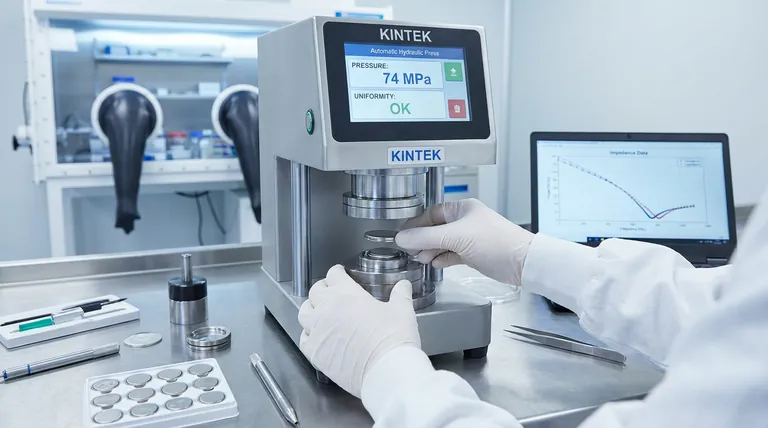
Overcoming the Solid-Solid Interface Challenge
Liquid electrolytes naturally flow into porous electrodes, creating immediate contact. Solid-state electrolytes lack this fluidity, making mechanical pressure the only way to establish a conductive path.
Eliminating Microscopic Voids
Even carefully prepared solid layers possess inherent surface roughness. Without external force, these rough surfaces touch only at specific peaks, leaving microscopic gaps between the electrode and the electrolyte.
Applying significant stacking pressure (e.g., around 74 MPa) compacts these layers. This force crushes surface asperities, creating the void-free physical contact necessary for the battery to function.
Minimizing Ionic Transport Resistance
The performance of a solid-state cell is dictated by how easily ions move between the cathode, electrolyte, and anode. Any gap acts as an insulator, drastically increasing resistance.
By ensuring intimate contact, pressure creates a continuous pathway for ions. This directly minimizes ionic transport resistance at the solid-solid interfaces, which is a prerequisite for achieving low internal resistance.
Enabling High-Rate Performance
Mere contact is not enough; the contact must be robust. High-quality interfaces allow the battery to handle higher currents without significant voltage drops.
This assembly step is indispensable for activating the battery. Without sufficient pressure, the impedance remains too high to support practical charge and discharge rates.
Ensuring Environmental Integrity
Beyond the internal chemistry, the press plays a critical role in the mechanical integrity of the coin cell casing itself.
Creating a Hermetic Seal
The press deforms the coin cell casing to crimp it shut. This creates a reliable seal that isolates the internal components from the outside world.
Protecting Against Contamination
Many solid-state electrolytes and lithium anodes are highly reactive to moisture and oxygen. A compromised seal leads to immediate degradation of these components.
The pressure applied during sealing ensures the cell remains environmentally secure. This protection is vital for maintaining the chemical stability of the materials over time.
Guaranteeing Data Reproducibility
Scientific validity requires that every variable be controlled. If pressure varies from cell to cell, or if seals leak, test results become erratic.
Uniform pressure ensures that any difference in performance is due to the material chemistry, not assembly errors. This consistency ensures the accuracy and reproducibility of electrochemical tests.
Understanding the Precision Trade-offs
While pressure is necessary, the references highlight that it must be "precise" and "uniform." It is not merely about applying maximum force.
The Necessity of Uniformity
Pressure must be distributed evenly across the entire surface area of the cell components.
If pressure is non-uniform, contact will be good in some areas and poor in others. This leads to uneven current distribution, which can cause localized degradation and unpredictable performance.
The Balance of Force
There is a specific threshold required to overcome surface roughness.
If the pressure is too low, the solid-solid interfaces remain poor, resulting in high impedance. Conversely, the equipment must be capable of maintaining this pressure consistently to prevent the contact from loosening over time.
Making the Right Choice for Your Assembly Process
To optimize your solid-state coin cells, you must view the press not just as a closing tool, but as a critical parameter of your electrochemical design.
- If your primary focus is lowering internal resistance: Prioritize the magnitude of the stacking pressure (e.g., ~74 MPa) to eliminate microscopic voids and maximize contact area.
- If your primary focus is experimental reproducibility: Focus on the uniformity of the pressure distribution and the mechanical consistency of the crimping seal to eliminate environmental variables.
Ultimately, the success of a solid-state battery relies as much on mechanical engineering as it does on chemical synthesis.
Summary Table:
| Pressure Function | Key Benefit | Impact on Cell Performance |
|---|---|---|
| Eliminates Microscopic Voids | Creates intimate solid-solid contact | Minimizes ionic transport resistance, enabling ion flow |
| Ensures Uniform Current Distribution | Prevents localized degradation | Supports high-rate charge/discharge performance |
| Creates a Hermetic Seal | Protects against moisture/oxygen | Ensures long-term chemical stability and data reproducibility |
Achieve Peak Performance and Reproducibility in Your Solid-State Battery Research
Precise mechanical pressure is a non-negotiable parameter for activating your solid-state coin cells. KINTEK specializes in laboratory press machines—including automatic lab presses, isostatic presses, and heated lab presses—designed to deliver the precise, uniform pressure required for reliable assembly and sealing.
Our equipment helps you:
- Minimize Internal Resistance: Apply consistent stacking pressure (e.g., ~74 MPa) to eliminate voids and ensure optimal ion pathways.
- Guarantee Hermetic Seals: Create environmentally secure cells to protect sensitive materials like lithium anodes.
- Ensure Data Reproducibility: Maintain uniform pressure across every cell for accurate, reliable electrochemical test results.
Stop letting assembly variability compromise your research. Let our expertise in lab press technology become the foundation of your success.
Contact KINTEK today to discuss your specific solid-state coin cell assembly needs and find the perfect press solution for your laboratory.
Visual Guide
Related Products
- Warm Isostatic Press for Solid State Battery Research Warm Isostatic Press
- Assemble Lab Cylindrical Press Mold for Laboratory Use
- Assemble Square Lab Press Mold for Laboratory Use
- Lab Button Battery Tablet Press Sealing Mold
- Button Battery Sealing Press Machine for Lab
People Also Ask
- Why must composite cathodes be sealed in vacuum lamination bags for WIP? Ensure Battery Stability and Density
- How do sacrificial volume materials (SVM) maintain microchannels in isostatic pressing? Ensure Structural Integrity
- What is the function of elastic molds in warm isostatic pressing? Achieve Uniform Density in Composite Particles
- What is the significance of temperature control in Warm Isostatic Pressing? Unlock Uniform Densification and Process Stability
- What is the process involved in warm isostatic pressing? Mastering Uniform Density with WIP Technology





