
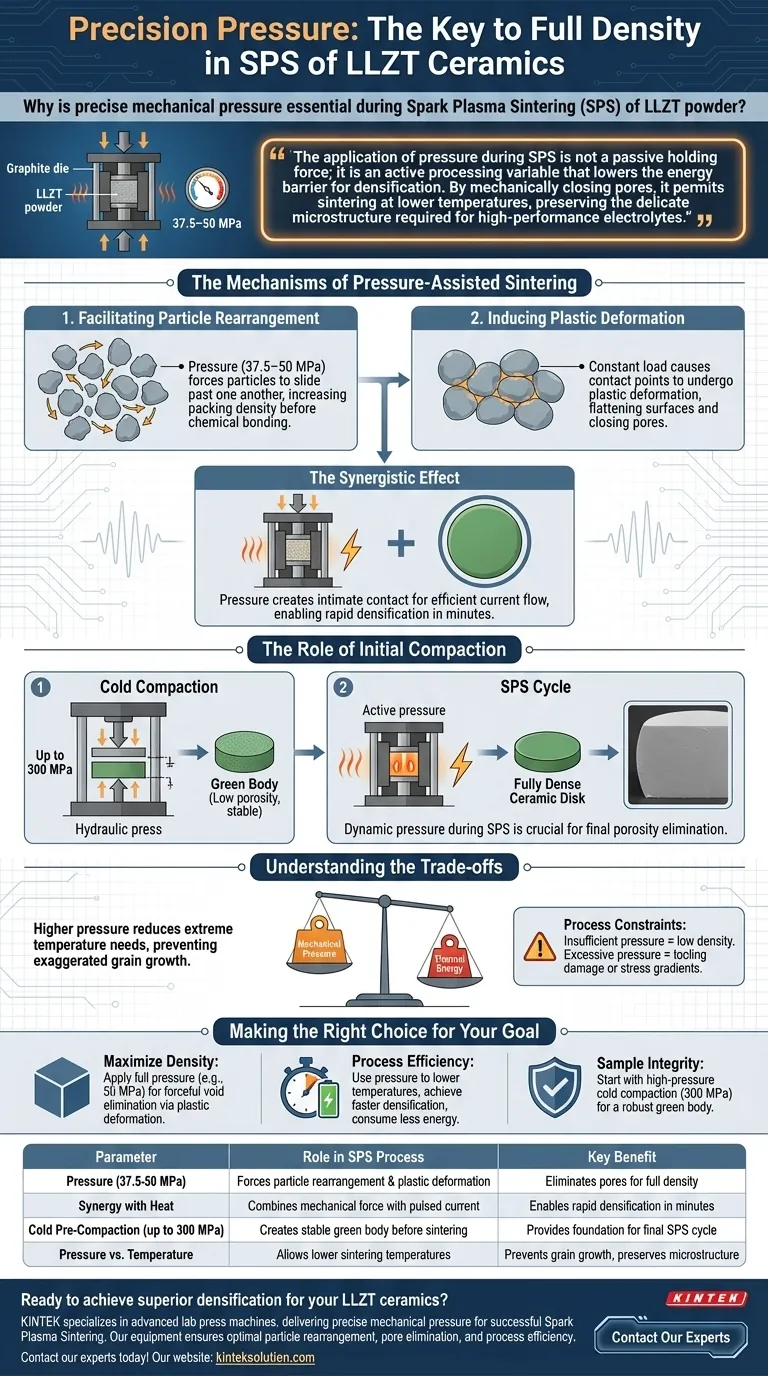
Applying precise mechanical pressure is the critical physical driver that enables the Spark Plasma Sintering (SPS) process to achieve full density in LLZT ceramics. Specifically, maintaining a pressure range of 37.5–50 MPa during the active heating phase forces powder particles to physically rearrange and deform. This mechanical action eliminates inter-particle pores far more effectively than thermal energy alone, allowing the material to densify without requiring excessive dwell times.
The application of pressure during SPS is not a passive holding force; it is an active processing variable that lowers the energy barrier for densification. By mechanically closing pores, it permits sintering at lower temperatures, preserving the delicate microstructure required for high-performance electrolytes.
The Mechanisms of Pressure-Assisted Sintering
Facilitating Particle Rearrangement
In the initial stages of sintering, the LLZT powder consists of loosely packed particles with significant void space.
The application of mechanical pressure (37.5–50 MPa) forces these particles to slide past one another. This rearrangement increases packing density immediately, even before high temperatures trigger chemical bonding.
Inducing Plastic Deformation
As the temperature rises during the rapid heating phase, the ceramic material becomes slightly more compliant.
The constant mechanical load causes the contact points between particles to undergo plastic deformation. This physical yielding effectively flattens contact surfaces and closes the remaining pores that would otherwise trap air and reduce conductivity.
The Synergistic Effect
The true power of SPS lies in the combination of this mechanical pressure and pulsed current heating.
Pressure and heat work in tandem: the pressure creates intimate contact between particles, which improves the efficiency of the current passing through the mold. This synergy is the fundamental reason SPS can densify materials in minutes rather than the hours required by conventional methods.
The Role of Initial Compaction
Establishing the Green Body
While active pressure during sintering is vital, the process begins with cold compaction.
References indicate that applying high pressure (up to 300 MPa) using a hydraulic press prior to sintering is essential for creating a "green pellet." This step provides a solid foundation by reducing initial porosity, ensuring the subsequent SPS process starts with a mechanically stable sample.
Connecting Pre-Compaction to SPS
High-pressure cold compaction ensures close contact between particles before the SPS machine is even turned on.
However, this static compaction is not enough on its own. The dynamic pressure applied during the SPS cycle is what ultimately eliminates the final porosity to achieve a fully dense ceramic disk.
Understanding the Trade-offs
Pressure vs. Temperature Balance
The primary trade-off in SPS is balancing mechanical force against thermal energy.
By applying higher mechanical pressure, you reduce the need for extreme temperatures. This is advantageous because lower sintering temperatures prevent exaggerated grain growth, which can be detrimental to the material's mechanical strength and electrochemical performance.
Process Constraints
While pressure is beneficial, it must be precise.
Insufficient pressure will fail to close pores, leading to a low-density ceramic. Conversely, the specific range mentioned (37.5-50 MPa) is optimized for the tooling and material limits; exceeding this could potentially damage the graphite dies typically used in SPS or induce stress gradients in the material.
Making the Right Choice for Your Goal
To optimize the production of LLZT ceramic electrolytes, you must view pressure as a variable equal in importance to temperature.
- If your primary focus is Maximizing Density: Ensure you apply the full recommended pressure (e.g., 50 MPa) during the heating ramp to forcefully eliminate voids via plastic deformation.
- If your primary focus is Process Efficiency: Utilize the pressure to lower your maximum sintering temperature, achieving densification faster while consuming less energy.
- If your primary focus is Sample Integrity: Start with a high-pressure cold compaction (300 MPa) to create a robust green body that can withstand the thermal and mechanical stresses of the SPS cycle.
Mechanical pressure serves as the bridge between a porous powder and a solid, high-performance ceramic electrolyte.
Summary Table:
| Parameter | Role in SPS Process | Key Benefit |
|---|---|---|
| Pressure (37.5-50 MPa) | Forces particle rearrangement & plastic deformation | Eliminates pores for full density |
| Synergy with Heat | Combines mechanical force with pulsed current | Enables rapid densification in minutes |
| Cold Pre-Compaction (up to 300 MPa) | Creates stable green body before sintering | Provides foundation for final SPS cycle |
| Pressure vs. Temperature | Allows lower sintering temperatures | Prevents grain growth, preserves microstructure |
Ready to achieve superior densification for your LLZT ceramics? KINTEK specializes in advanced lab press machines, including automated and isostatic systems, designed to deliver the precise mechanical pressure required for successful Spark Plasma Sintering. Our equipment ensures optimal particle rearrangement, pore elimination, and process efficiency—helping you produce high-performance solid electrolytes with consistent results. Contact our experts today to discuss how our lab presses can enhance your SPS workflow and meet your specific laboratory needs.
Visual Guide
Related Products
People Also Ask
- What is the purpose of incorporating cartridge heaters into a lab press mold for MLCC block compression? Optimize Results
- How do industrial-grade pressure molds affect zinc metal pouch cells? Maximize Energy Density & Performance
- What role do precision positioning and pressure molds play in single-lap joints? Ensure 100% Data Integrity
- How does the geometry of laboratory molds influence mycelium-based composites? Optimize Density and Strength
- Why are precision laboratory molds essential for forming basalt-reinforced lightweight concrete specimens?
