
Uniaxial pre-pressing acts as the foundational shaping step in transforming loose LiFePO4 powder into a solid ceramic component. By applying uniform mechanical force via a laboratory hydraulic press, you convert volatile powder into a cohesive "green body" with the mechanical strength necessary to be safely handled, vacuum-sealed, and subjected to further densification processes like Cold Isostatic Pressing (CIP).
Core Takeaway Processing ceramic powders requires a transition from loose particles to a dense solid; uniaxial pre-pressing provides the initial structural integrity required for this transition. Without this step, the material lacks the internal cohesion to survive high-pressure forming (CIP) or high-temperature sintering.
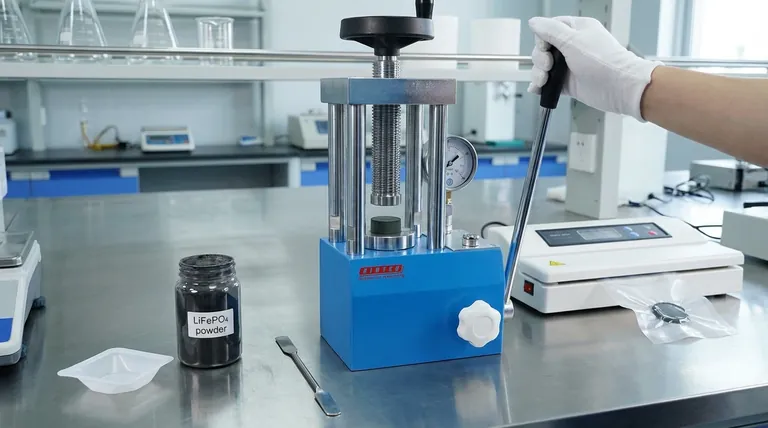
Establishing Mechanical Integrity
Creating a robust "Green Body"
The primary objective of using a laboratory hydraulic press is to compact loose LiFePO4 powder into a defined shape known as a green body.
Without this compaction, the powder remains loose and impossible to manipulate. The press creates a solid object that is robust enough to be moved, measured, and vacuum-sealed without crumbling.
Enabling Cold Isostatic Pressing (CIP)
In the fabrication workflow for LiFePO4 ceramics, uniaxial pre-pressing is a critical prerequisite for Cold Isostatic Pressing (CIP).
CIP subjects the material to intense hydrostatic pressure to achieve final shaping. The pre-pressed green body must possess sufficient initial density and strength to withstand these forces without deforming unpredictably or disintegrating.
Ensuring Dimensional Regularity
The hydraulic press applies force within a rigid die, which guarantees the regularity of the green body's shape and dimensions.
This geometric precision is essential for ensuring the final product meets specific design tolerances before it undergoes shrinkage during sintering.
Optimizing Green Density for Sintering
Forcing Particle Rearrangement
A laboratory hydraulic press is capable of applying substantial, uniform pressure (often ranging from 12 MPa to 400 MPa depending on the specific powder mixture).
This mechanical pressure forces the individual powder particles to rearrange and pack tightly together. This reduces the void space between particles and significantly increases the bulk density of the workpiece.
establishing the Ceramic Skeleton
The pressing process creates initial close contact among the powder particles.
This contact is fundamental for creating a structural "skeleton." These contact points are where atomic diffusion will occur during the subsequent high-temperature sintering phase.
The Link to Final Densification
Achieving a high "green density" during the pressing stage is a critical predictor of sintering success.
If the particles are not packed tightly enough initially, the material may fail to densify completely during heating. High green density leads to a stronger, more uniform final ceramic product.
Understanding the Process Dynamics
The Role of Specific Pressures
While the general goal is compaction, the specific pressure required varies by material composition.
For example, creating a green body might require 12 MPa for certain mixtures to establish particle contact, while other powders may require pressures up to 400 MPa for maximum density. The laboratory press provides the precision needed to hit these specific targets without over-compressing.
Uniaxial Pressing is Not the Final Step
It is important to recognize that uniaxial pressing is rarely the final forming step for high-performance ceramics.
While it provides excellent initial compaction, it is primarily used to prepare the sample for CIP. CIP ensures the density is uniform in all directions, whereas uniaxial pressing mainly compacts in one direction.
Making the Right Choice for Your Goal
To ensure the integrity of your LiFePO4 ceramic bodies, align your pressing parameters with your downstream processing requirements.
- If your primary focus is Handling and Safety: Prioritize sufficient pressure to create a green body that can be vacuum-sealed and moved without edge chipping or crumbling.
- If your primary focus is Final Sintered Density: Maximize the initial "green density" by applying higher uniform pressure to force maximum particle packing and contact.
Summary: Uniaxial pre-pressing is the essential bridge between loose powder and a high-performance ceramic, providing the initial density and strength required for all subsequent manufacturing steps.
Summary Table:
| Key Function | Benefit for LiFePO4 Processing |
|---|---|
| Creates Mechanical Integrity | Transforms loose powder into a solid, handleable green body that can be vacuum-sealed. |
| Enables CIP | Provides the initial strength needed for the green body to withstand high hydrostatic pressure without deforming. |
| Optimizes Green Density | Forces particle rearrangement and tight packing, which is critical for achieving high final density after sintering. |
| Ensures Dimensional Regularity | Uses a rigid die to create a precise shape, ensuring the part meets design tolerances before sintering shrinkage. |
Ready to perfect your LiFePO4 ceramic sample preparation?
KINTEK's precision laboratory hydraulic presses are engineered to deliver the uniform pressure and control you need to create robust green bodies with optimal density. Whether your priority is safe handling for CIP or maximizing final sintered density, our automatic lab presses, isostatic presses, and heated lab presses provide the reliable performance essential for your research and development.
Contact our experts today to discuss how KINTEK's lab press solutions can enhance your ceramic processing workflow.
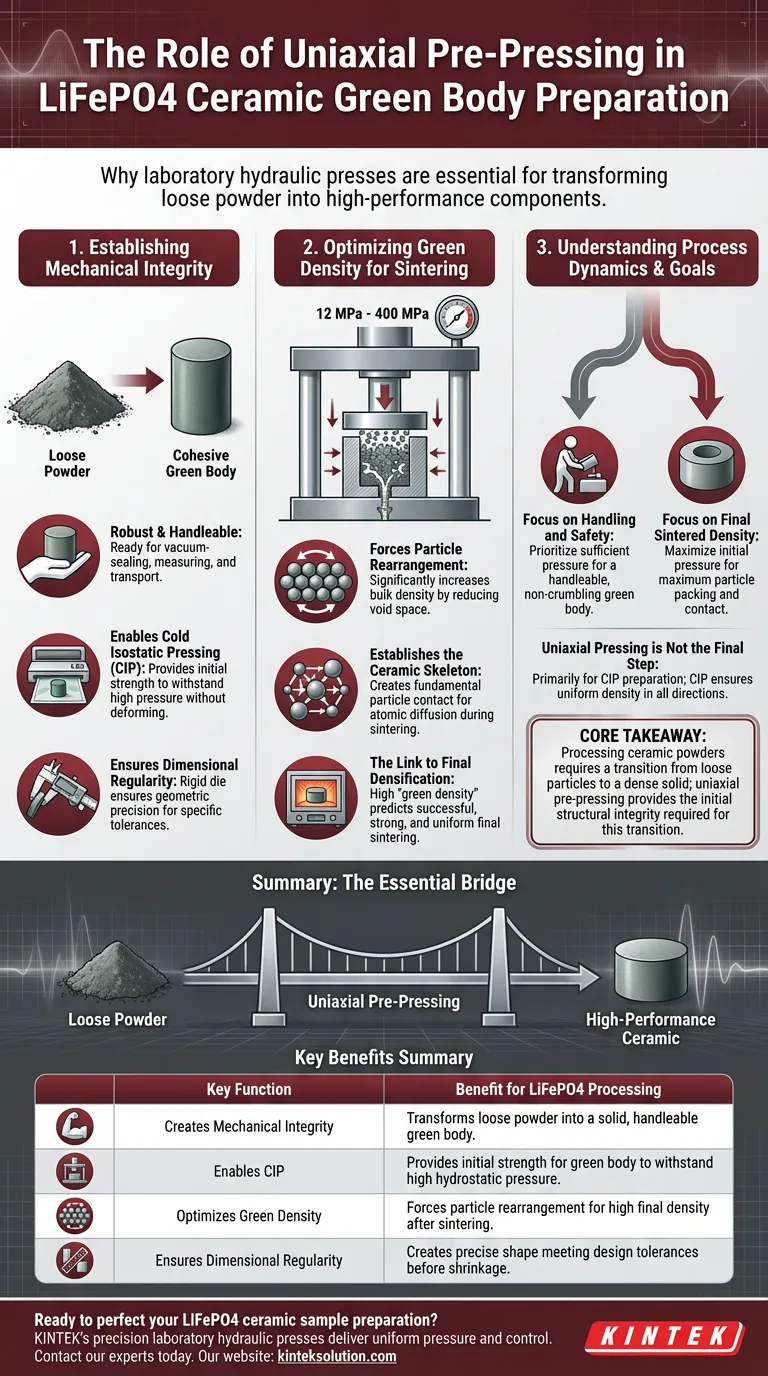
Visual Guide
Related Products
- Laboratory Hydraulic Press 2T Lab Pellet Press for KBR FTIR
- Manual Laboratory Hydraulic Pellet Press Lab Hydraulic Press
- Laboratory Hydraulic Press Lab Pellet Press Button Battery Press
- Automatic Laboratory Hydraulic Press Lab Pellet Press Machine
- 24T 30T 60T Heated Hydraulic Lab Press Machine with Hot Plates for Laboratory
People Also Ask
- What is the role of a laboratory pressure machine and KBr in FTIR? Master Sample Preparation for Flame Retardants
- What is the role of a laboratory hydraulic press in high-loading NCM811 cathode prep for solid-state batteries?
- Why is a laboratory hydraulic press necessary for sample preparation? Precise Pelleting for Spiro Heterocyclic Analysis
- What role does a laboratory hydraulic press play in reaction pellets? Optimizing Lunar Soil and Metal Fuel Density
- How does a laboratory hydraulic press ensure repair performance? Master Self-Healing CFRP Molding with Precision


















